
Quick Insights
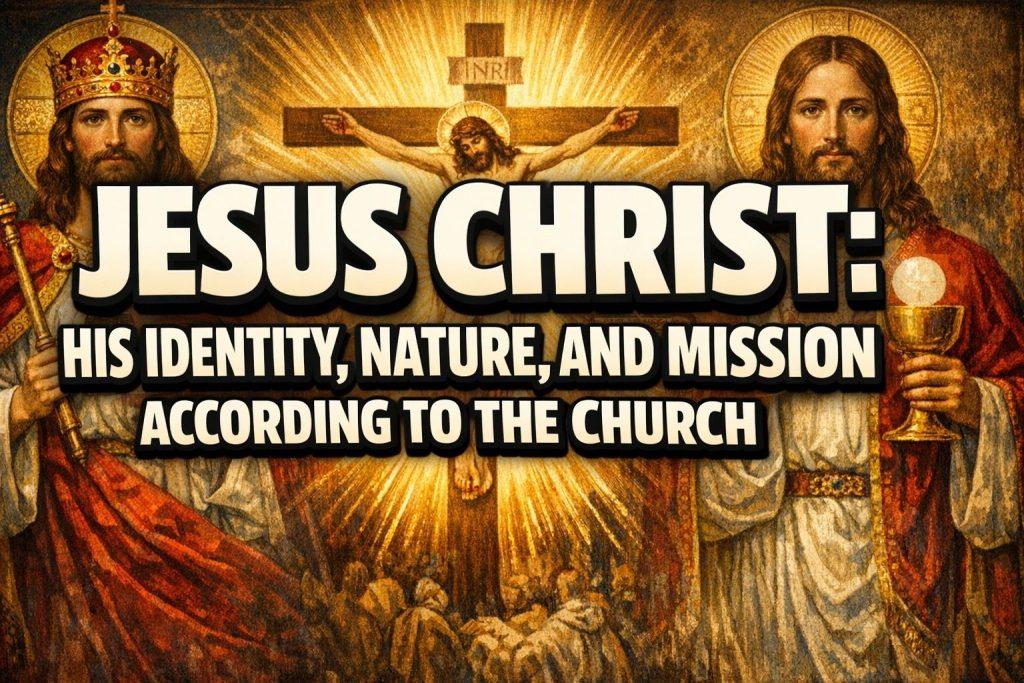
- Jesus Christ is, according to Catholic teaching, the eternal Son of God who took on a complete and true human nature in the womb of the Virgin Mary, making him simultaneously and fully both God and man.
- The Catholic Church teaches that Jesus is the second Person of the Holy Trinity, not a created being or a holy man elevated to divine status, but God himself who entered human history from within.
- Christ’s mission on earth centered on the redemption of humanity from sin and death, accomplished through his public ministry, his suffering and death on the cross, and his bodily resurrection from the dead.
- The Church holds that the identity of Jesus was definitively clarified through a series of ecumenical councils, particularly Nicaea in 325 AD and Chalcedon in 451 AD, whose definitions remain the authoritative standard of Catholic Christology.
- Catholics believe that Jesus Christ is the sole mediator between God and humanity, the one through whom all grace, forgiveness, and eternal life flow to the world, as stated in 1 Timothy 2:5.
- The saving work of Christ is not merely a past event but a living reality made present in the Church through the sacraments, the Scriptures, and the Eucharist, where his body and blood are truly present under the forms of bread and wine.
Introduction
No figure in the history of the world has generated more theological reflection, more controversy, more devotion, and more life-changing personal encounter than Jesus of Nazareth. The Catholic Church confesses him as the Christ, the Anointed One, the fulfillment of every promise God made to Israel, the Savior of the entire human race, and the eternal Son of God who became man so that men and women might share in the divine life. This is not merely a historical claim about a first-century Jewish teacher; it is the foundational conviction around which every Catholic doctrine, every sacrament, every act of worship, and every moral teaching is organized. The Catechism of the Catholic Church opens its treatment of Jesus Christ by stating that the Good News of the Gospel “is summed up in Jesus Christ, the Son of God made man, who died and rose for our salvation” (CCC 430). To understand who Jesus is, in the Catholic understanding, is to understand the meaning of human existence itself, since he is the one in whom God and humanity are permanently and irrevocably united. The question Jesus asked his disciples at Caesarea Philippi, “Who do you say that I am?” (Matthew 16:15), remains the central question that the Church places before every person in every age. Catholic faith responds to that question with the full weight of two thousand years of theological reflection, conciliar definition, scriptural study, and lived holiness: Jesus Christ is Lord, truly God and truly man, crucified and risen, present in his Church, and coming again in glory. Understanding the full significance of that response requires attention to the biblical foundations of Christ’s identity, the historical development of the Church’s theological precision about his nature, the meaning of his redemptive mission, and the way that mission continues to unfold in the sacramental life of the Church today.
The history of Christian reflection on the identity of Jesus is not a simple or straightforward story; it is one of the most intellectually intense chapters in the entire history of human thought. From the very first generation of believers, the followers of Jesus struggled to find language adequate to describe what they had witnessed and experienced: a man who spoke with divine authority, forgave sins as only God can forgive them, worked miracles over nature and death, died a criminal’s death on a Roman cross, and then appeared alive again on the third day. The earliest Christian communities drew on the rich theological vocabulary of Judaism, using titles such as Messiah, Son of David, Son of Man, Lord, and Son of God to express their convictions, each title carrying its own weight of meaning from the Old Testament tradition. As the Gospel spread into the Greek-speaking world, new questions arose that required new precision: Was Jesus divine in the full sense, or was he a lesser divine being? Did he truly suffer and die, or was his humanity merely an appearance? Was his divine nature distinct from his human nature, and if so, how could one person hold both? These questions were not idle intellectual puzzles; they were matters of life and death, for the wrong answer about who Jesus is leads inevitably to the wrong understanding of what his death and resurrection mean and therefore of whether humanity has truly been saved. The great ecumenical councils of the fourth and fifth centuries, Nicaea, Constantinople, Ephesus, and Chalcedon, forged the precise theological language that the Catholic Church still uses today, insisting that Jesus is consubstantial with the Father as God and consubstantial with us as man, two complete natures in one divine Person, without confusion or separation. These definitions drew on the work of brilliant and courageous theologians such as Saint Athanasius, Saint Cyril of Alexandria, Pope Leo the Great, and the Cappadocian Fathers, whose writings remain indispensable resources for understanding the Catholic faith in Christ. The Church did not arrive at these definitions by speculative philosophy alone; she arrived at them by reading Scripture faithfully, defending the truth of salvation against distortions, and listening to the Holy Spirit who guides her into all truth.
The Divine Identity of Jesus Christ
Catholic faith begins its account of Jesus Christ not at his birth in Bethlehem but at the moment before all creation, in the eternal life of God himself. The Gospel of John opens with the declaration, “In the beginning was the Word, and the Word was with God, and the Word was God” (John 1:1), and this verse has served as the cornerstone of Catholic teaching about the divine identity of Jesus Christ from the earliest centuries of the Church. The “Word” in this passage, the Greek “Logos,” identifies Jesus as the eternal self-expression of God, the one through whom “all things were made, and without him nothing was made that was made” (John 1:3), making him not a creature who came into existence at some point in history but the eternal Son through whom history itself was called into being. Jesus himself spoke with a directness that left his contemporaries in no doubt about the extraordinary nature of his claims: he declared “I and the Father are one” (John 10:30), accepted the worship of his disciples after the resurrection when Thomas fell before him crying “My Lord and my God!” (John 20:28), and used the divine name “I AM” in ways that clearly recalled the name God revealed to Moses at the burning bush (John 8:58, Exodus 3:14). The Letter to the Colossians, one of the richest Christological texts in the Pauline corpus, describes Jesus as “the image of the invisible God, the firstborn of all creation,” and immediately clarifies that “firstborn” does not mean he was created, for “in him all things in heaven and on earth were created, things visible and invisible, whether thrones or dominions or rulers or powers, all things were created through him and for him” (Colossians 1:15-16). The Letter to the Hebrews opens by describing the Son as “the radiance of the glory of God and the exact imprint of his nature,” the one who “upholds the universe by his word of power” (Hebrews 1:3). These scriptural witnesses, taken together, present not a holy man elevated to divine dignity but a divine Person who is by nature God and who, in an act of infinite condescension and love, entered the creation he had called into being in order to save it.
The Church’s precise doctrinal articulation of Christ’s divine identity came primarily through the crisis of Arianism in the fourth century, when the teaching of the Alexandrian priest Arius forced the Church to state her convictions in technical theological language that left no room for ambiguity. Arius taught that the Son was the first and greatest of all created beings, the instrument through whom God made everything else, but not himself truly God; his memorable slogan was “there was when he was not,” asserting that the Son had a beginning and was therefore a creature rather than the creator. The Council of Nicaea in 325 AD rejected this position with absolute clarity, defining that the Son is “of the same substance as the Father,” using the Greek term “homoousios” to insist on the full and complete equality of the Son’s divine nature with that of the Father. Saint Athanasius of Alexandria, who spent decades in exile rather than accept any compromise with Arianism, argued with devastating clarity that if the Son were a creature, then Christians who worship him are worshipping a creature, which is idolatry, and the salvation he offers cannot be a true divine salvation since only God can truly save. The theological stakes of the debate were therefore not merely academic; the entire economy of salvation depended on whether the one who died on the cross for human sin was truly and fully God. After Nicaea, the First Council of Constantinople in 381 AD confirmed and extended the Nicene definition, further establishing the full divinity of the Holy Spirit and consolidating the Trinitarian framework within which the full identity of Christ could be understood. The Catechism summarizes this doctrinal history by teaching that Jesus Christ is the eternal Son of God, the second Person of the Holy Trinity, consubstantial with the Father and the Holy Spirit, who became man without ceasing to be God (CCC 461). This is the faith that the Catholic Church has professed without interruption or modification from the apostolic age to the present day, and it remains the foundation upon which every other aspect of Catholic teaching about Jesus rests.
The True Humanity of Jesus Christ
Equally important to Catholic faith as the full divinity of Jesus is the full reality of his human nature, and the Church has defended this truth with the same vigor with which she defended his divinity. A recurring temptation in Christian history has been to so emphasize the divinity of Jesus that his humanity becomes merely symbolic, a kind of divine disguise rather than a genuine and complete human existence. The heresy of Docetism, from the Greek word meaning “to seem,” taught in the early centuries that Jesus only appeared to be human, that his body was a phantom or spiritual appearance rather than real flesh and blood. Saint Ignatius of Antioch, writing at the very beginning of the second century, combated Docetism with passionate directness, insisting that Jesus truly ate, truly suffered, truly died, and truly rose again in the flesh. The Gospel accounts leave no room for doubt about the genuine humanity of Jesus: he grew tired and slept in the boat during a storm (Mark 4:38), he wept at the tomb of Lazarus (John 11:35), he expressed intense emotional distress in the Garden of Gethsemane (Luke 22:44), he hungered in the desert (Matthew 4:2), and he cried out from the cross in the words of the Psalmist, “My God, my God, why have you forsaken me?” (Matthew 27:46). The Letter to the Hebrews insists on the full reality of Christ’s humanity precisely because his human experience is the ground of his priestly intercession on humanity’s behalf: “For we do not have a high priest who is unable to sympathize with our weaknesses, but one who in every respect has been tested as we are, yet without sin” (Hebrews 4:15). The Catechism teaches that Christ’s human soul possessed the fullness of human knowledge in a way proper to his unique person, that he truly learned and grew in wisdom as Luke records (Luke 2:52), and that his human will was genuinely free and genuinely submitted to the Father’s will (CCC 472). Understanding the true humanity of Jesus is not a secondary or optional point of Catholic faith; it is essential to the coherence of the entire Gospel, since what was not assumed by the Son cannot be healed and saved.
The Council of Chalcedon in 451 AD produced what remains the most precise and authoritative statement of Catholic teaching on the two natures of Christ, a definition that emerged from decades of intense theological struggle and that has served as the standard of orthodox Christology ever since. The background to Chalcedon included not only the continued influence of Arianism but also the debate between the theological schools of Alexandria and Antioch over how to understand the union of divinity and humanity in Jesus. The Alexandrian tradition, represented most powerfully by Saint Cyril of Alexandria, emphasized the unity of Christ’s Person so strongly that some of Cyril’s followers fell into the error of Monophysitism, meaning the teaching of one nature, which held that the human nature of Jesus was absorbed into or transformed by his divine nature after the union, leaving only a single divine-human nature. The Antiochene tradition, meanwhile, emphasized the distinction of the two natures so strongly that some of its representatives seemed to divide Christ into two separate persons, a divine Son and a human Jesus who were joined in a moral rather than a truly personal unity. The Council of Chalcedon, guided by the theological clarity of Pope Leo the Great’s famous “Tome,” a letter that the council fathers recognized as the voice of Peter himself, steered between both errors by defining that Jesus Christ is “one and the same Son, the same perfect in divinity and perfect in humanity, the same truly God and truly man,” existing “in two natures without confusion, change, division, or separation.” This definition, known as the Chalcedonian definition, remains the touchstone of Catholic Christology to this day and is received as authoritative not only by Catholics but by most Orthodox and Protestant Christians as well. The Catechism reflects this definition when it teaches that in Christ, the divine and human natures are united in the one Person of the Son without the one destroying, diminishing, or being absorbed into the other (CCC 481). This precise theological statement has enormous practical implications: when Catholics look at Jesus as portrayed in the Gospels, they see not two beings awkwardly joined but a single, integrated Person whose every word, every action, every suffering, and every joy belongs fully and simultaneously to both his divine and his human existence.
The Virgin Birth and the Incarnation
The moment at which the eternal Son of God took on a human nature is called the Incarnation, a word that comes from the Latin for “enfleshment,” and the Catholic Church holds this event as the most decisive moment in the entire history of the universe. The Incarnation did not happen gradually or symbolically; it happened at a specific moment in real human history when the Angel Gabriel appeared to a young Jewish woman named Mary in the town of Nazareth and announced to her that she would conceive a son through the power of the Holy Spirit (Luke 1:26-38). Mary’s consent, her free and trusting “Let it be done to me according to your word,” is itself a moment of immense theological significance in Catholic understanding, for it was through her willing cooperation that the Son of God entered the world as a human being. The Council of Ephesus in 431 AD, resolving a controversy about whether Mary could properly be called the “Mother of God,” declared that she rightly bears the title “Theotokos,” meaning “God-bearer” or “Mother of God,” not because Mary existed before God or was the source of his divinity but because the child she bore in her womb was the one divine Person of the Son, who is truly God. This definition was not primarily about Mary; it was primarily about Christ, insisting that the one she carried, bore, nursed, and raised was not merely a human being who later became divine or in whom God was merely present in a special way, but the Son of God himself, present from the moment of conception as a complete divine Person assuming a complete human nature. The Catechism teaches that the virginal conception of Jesus is a historical fact attested by both Matthew and Luke in the Gospels, and it is a sign that points to the unique identity of the child: he has no human father because his ultimate origin is in the eternal generation of the Son from the Father within the Trinity (CCC 496). Saint Augustine reflected on the wonder of the Incarnation by noting that the one who made the Virgin took his flesh from the Virgin, the Creator of the human mother became the Son of the human mother, a mystery that surpasses all human comprehension while remaining entirely coherent with the logic of divine love.
The theological depth of the Incarnation extends far beyond the miracle of the virgin birth, touching the very meaning of human nature and its capacity for relationship with God. Saint Athanasius expressed the fundamental logic of the Incarnation with a phrase that has become one of the most celebrated in the entire Christian tradition: “God became man so that man might become God.” This statement, known in theological language as the doctrine of “divinization” or “theosis,” the process by which human beings are transformed by grace into genuine sharers of the divine life, captures the purpose of the Incarnation in its most generous and astonishing dimensions. The Son did not become man merely to provide a moral example or to teach wisdom; he became man in order to unite human nature to the divine nature in his own Person, thereby opening a path for every human being to participate in the life of God. The Second Vatican Council, in its Pastoral Constitution “Gaudium et Spes,” expressed this truth by teaching that “by his Incarnation the Son of God has united himself in some fashion with every human being,” a statement that grounds the Church’s profound respect for every human person regardless of their faith, their culture, or their moral condition. The Incarnation also means that matter itself, the physical world of bodies and seasons and bread and water, has been sanctified by the fact that God himself lived within it as a creature of flesh and blood. This is why the Catholic Church celebrates the physical world through her sacraments, using water, oil, bread, wine, touch, and words as genuine instruments of divine grace, rather than treating the material world as a barrier to spiritual life. Every time a Catholic receives communion, bathes a child in baptismal water, or anoints the sick with oil, the Incarnation continues to have its effect, for these sacramental actions draw their meaning and power from the fact that the eternal Son of God truly inhabited the physical world and made it capable of carrying divine grace.
The Public Ministry of Jesus
The public ministry of Jesus, which Catholic tradition understands as spanning approximately three years and centered in the region of Galilee and Judea, reveals both the identity and the mission of the Son of God in action. Jesus began his public work with his baptism by John in the Jordan River, an event at which the entire Trinity was manifested, and with his forty days of fasting and prayer in the desert, where he was tested by the devil and refused every temptation to use his divine power for self-interest (Matthew 4:1-11). From the beginning of his ministry, Jesus proclaimed a message that was simultaneously familiar and radically new: “The time is fulfilled, and the kingdom of God is at hand; repent and believe in the Gospel” (Mark 1:15). The kingdom of God, a concept rich with Old Testament resonance pointing to God’s sovereign and saving reign over his people and ultimately over all creation, stood at the center of everything Jesus taught and did, and the Catholic Church understands the Church herself as the seed and beginning of that kingdom on earth (CCC 541). Jesus expressed the reality of the kingdom primarily through parables, short narrative comparisons drawn from the everyday world of first-century Palestinian life: farmers sowing seed, merchants seeking fine pearls, fathers welcoming prodigal sons, women sweeping houses in search of lost coins. These parables were not simple moral tales; they were theological provocations, inviting hearers to reconsider everything they thought they knew about God, about righteousness, and about who would ultimately stand before God in the day of judgment. Jesus’s miracles, his healings of the sick and the blind and the lame, his exorcisms of demonic spirits, his raising of the dead, and his mastery over natural forces, were signs of the kingdom’s arrival rather than mere demonstrations of power, showing that the reign of God meant the defeat of everything that diminishes human life, including disease, death, sin, and the powers of darkness. The Sermon on the Mount in Matthew’s Gospel, chapters five through seven, presents the most extended and systematic account of Jesus’s moral teaching, and its demands, loving one’s enemies, forgiving without limit, seeking purity of heart rather than mere outward observance, revealed a standard of righteousness that exceeded the requirements of the Mosaic Law while fulfilling its deepest intention.
Jesus’s relationships with those around him during his ministry reveal in human and personal terms the God who had been proclaimed by Israel’s prophets but who had never before been directly encountered in the flesh. He chose twelve apostles as the foundation of a new community, deliberately echoing the twelve tribes of Israel to signal that he was constituting a new covenant people, and he gave particular authority to Simon, whom he renamed Peter, saying “You are Peter, and on this rock I will build my church, and the powers of death shall not prevail against it” (Matthew 16:18). The Catholic Church sees in this commission the foundation of the papacy, the unbroken succession of bishops of Rome who continue Peter’s ministry of confirming and unifying the Church in faith. Jesus consistently sought out those whom his society excluded or marginalized: tax collectors, prostitutes, Samaritans, the ritually unclean, Gentiles, and public sinners, not to approve of their sins but to offer them the mercy and transformation that only he could give. His friendship with Mary Magdalene, Lazarus, Martha, and Mary of Bethany reveals a man of genuine warmth, loyalty, and personal affection, fully human in his capacity for friendship and love. His confrontations with the religious authorities of his time were not exercises in cynical polemics but prophetic challenges rooted in a passion for the authentic worship of God and the genuine spiritual welfare of the people. The raising of Lazarus in John chapter eleven, described in careful detail by the Gospel and punctuated by the shortest and most moving verse in the New Testament, “Jesus wept” (John 11:35), presents the full reality of his humanity and divinity in a single scene: a man who grieves the death of his friend and a God who calls the dead back to life by his word alone. Understanding the public ministry of Jesus is not a merely historical exercise; for the Catholic, it is a theological encounter with the living Person of Christ, whose words and actions in the Gospels continue to speak to the human condition with undiminished power and relevance.
The Passion, Death, and Resurrection of Christ
At the center of the entire Catholic faith stands the cross of Jesus Christ, the event toward which his entire earthly life was oriented and from which the whole of Christian theology draws its meaning and power. The Passion of Jesus, his arrest in the Garden of Gethsemane, his trials before the Jewish Sanhedrin and the Roman governor Pontius Pilate, his torture and humiliation, and his crucifixion on Calvary outside the walls of Jerusalem, is narrated by all four Gospels with a degree of detail and historical specificity unmatched by any other episode in the New Testament. Catholic theology understands the death of Jesus not as the tragic end of a noble life cut short but as a freely chosen sacrifice, the definitive act of love by which the Son of God offered himself in atonement for the sins of all humanity. Saint Paul captures this understanding concisely when he writes that “God shows his love for us in that while we were still sinners, Christ died for us” (Romans 5:8), and again when he proclaims “he who did not spare his own Son but gave him up for us all” (Romans 8:32). The Catechism teaches that Christ’s death was a sacrifice of atonement, meaning that Jesus, as both priest and victim, offered to the Father the perfect act of love and obedience that sin had refused, thereby reconciling humanity to God and opening the way to eternal life (CCC 614). The sacrifice of the cross was not the Father punishing an innocent victim in place of the guilty, a misunderstanding sometimes called penal substitution in its crudest form; rather, it was the eternal Son freely taking on the full weight of human sin and its consequences in his own person, from the inside of humanity, in order to transform and heal the human condition from within. The cry from the cross, “It is finished” (John 19:30), does not express defeat but completion: the mission the Son received from the Father has been carried out to its uttermost limit, and the redemption of the world has been accomplished.
The resurrection of Jesus from the dead on the third day is, in the Catholic understanding, the decisive event that confirms everything Jesus claimed about himself and gives his death its saving meaning. Saint Paul states the stakes with absolute clarity: “If Christ has not been raised, your faith is futile and you are still in your sins” (1 Corinthians 15:17). The resurrection is not a symbolic way of saying that Jesus’s memory or influence “lives on” in his followers; the Catholic Church insists that Jesus truly, bodily, and historically rose from the dead, that the tomb was genuinely empty, and that the risen Christ appeared in his real body, though transformed and glorified, to Mary Magdalene, to the apostles, to more than five hundred people at once, and finally to Saint Paul on the road to Damascus (1 Corinthians 15:3-8). The resurrection reveals that Jesus is Lord over sin and death, that the human nature he assumed in the Incarnation has been permanently glorified and taken into the life of God, and that the destiny God intends for every human person, the resurrection of the body and eternal life, has been inaugurated in Christ as its first fruits. Pope Benedict XVI, in his trilogy “Jesus of Nazareth,” reflected at length on the historical credibility of the resurrection accounts, noting that the Gospel testimonies bear all the marks of genuine historical memory, including the prominent role of women as the first witnesses, which would never have been invented in the cultural context of first-century Judaism if the accounts were fabricated. The ascension of the risen Christ to the right hand of the Father, described in the Acts of the Apostles (Acts 1:9-11), does not mark the end of Christ’s active presence in the world; rather, it marks the beginning of his universal lordship, exercised through the Holy Spirit whom he sends to his Church. The Catechism teaches that Christ’s glorified humanity now intercedes permanently for humanity before the Father and that his session at the Father’s right hand is the source from which all grace flows to the Church and to every believer (CCC 665).
Christ as Priest, Prophet, and King
The Catholic theological tradition has long organized its understanding of Christ’s mission around three titles drawn from the Old Testament: Priest, Prophet, and King. Each of these titles describes a distinct dimension of Jesus’s saving work, and together they provide a comprehensive framework for understanding what he came to do and why his mission was unique in the history of the world. The title of Prophet places Jesus in continuity with the long line of God’s spokespersons in Israel, those men and women who received God’s word and communicated it to the people, often at great personal cost. Jesus exceeded every prophet before him not merely in the content of his message but in his very identity, for the prophets spoke on behalf of God while Jesus spoke as God, using the arresting formula “You have heard that it was said… but I say to you” (Matthew 5:21-22) to place his own authority on a level with or above the divine Law given to Moses on Sinai. The Catechism identifies Jesus as “the Prophet,” the one who fulfills all the prophetic tradition of Israel and in whom God’s definitive word to humanity is spoken once and for all (CCC 719). As the supreme teacher and revealer, Jesus opens the meaning of the Scriptures, interprets the Law in its fullest spiritual sense, and announces the coming of the kingdom with an authority that derives not from any human institution or tradition but from his own divine identity. His prophetic mission continues in the Church through the proclamation of the Gospel, the celebration of the liturgy, and the witness of holy lives, so that every Catholic who speaks the truth of faith in a world that prefers comfortable fictions participates in some way in the prophetic ministry of Christ.
The title of Priest places Jesus at the center of the drama of worship and reconciliation between God and humanity, a drama that the entire Old Testament sacrificial system had pointed toward without being able to definitively resolve. The Letter to the Hebrews develops the theology of Christ’s priesthood at length, describing him as “a great high priest who has passed through the heavens” (Hebrews 4:14) and as a priest “after the order of Melchizedek” (Hebrews 5:10), meaning a priesthood that does not depend on hereditary succession but on a direct divine appointment that has no beginning and no end. As the perfect high priest, Jesus offered the one sacrifice that all the animal sacrifices of the Mosaic covenant had only foreshadowed: he offered himself, his own body and blood, “once for all” (Hebrews 10:10), a sacrifice of infinite value because the one offering it is himself infinite God. The title of King completes the threefold description of Christ’s mission, situating him as the fulfillment of the Davidic covenant in which God promised that a descendant of David would reign over an everlasting kingdom (2 Samuel 7:12-16). Jesus accepted the title of king before Pilate, though he clarified that his kingdom “is not of this world” (John 18:36), meaning not that it has no relevance to earthly life but that it does not operate by the coercive power that earthly kingdoms rely upon. His kingship is exercised through truth, love, and service, expressed paradigmatically in the act of washing his disciples’ feet at the Last Supper, an act that redefines leadership as servanthood and power as self-giving. The Catechism teaches that Christ’s kingship will be fully and publicly revealed at the end of time when he comes again to judge the living and the dead and to hand the completed kingdom over to the Father (CCC 671). In the meantime, the Church lives under the kingship of Christ, recognizing his authority in the Scriptures, the sacraments, and the teaching of the Magisterium, and working to extend his reign through acts of justice, mercy, and love in the world.
Christ’s Ongoing Presence in the Church and the Sacraments
One of the most distinctive and important aspects of Catholic faith in Jesus Christ is the conviction that his saving presence is not merely a memory preserved in books and traditions but a living, active, and genuinely personal reality encountered in the Church and her sacraments. Jesus himself promised this ongoing presence to his disciples in the most explicit terms: “Behold, I am with you always, to the close of the age” (Matthew 28:20). The Second Vatican Council, in the Constitution on the Sacred Liturgy “Sacrosanctum Concilium,” taught that Christ is present in the Church’s liturgy in multiple ways: in the gathered assembly, in the person of the priest who acts in persona Christi (meaning “in the person of Christ”), in the proclamation of the Scriptures, and most fully and substantially in the Eucharistic species after the consecration. The doctrine of the Real Presence, the Catholic teaching that Jesus Christ is truly, really, and substantially present in the Eucharist under the appearances of bread and wine, is one of the most defining and distinctive elements of Catholic faith and one that the Church has defended with great firmness throughout her history. Jesus instituted the Eucharist at the Last Supper, taking bread and saying “This is my body, which is given for you” and taking the cup and saying “This cup that is poured out for you is the new covenant in my blood” (Luke 22:19-20), and the Catholic Church holds these words as performative declarations rather than metaphors, meaning they actually accomplish what they say rather than merely describing a spiritual reality. The Council of Trent in the sixteenth century, responding to Protestant reformers who interpreted the words of institution symbolically, defined the doctrine of transubstantiation, the teaching that at the moment of consecration in the Mass, the entire substance of the bread and wine is changed into the body and blood of Christ, while only the outward appearances of bread and wine remain. The Catechism grounds this teaching in the explicit words of Jesus recorded in the sixth chapter of John’s Gospel, where he says “my flesh is real food and my blood is real drink” and promises that “whoever eats my flesh and drinks my blood has eternal life” (John 6:55-54), words so stark and so literally intended that many of his disciples found them too hard and walked away (CCC 1376).
The other sacraments of the Church similarly communicate the saving presence and action of Christ to those who receive them with faith and proper disposition. Baptism incorporates a person into the Body of Christ, washes away original sin, and begins the life of grace; it is the gate through which every other sacrament becomes accessible and through which a person formally becomes a member of the Church founded by Christ. The Sacrament of Reconciliation, also called Confession or Penance, continues the ministry of forgiveness that Jesus exercised throughout his public life and formally conferred on the apostles when the risen Christ breathed on them and said “Receive the Holy Spirit. If you forgive the sins of any, they are forgiven them” (John 20:22-23). In the anointing of the sick, Christ continues his ministry of compassion toward the suffering, bringing not only physical comfort but spiritual healing and the grace to unite one’s suffering to his own redemptive passion. Matrimony raises the love between a Christian man and woman to the dignity of a sacrament, making their covenant an image of Christ’s own covenant love for the Church as described by Saint Paul in his Letter to the Ephesians (Ephesians 5:25-32). Holy Orders perpetuates the apostolic ministry that Christ established, ensuring that the Church in every generation has priests who act in Christ’s name to offer the Eucharistic sacrifice and administer the sacraments of forgiveness and healing. The Catechism teaches that the sacraments are “the masterworks of God” in the new covenant, the privileged places where Christ continues to act with saving power in the lives of believers (CCC 1116). For a Catholic, therefore, faith in Jesus Christ is not a private interior conviction alone; it is a sacramental way of life, a daily and weekly encounter with the living Person of Christ through the concrete, physical actions of washing, anointing, eating, confessing, and blessing that the Church has practiced from the time of the apostles.
See Also
- The Holy Trinity: Father, Son, and Holy Spirit in Catholic Teaching
- The Virgin Mary: Mother of God and Model of the Church
- The Eucharist: The Real Presence of Christ in Catholic Teaching
- The Councils of Nicaea and Chalcedon: Defining the Faith in Christ
- The Redemption: How the Death and Resurrection of Christ Saves Humanity
- Original Sin and the Fall: Why Humanity Needed a Savior
- The Second Coming of Christ: Catholic Teaching on the End of History
- The Sacraments: Christ’s Saving Action in the Life of the Church
What Faith in Jesus Christ Means for Catholics Today
The Catholic faith in Jesus Christ is not a collection of abstract propositions to be filed away after confirmation class; it is a living relationship with a living Person who remains accessible to every human being in every century through the Church, the Scriptures, the sacraments, and the movements of grace in the human heart. The clearest summary of what the Church believes about Jesus appears in the Nicene Creed, which Catholics recite every Sunday at Mass, and reading those words carefully and deliberately remains one of the most powerful ways to deepen one’s understanding of who Christ is and what he has done. Each clause of the creed answers one of the questions that the history of theology has been pressing since the first generation of believers: “I believe in one Lord Jesus Christ, the Only Begotten Son of God” affirms his divine identity; “born of the Virgin Mary” affirms his genuine humanity; “suffered death and was buried” affirms the reality of his sacrifice; “on the third day he rose again” affirms the resurrection that is the foundation of all Christian hope. Living out faith in Christ means allowing each of these truths to shape one’s understanding of one’s own identity, since Catholics believe that through baptism they have been united to Christ in such a way that, as Saint Paul writes, “it is no longer I who live, but Christ who lives in me” (Galatians 2:20). This is not a metaphor for moral inspiration; it is a description of a genuine ontological transformation, meaning a real change in the very being and nature of the baptized, who truly share through grace in the divine life of the Son. The practical implication is that every act of charity, every prayer, every sacrifice, every honest effort to live virtuously is not merely a human moral achievement but a participation in the life, love, and mission of Christ himself working through a human life surrendered to his grace.
Catholics who wish to grow in their knowledge and love of Jesus Christ have a wealth of resources available to them that the Church has cultivated across twenty centuries of spiritual and intellectual tradition. Regular and attentive reading of the Gospels, especially with the aid of good Catholic commentaries or the Church’s own liturgical lectionary, places one in direct contact with the words and actions of Jesus as the evangelists recorded them under the inspiration of the Holy Spirit. The practice of Lectio Divina, a form of prayerful reading of Scripture developed in the monastic tradition, involves reading a Gospel passage slowly, allowing the words to rest in the heart, responding in prayer, and resting in the presence of the God who speaks through his word. Frequent reception of the Eucharist, especially with careful preparation and genuine reverence for the Real Presence, is the most direct and personal encounter with Jesus Christ that is available to a Catholic in this life, for in communion one receives not a symbol of Christ but Christ himself. Devotion to the Sacred Heart of Jesus, formalized through the revelations granted to Saint Margaret Mary Alacoque in seventeenth-century France and strongly promoted by several popes, invites Catholics to contemplate the human heart of Christ as the visible sign of his infinite love for humanity and to respond with love and reparation for the indifference of the world. The Rosary, described by Pope John Paul II in his apostolic letter “Rosarium Virginis Mariae” as a fundamentally Christocentric prayer, leads the one who prays it through the principal mysteries of Christ’s life, death, and resurrection, making it one of the richest forms of meditative prayer on the identity and mission of Jesus that the Church’s tradition offers. Ultimately, the entire Catholic life can be understood as a gradual and deepening configuration to Christ, a slow transformation of the whole person, mind, will, body, and heart, into the image of the one who is “the same yesterday and today and forever” (Hebrews 13:8), the Lord who holds all history in his hands and who calls every human being by name to share in his own eternal life.
About This Article
CatholicWiki is an unofficial, independently maintained Catholic encyclopedia. It is not affiliated with, endorsed by, or representative of the Holy See, the Vatican, any diocese, any Catholic religious order, or any official body of the Catholic Church. While every effort is made to ensure that all content faithfully reflects Catholic teaching as expressed in Sacred Scripture, Sacred Tradition, the Magisterium, and other authoritative Catholic sources, readers are encouraged to consult official Church documents, their local pastor, or a qualified theologian for matters of personal faith and practice. CatholicWiki is committed to accuracy, fidelity, and continuous improvement. If you believe any content on this page contains an error, please consider contributing a correction in the spirit of truth and charity.