
Quick Insights
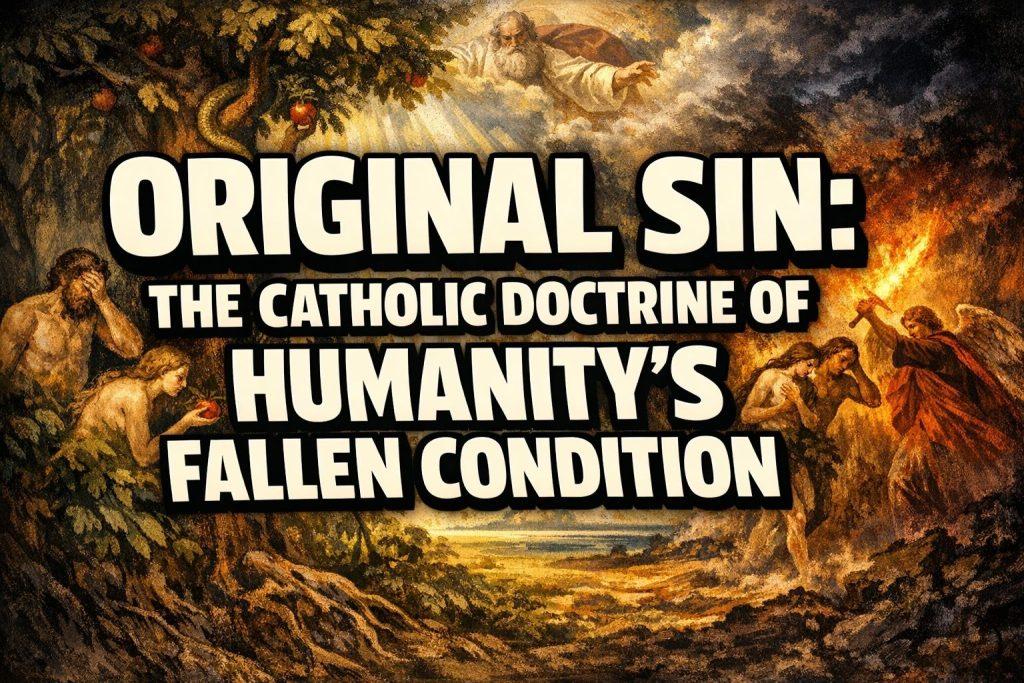
- Original sin refers to both the first sin committed by Adam and Eve in the Garden of Eden and the wounded condition of human nature that every person inherits as a consequence of that sin, entering the world deprived of sanctifying grace and inclined toward wrongdoing.
- Catholic teaching holds that original sin is not a personal sin for which each individual bears personal guilt, but an inherited condition of spiritual deprivation and moral weakness that affects every human being conceived in the ordinary way, with the sole exception of the Virgin Mary.
- The Catechism of the Catholic Church teaches that original sin resulted in the loss of original holiness and justice for all humanity, the darkening of the intellect, the weakening of the will, and the introduction of suffering and death into human experience.
- The Catholic doctrine of original sin is inseparably connected to the doctrine of redemption, since understanding why humanity needed saving requires understanding what was lost in Adam, and understanding what was lost in Adam illuminates the full scope of what was restored and exceeded in Jesus Christ.
- Baptism is the sacrament through which original sin is remitted and the grace of new life in Christ is given, making every unbaptized person, regardless of personal sinlessness, in need of this sacrament for the fullness of salvation.
- The Catholic Church defined the doctrine of original sin with formal precision at the Council of Trent in the sixteenth century, responding to Protestant reformers while also distinguishing the Catholic position from both Pelagian optimism about human nature and the Protestant reformers’ more radical account of nature’s total corruption.
Introduction
Original sin is among the most foundational and consequential doctrines in the entire Catholic theological tradition, functioning as the essential background against which the entire drama of creation, fall, redemption, and final glory becomes intelligible. Without an understanding of original sin, the Incarnation appears unnecessary, the cross seems excessive, the sacraments lose their urgency, and the moral struggle that every human being recognizes in their own experience remains unexplained. The Catholic Church teaches that the first human beings, described in Genesis as Adam and Eve, were created in a condition of original holiness and justice, elevated above the demands of their created nature by the gift of sanctifying grace, and endowed with extraordinary gifts including freedom from concupiscence, meaning disordered desire, freedom from suffering, and immunity from death. These were not simply natural endowments but freely given divine gifts, sometimes called “preternatural gifts” in the theological tradition, meaning gifts above and beyond what human nature as such would possess or require. When Adam and Eve transgressed the divine command through an act of pride, disobedience, and distrust of God, they lost these gifts not only for themselves but for all their descendants, transmitting to every subsequent human person a nature deprived of grace, darkened in intellect, weakened in will, and subject to suffering, concupiscence, and death. The Catechism of the Catholic Church describes this condition as a “deprivation of original holiness and justice,” and while it carefully distinguishes original sin from personal sin by noting that it is a condition contracted rather than committed, meaning it is something that happens to human beings by virtue of their origin rather than something each person actively does, it insists that the condition is nonetheless genuinely sinful and genuinely in need of remedy (CCC 404). Every major Catholic theologian from Saint Augustine through Saint Thomas Aquinas and the Council of Trent to the Second Vatican Council has affirmed that this teaching is not a pessimistic invention of gloomy clerics but a sober and honest account of what human experience reveals and what divine revelation confirms.
The history of the Church’s formal theological development of the doctrine of original sin is one of the most important chapters in the history of Christian thought, marked by several decisive controversies that forced the Church to articulate with increasing precision exactly what she believed and exactly what she rejected. The foundational controversy was the Pelagian dispute of the fifth century, in which the British monk Pelagius and his followers argued that human nature had not been fundamentally wounded by Adam’s sin, that each person possesses the full natural capacity to choose good and avoid evil without the assistance of divine grace, and that Adam’s sin harmed only Adam himself by setting a bad example rather than by transmitting a wounded nature to his descendants. Saint Augustine of Hippo, drawing on his own experience of the depths of human moral weakness and his careful reading of Saint Paul’s letters, combated Pelagianism with extraordinary energy and theological depth, arguing that the entire tradition of infant baptism for the remission of sins, practiced universally in the Church from the earliest times, makes sense only if infants genuinely carry a condition of sin that needs to be remitted, not merely a bad example that needs to be corrected. The Church confirmed Augustine’s anti-Pelagian position at a series of African councils and through the teaching of Pope Zosimus, establishing that grace is not merely an external divine assistance that makes difficult choices easier but an interior transformation that restores the capacity to choose genuine good that sin had damaged. The Protestant Reformation reopened the questions from the opposite direction, with Luther and Calvin arguing that Augustine’s position had not gone far enough and that original sin had so thoroughly corrupted human nature as to eliminate any genuine capacity for good, turning the human will into an instrument enslaved entirely to sin. The Council of Trent, convened between 1545 and 1563, produced the most comprehensive and precisely worded Catholic definition of original sin ever formulated, rejecting both Pelagianism on one side and Protestant anthropological pessimism on the other, and affirming that original sin genuinely wounds human nature without utterly destroying it, so that the image of God in the human person, though darkened and distorted, is not completely erased.
The Original State of Humanity and the Meaning of the Fall
Catholic theology’s account of original sin begins with its account of the original condition from which humanity fell, since the magnitude of the loss can only be understood in light of what was possessed before it was lost. The Church teaches that God created the first human beings not merely as natural animals endowed with reason and freedom but in a condition of supernatural elevation, sharing by God’s free gift in the divine life itself through sanctifying grace, and enjoying a harmony of soul and body, of reason and desire, of the human person and the natural world, that went far beyond what human nature as such could claim or achieve on its own. The Catechism describes this original condition as one of “original holiness and justice,” a state in which the human intellect was illumined by divine knowledge, the will was inclined toward genuine good, the passions were ordered to reason, and the whole person was oriented toward God as the ultimate end and fulfillment of human existence (CCC 375). The body was not subject to suffering or death, not because the human being was by nature immortal, but because God sustained the body’s life through the preternatural gifts that accompanied the grace of original justice. The harmony between human beings and the rest of creation was also a dimension of this original state, and the Catholic tradition has consistently understood the disruption of that harmony, expressed in the toil of work, the pain of childbirth, and the enmity between humans and the animal world described in Genesis chapter three, as part of the consequences of the fall rather than as permanent features of the created order in its intended form. Understanding this original state matters enormously for understanding original sin, because the sin itself consisted precisely in a refusal to remain within the condition of creaturely dependence on God that this state required, a grasping for an autonomy that the creature cannot sustain by its own powers and that the creature was never intended to exercise apart from God.
The actual sin of Adam and Eve, narrated in the third chapter of Genesis, is presented in Catholic theology as a sin of pride, disobedience, and distrust of God rather than merely a violation of an arbitrary rule about a piece of fruit. The serpent’s temptation in Genesis proceeds by first casting doubt on the goodness of God’s command, suggesting that the prohibition against eating the fruit of the tree of knowledge of good and evil was motivated by divine jealousy rather than by love: “God knows that when you eat of it your eyes will be opened, and you will be like God, knowing good and evil” (Genesis 3:5). The temptation invites the human person to view the creaturely condition not as a gift and a vocation but as a limitation to be overcome, to treat dependence on God not as the ground of freedom and flourishing but as an obstacle to authentic human self-determination. The Catechism identifies the sin as consisting at its root in the desire “to be like God without God, before God, and not in accordance with God,” meaning the desire for a self-sufficiency and a moral autonomy that belongs to God alone and that the creature can never genuinely possess (CCC 398). Saint Irenaeus of Lyons, writing in the second century, offered an influential reading of the fall that emphasized the immaturity of the first humans rather than their malice, suggesting that Adam and Eve were, in a sense, spiritual children who seized by disobedience what God had intended to give them in the fullness of time through growth in obedience and love. Whatever the precise character of the first sin, the Catholic tradition is unanimous in holding that its consequences were catastrophic and universal: not merely a private moral failure affecting only the individuals involved, but a structural change in the condition of human nature that would be transmitted to every subsequent human being.
The Transmission of Original Sin
The mechanism by which original sin passes from Adam and Eve to all their descendants is one of the most debated questions in the entire history of Catholic theology, and the Church has been careful to define the fact of transmission without prescribing any single philosophical account of how the transmission occurs. The Council of Trent defined that original sin is transmitted “by propagation and not by imitation,” meaning that it passes through the natural process of human generation rather than merely through the influence of bad example, and this definition excludes the Pelagian account while leaving open the precise biological, metaphysical, or theological mechanism of transmission. Saint Augustine, whose account of original sin has been more influential in the Western theological tradition than any other, suggested that original sin is transmitted through the disordered sexual desire that accompanies human conception, though the Church has never defined this aspect of his teaching and later theologians have generally not followed him in connecting the transmission of original sin specifically to sexual desire. Saint Thomas Aquinas proposed a more philosophically refined account, arguing that original sin is transmitted because Adam was the head of the entire human race in a way that went beyond mere biological parenthood, so that when he sinned as head, the nature he transmitted to all his descendants was a nature deprived of the grace that it had possessed in him, much as a craft passed from father to son is passed in whatever condition the father’s hands had left it. The Catechism describes the transmission of original sin as a “mystery,” acknowledging that the full coherence of the doctrine requires keeping in view truths that are difficult to hold together simultaneously: the genuine unity of the human race in Adam, the genuine personal freedom of each human individual, and the genuine solidarity of all human beings in the wounded condition that Adam’s sin introduced (CCC 404).
The universality of original sin across the entire human race, with the sole exception of the Virgin Mary, is a defined article of Catholic faith, and the Church bases this universality both on the explicit testimony of Scripture and on the universal practice of infant baptism for the remission of sins. Saint Paul’s argument in the fifth chapter of Romans is the most theologically developed Scriptural treatment of the universality and consequences of original sin: “Sin came into the world through one man and death through sin, and so death spread to all men because all men sinned” (Romans 5:12). The Greek phrase translated “because all men sinned” has been the subject of sustained interpretive debate in Catholic theology, with some reading it to mean that all sinned in Adam as their corporate head, and others reading it to mean that all sinned individually as a consequence of inheriting the sinful nature transmitted from Adam. The Council of Trent, following the Latin translation of this verse that reads “in whom all sinned,” tended toward the interpretation that emphasizes solidarity in Adam as the primary meaning, though subsequent Catholic theologians have continued to debate the precise exegesis. The universality of original sin is also supported, in Saint Augustine’s argument, by the universal human experience of moral weakness and the universal tendency toward wrongdoing that characterizes human beings across every culture, era, and condition of life. The Catechism notes that a world marked by violence, injustice, and suffering on the scale that human experience presents requires a deeper explanation than the simple accumulation of individual bad choices, and that original sin provides precisely such an explanation by identifying a structural condition of moral disorder that underlies and predisposes individual sins (CCC 408).
The Effects of Original Sin on Human Nature
The Catholic Church’s teaching on the effects of original sin on human nature represents one of the most careful and balanced positions in the entire history of Christian anthropology, steering between an optimism that denies or minimizes the real damage done to human nature and a pessimism that regards human nature as so thoroughly corrupted as to be incapable of any genuine good. The primary effect of original sin is the loss of sanctifying grace and the consequent deprivation of the supernatural life that had elevated humanity beyond its natural condition; this is the core of what Catholic theology means by calling original sin a “deprivation,” since the human person now exists in a condition of spiritual poverty, lacking the divine life that God had freely given and that the creature’s deepest longings require. The Catechism describes the effects of original sin as including the darkening of the intellect, meaning a reduction in the clarity with which human reason perceives moral and religious truth; the weakening of the will, meaning a reduced capacity to choose genuine good consistently and persistently even when it is recognized; the introduction of concupiscence, meaning a disordered tendency of the lower appetites, including sexual desire, hunger, thirst, anger, and ambition, to operate in ways that are disproportionate to reason and to genuine human flourishing; and the subjection of the human person to suffering and death (CCC 405). These effects are real and significant, but the Church insists that they do not utterly destroy the image of God in the human person: reason, freedom, moral awareness, the capacity for love, and the longing for God all survive the fall, wounded and weakened but not extinguished, so that human beings remain genuinely capable of natural goodness, genuine natural knowledge of God, and genuine moral reasoning even in their fallen state.
The effect of original sin on the human intellect is particularly important for understanding the Catholic approach to reason, faith, and the relationship between natural theology and revealed religion. Catholic teaching holds that even after the fall, human reason retains the natural capacity to know God through the created world, as Saint Paul affirms when he writes that “what can be known about God is plain to them, because God has shown it to them. Ever since the creation of the world his invisible nature, namely, his eternal power and deity, has been clearly perceived in the things that have been made” (Romans 1:19-20). The First Vatican Council defined in 1870 that unaided human reason can know with certainty the existence of God from created things, a definition that directly contradicts Protestant accounts of fallen reason as incapable of any genuine natural knowledge of God. At the same time, Catholic theology acknowledges that in the concrete fallen condition of humanity, this natural knowledge of God is persistently obscured by sin, passion, cultural distortion, and the sheer difficulty of sustained rational inquiry, so that divine revelation is morally necessary for humanity to arrive at the knowledge of God clearly, with certainty, and without mixture of error, even though it is not strictly philosophically necessary in the abstract. The effect of original sin on the will is equally consequential: the weakening of the will that original sin introduced means that even when a person clearly recognizes what is morally right, a persistent tendency toward what is easier, more pleasant, or more immediately satisfying works against the sustained choice of genuine good, a phenomenon that Saint Paul describes with painful honesty in Romans chapter seven, “I do not do the good I want, but the evil I do not want is what I do” (Romans 7:19), and that every serious Catholic recognizes from their own experience of the moral life.
Original Sin and the Catholic Understanding of Concupiscence
Concupiscence, the disordered tendency of the lower appetites and passions to operate in ways that resist the governance of reason and the direction of genuine human flourishing, is one of the most practically significant effects of original sin and one of the topics on which Catholic theology differs most importantly from both secular anthropology and from some Protestant accounts of human nature. The word “concupiscence” in the Catholic tradition refers primarily to the tendency of sensory desires, including but not limited to sexual desire, toward excess, disorder, or misdirection that reason and will struggle to control; in a broader sense, it also encompasses the tendencies toward pride, avarice, envy, and other disordered orientations of the spirit that Catholic theology identifies in the doctrine of the seven capital sins. The Catholic Church teaches that concupiscence remains in the baptized as what the Catechism calls a “tinder of sin,” meaning a source of temptation and moral difficulty that baptism does not remove but that grace, virtue, and cooperation with the Holy Spirit can progressively order and discipline over the course of a Christian life (CCC 1264). This teaching was defined with particular care at the Council of Trent in response to Protestant reformers, especially Luther, who held that concupiscence remaining after baptism is itself sinful in a proper sense, so that even justified believers remain genuinely sinners by reason of the concupiscence within them. The Council of Trent rejected this position, defining that while concupiscence remaining after baptism comes from sin and inclines toward sin, the Church does not call it sin in the proper sense in those who have been regenerated, unless they consent to it; concupiscence becomes an occasion of personal sin only when the will consents to the disordered desire it presents, not by the mere fact of its presence.
The practical implications of the Catholic doctrine of concupiscence are far-reaching and touch every area of Catholic moral and spiritual life. Recognizing concupiscence as a real and persistent feature of fallen human nature gives the Catholic a framework for understanding the moral struggle without either despairing of ever achieving genuine holiness or pretending that moral effort is unnecessary. The existence of concupiscence means that the Christian life is genuinely difficult, not merely difficult in the sense that it requires some effort, but difficult in the deeper sense that the very desires and impulses of the human person persistently incline toward what reason and faith identify as harmful, disordered, or wrong. This is why the Catholic moral tradition places such strong emphasis on the formation of virtue, the cultivation of habits of good action that gradually reshape the desires themselves rather than merely constraining them through willpower, and why the sacramental life, especially regular confession and the Eucharist, is so important as a source of the grace needed for sustained moral growth. Saint Thomas Aquinas’s treatment of the virtues in the “Summa Theologiae” is built on the premise that fallen human nature requires a systematic program of moral formation, supported by grace, to develop the stable dispositions of intellect and will that genuine human flourishing requires, and that this formation is a lifelong project rather than a once-for-all transformation. The Catholic understanding of concupiscence also grounds the Church’s consistent teaching that sexual temptation, the temptation to anger, and the temptation to various forms of self-serving behavior are not evidences of moral failure but normal features of fallen human experience that every person must engage with honesty, discipline, and reliance on divine grace.
Original Sin and the Sacrament of Baptism
The indissoluble connection between original sin and the sacrament of baptism is one of the most practically important dimensions of the Catholic doctrine, and it explains both why the Church baptizes infants and why she has consistently taught that baptism is necessary for salvation in a way that no purely voluntary act of the will can substitute for. The Council of Trent defined that the remedy for original sin is the merit of Jesus Christ applied to individuals through the sacrament of baptism, and that without this application every human being, however morally upright, remains in the condition of spiritual deprivation and estrangement from God that original sin introduced. The Church’s universal practice of baptizing infants, attested from the earliest patristic writings and consistently defended by theologians including Saint Augustine, Origen, and Saint Cyprian, rests directly on the conviction that infants, who have committed no personal sin whatsoever, nonetheless carry the condition of original sin and need its remission through the sacramental grace of baptism. Saint Augustine argued against those who suggested that unbaptized infants might occupy a middle state between heaven and the eternal suffering of the damned, insisting that the universality of original sin and the necessity of baptism for its remission left no theological room for such a middle state, though he also acknowledged that the mildest possible form of suffering would be the fate of such infants rather than the full punishment of adult sinners. The theological tradition later developed the concept of “limbo,” understood as a state of natural happiness without the beatific vision, as a way of doing justice to both the necessity of baptism and the difficulty of attributing suffering to those who had committed no personal fault; however, the Catechism notes that this concept remains only a theological hypothesis rather than a defined doctrine of the Church, and that the Church commends unbaptized infants to the mercy of God while trusting in his universal salvific will (CCC 1261).
Baptism’s effect on original sin is described in Catholic theology as a genuine remission, meaning that the condition of spiritual deprivation and the guilt associated with it are truly and completely removed by the sacramental grace of the rite, and not merely covered over, declared non-imputable, or forensically set aside as some Protestant accounts of justification suggest. The Catechism teaches that baptism erases original sin and turns the baptized person toward God, giving him the grace to live the life of a child of God, while also noting that certain consequences of original sin, especially concupiscence and the inclination toward sin, remain in the baptized as an arena for moral struggle and spiritual growth rather than as a punishment or a persistent condemnation (CCC 405). Saint Paul’s description of baptism in the sixth chapter of Romans makes clear that the sacrament accomplishes a genuine ontological change, meaning a real change in the very being and condition of the baptized: “We were buried therefore with him by baptism into death, in order that, just as Christ was raised from the dead by the glory of the Father, we too might walk in newness of life” (Romans 6:4). This “newness of life” is not merely a changed relationship or a different legal standing before God; it is a genuine participation in the divine life through sanctifying grace, a real restoration of what was lost in Adam and more, since the grace received in Christ exceeds the original justice of Eden by incorporating the baptized into the very life of the Son of God. The Catholic insistence on infant baptism, which strikes some non-Catholic Christians as theologically problematic on the grounds that infants cannot make a personal act of faith, rests precisely on this understanding of original sin as a condition that requires a remedy rather than as a moral failure that requires repentance, and on the conviction that God’s grace acts in the infant before and independently of the infant’s own conscious response, just as God’s love reaches human beings before they have done anything to merit it.
Original Sin, Personal Sin, and Human Solidarity
Catholic theology carefully distinguishes original sin from personal sin while insisting on a deep and essential connection between them, and this distinction is crucial for understanding both the nature of original sin as an inherited condition and the nature of personal sins as free acts for which each individual bears genuine moral responsibility. Original sin is not personal sin in the sense that each individual personally chose to commit it; no one is morally responsible for having been born in a condition of spiritual deprivation, just as no one is morally responsible for having been born with a hereditary disease or a genetic predisposition to certain forms of weakness. Yet the Catechism insists that original sin is “sin” in a real and proper sense, not merely by analogy or by theological convention, because it is a genuine privation of the holiness and grace that human beings ought to possess and were designed by God to enjoy, and because it is the root cause and constant background condition of the personal sins that every human being commits throughout their life (CCC 404). The connection between original sin and personal sin runs in both directions: original sin is the source and condition of personal sins, since the darkened intellect, weakened will, and disordered concupiscence that original sin introduces are precisely the vulnerabilities through which temptation operates and personal sins occur; and personal sins in their turn deepen and reinforce the condition of original sin in both the individual and in the social world that individuals help to create and sustain. The concept of what the Catechism calls “social sin” or “structures of sin,” developed most fully in Pope John Paul II’s apostolic exhortation “Reconciliatio et Paenitentia,” refers to the way in which the accumulation of personal sins over time creates social, cultural, economic, and political structures that themselves become sources of further sin and further human damage, perpetuating cycles of injustice and moral disorder that no individual acting alone can easily break.
The doctrine of human solidarity in original sin has important implications for how Catholics understand their responsibilities toward one another and toward the social order, since if sin is genuinely not only a personal but also a collective and structural reality, then the Christian response to sin cannot be limited to personal moral reform but must also address the social conditions that sin creates and sustains. The Catholic social teaching tradition, developed from Pope Leo XIII’s encyclical “Rerum Novarum” in 1891 through the Second Vatican Council and the subsequent social encyclicals of popes from Paul VI through Pope Francis, consistently grounds its concern for justice, human dignity, and the common good in the theological anthropology that includes the doctrine of original sin. Recognizing that human beings are not naturally inclined toward justice, that power tends to be abused, that economic systems left without moral governance tend toward exploitation, and that cultural environments can reinforce vice as easily as virtue, the Catholic social tradition insists on the necessity of institutions, laws, and social structures that take fallen human nature seriously rather than assuming a natural convergence of self-interest toward the common good. At the same time, the Catholic tradition’s insistence that original sin does not destroy the image of God or eliminate the genuine capacity for good grounds its equal insistence on the dignity of every human person, the genuine goodness of creation, the possibility of authentic human achievement in art, science, culture, and politics, and the genuine moral progress that individuals, communities, and civilizations can make with the assistance of grace and through the cultivation of virtue. The balance between these two convictions, realism about the depth of human sinfulness and confidence in the genuine goodness of human nature and its capacity for redemption, is one of the most distinctive and important contributions of Catholic social thought to the broader cultural and political conversation of the modern world.
Original Sin in Comparison with Protestant and Orthodox Perspectives
The doctrine of original sin is one of the areas of Christian theology where important agreements and significant differences exist between the Catholic Church and other major Christian traditions, and a careful account of these agreements and differences illuminates both the distinctive contribution of the Catholic position and the shared heritage that Catholic theology draws upon and develops. The Eastern Orthodox tradition shares with Catholicism the conviction that Adam’s sin introduced a genuine wound into human nature affecting all his descendants, the loss of original righteousness, the subjection to death and suffering, and the disordering of human desires that the Greek Fathers sometimes called “passions.” The Orthodox tradition tends, however, to emphasize the transmission of mortality and corruption more than the transmission of guilt, holding that what all human beings inherit from Adam is primarily a nature subject to death and therefore prone to sin, rather than a nature bearing the guilt of Adam’s specific act. This difference in emphasis is reflected in the Orthodox reluctance to use the Latin term “original sin” and their preference for terms such as “ancestral sin,” which conveys the sense of an inherited condition without necessarily implying the inherited guilt that the Western tradition, following Augustine, has associated with the doctrine. The Catholic Church’s position, as defined at the Council of Trent, affirms both the inherited condition and the inherited guilt, though it is careful to specify that the guilt in question is the guilt of the state rather than the guilt of the personal act, meaning that the condition of being deprived of grace is itself a sinful condition that requires remission rather than merely a natural deficiency that requires supplementation.
The difference between the Catholic position and the major Protestant positions on original sin is more substantial and touches on questions that go to the heart of the Reformation controversies. Luther and Calvin both held that original sin had so thoroughly corrupted human nature as to leave the fallen human will entirely enslaved to sin and incapable of any genuine movement toward God without the irresistible action of divine grace. Luther’s doctrine of the “bondage of the will,” developed in his work “De Servo Arbitrio” written against Erasmus, insisted that fallen humanity possesses no genuine freedom with respect to matters of salvation and that the human will in its fallen state can only choose evil. Calvin’s account of “total depravity,” which means not that every fallen human being is as wicked as they could possibly be but that sin has touched every dimension of human nature, leaving no area genuinely unaffected, similarly leaves little room for the genuine natural goodness that Catholic theology consistently affirms in fallen human beings. The Council of Trent responded to these positions by defining that original sin, while genuinely wounding human nature, does not utterly destroy it, and that the human will, even in its fallen state, retains a genuine though weakened freedom that makes personal moral responsibility possible and that cooperates, under the influence of grace, with the process of justification and sanctification. The Catechism summarizes the Catholic position by describing original sin as “a deprivation of original holiness and justice, but human nature has not been totally corrupted: it is wounded in the natural powers proper to it, subject to ignorance, suffering and the dominion of death, and inclined to sin,” which is clearly distinguished from both Pelagian minimizing of the wound and Protestant assertions of total corruption (CCC 405).
Original Sin and the Question of Human Origins
The Catholic doctrine of original sin has engaged in sustained and sometimes difficult conversation with the findings of modern science, particularly with the evolutionary account of human origins, and the Church’s approach to this conversation reflects her commitment both to the truth of divine revelation and to the proper autonomy of the natural sciences as a path to genuine knowledge of the created world. The doctrine of original sin, as the Church has defined it, requires an actual historical first sin by actual first human beings from whom all subsequent humanity descends, since the doctrine’s insistence on the transmission of original sin “by propagation” and its grounding in the single Adamic origin of the human race assumes a genuine historical event and a genuine biological and spiritual unity of the human family in its origin. The encyclical “Humani Generis” of Pope Pius XII, issued in 1950, addressed the relationship between the doctrine of original sin and theories of human evolution, permitting Catholics to entertain the question of the evolution of the human body from prior animal forms while insisting that the human soul is directly created by God and that the doctrine of monogenism, meaning the derivation of all humanity from a single original couple, presents a more difficult question that the Church has not definitively resolved in its relationship to evolutionary science. Pope Pius XII warned that polygenism, meaning the theory that the human race descended from multiple original couples rather than from a single pair, seemed difficult to reconcile with the Catholic doctrine of original sin as the Church had traditionally understood it, though he stopped short of defining monogenism as a doctrine of faith. Subsequent theological discussion has explored whether the essential content of the doctrine of original sin, including the universality of fallen human nature, the need of all humanity for redemption in Christ, and the historical character of sin’s entrance into the world, might be maintained even if the precise historical circumstances of human origins were understood somewhat differently from the traditional reading of Genesis.
The Catholic Church’s approach to the relationship between original sin and human evolution is guided by the principle that truth cannot contradict truth, and that the God who reveals himself in Scripture and Tradition is the same God who created the natural world that science investigates. Pope John Paul II, addressing the Pontifical Academy of Sciences in 1996, reaffirmed that the theory of evolution is “more than a hypothesis” and represents a genuine contribution to the understanding of human origins, while also insisting that the spiritual dimension of the human person, including the soul’s direct creation by God, lies beyond the competence of empirical science to address. The Catechism’s treatment of the fall and original sin consistently presents the narrative of Genesis as conveying genuine theological truth about the human condition and about the historical reality of sin’s entrance into the world, while also noting that the narrative “uses figurative language” and that the account must be read with attention to its literary genre and theological purpose rather than as a scientific description of biological or geological events (CCC 390). The fundamental theological content that the Church regards as essential to the doctrine of original sin, including the goodness of creation, the free character of the first sin, the universal scope of its effects, and the need of all humanity for redemption in Christ, remains fully intact regardless of how the precise scientific questions about human biological origins are eventually resolved. This approach reflects the mature Catholic conviction that faith and science operate in distinct but complementary modes of inquiry, each contributing genuine knowledge to a complete understanding of the human person and the world in which that person lives.
See Also
- The Incarnation: Why the Eternal Son of God Became Man in Catholic Teaching
- Jesus Christ: His Identity, Nature, and Mission According to the Church
- The Sacrament of Baptism: New Birth and Entry into the Body of Christ
- Grace and Justification: How God Transforms and Saves the Human Person
- The Seven Deadly Sins: Catholic Teaching on the Roots of Human Wrongdoing
- Creation and the Catholic Doctrine of God as Maker of Heaven and Earth
- The Immaculate Conception: Mary’s Preservation from Original Sin
- Free Will and Human Dignity in Catholic Moral and Theological Thought
What the Doctrine of Original Sin Means for Catholics Today
The Catholic teaching on original sin is among the most practically relevant doctrines in the entire tradition, even though it is often misunderstood as a gloomy or pessimistic assertion about human badness that has little positive to offer contemporary people searching for meaning and hope. Properly understood, the doctrine of original sin is not a condemnation of human nature but an honest and compassionate account of the human condition as it actually is, an account that takes seriously the moral struggle that every person recognizes in themselves, that explains the persistence of injustice and violence in human societies, and that locates the source of these realities in a historical disorder rather than in the nature God created and declared “very good.” A Catholic who genuinely understands original sin stops being surprised by the persistence of moral failure in themselves and in others, stops attributing every act of cruelty or injustice to simple wickedness, and starts understanding human weakness and wrongdoing with a compassion rooted in the recognition that every person enters the world carrying a wound they did not choose and fighting a battle they did not initiate. This compassion does not excuse personal sin or diminish moral responsibility; it situates moral failure within a larger context that includes both the inherited condition of fallen nature and the freely given grace of redemption that is always available to those who seek it. The doctrine also grounds the Catholic’s constant return to the sacraments, especially baptism, confession, and the Eucharist, as the primary means by which the wound of original sin is continually addressed and the grace of new life in Christ is continually renewed and deepened.
The doctrine of original sin also carries significant implications for the way Catholics engage with the social and political questions of their time, providing a framework for realistic assessment of human institutions, social arrangements, and political proposals that neither dismisses human effort as futile nor places naive confidence in any purely human program for solving the deepest problems of the human condition. A Catholic who understands original sin will support institutions, laws, and social structures that account for human selfishness, the abuse of power, and the tendency of individuals and groups to pursue narrow self-interest at the expense of the common good, without despairing of the genuine good that human beings can achieve with grace and with well-designed social institutions. The same Catholic will be appropriately skeptical of any ideology that promises to solve the problem of human suffering and injustice through purely structural or technological means, recognizing that the disorder original sin introduces into human nature cannot be resolved by external arrangement alone but requires the interior transformation that only grace can accomplish. At the same time, understanding that grace does genuinely transform human nature, that baptism truly remits original sin, that the Holy Spirit truly dwells in and works through the members of the Body of Christ, and that the redemption accomplished by Christ truly exceeds what was lost in Adam, gives every Catholic a foundation for genuine and sustained hope that no depth of human sinfulness, personal or social, can entirely undermine. The Catechism’s summary of the Catholic position on original sin is worth returning to repeatedly: human nature is wounded but not destroyed, darkened but not extinguished, inclined toward sin but not enslaved to it, and redeemed in Christ not merely to its former condition but to something far greater, adopted sonship in the eternal family of God (CCC 405, 1996).
About This Article
CatholicWiki is an unofficial, independently maintained Catholic encyclopedia. It is not affiliated with, endorsed by, or representative of the Holy See, the Vatican, any diocese, any Catholic religious order, or any official body of the Catholic Church. While every effort is made to ensure that all content faithfully reflects Catholic teaching as expressed in Sacred Scripture, Sacred Tradition, the Magisterium, and other authoritative Catholic sources, readers are encouraged to consult official Church documents, their local pastor, or a qualified theologian for matters of personal faith and practice. CatholicWiki is committed to accuracy, fidelity, and continuous improvement. If you believe any content on this page contains an error, please consider contributing a correction in the spirit of truth and charity.