
Quick Insights
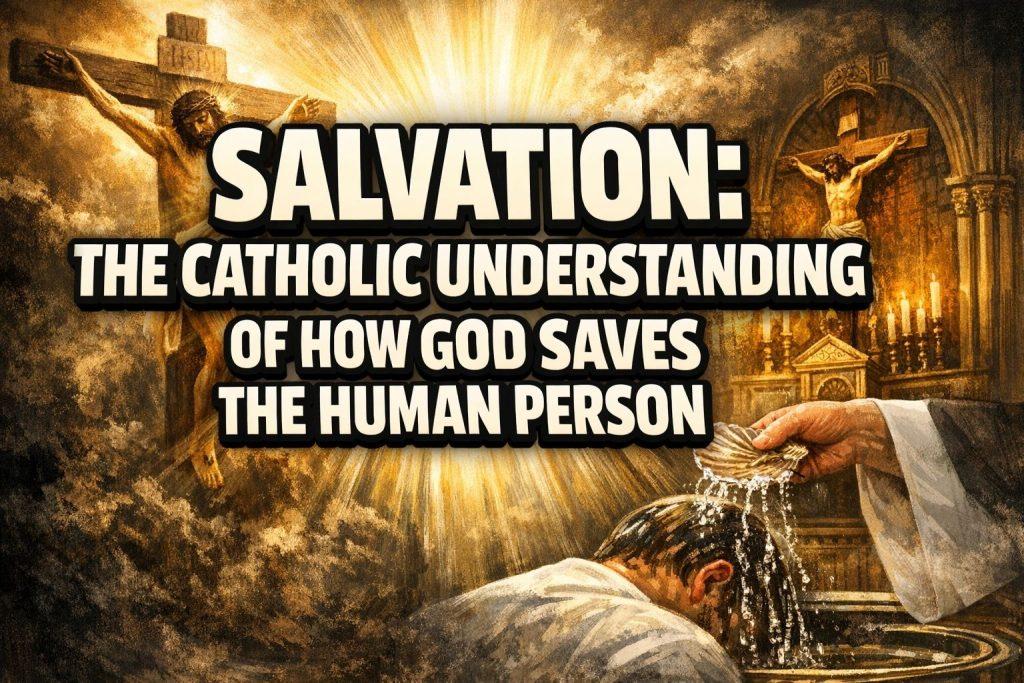
- Catholic teaching holds that salvation is the total liberation of the human person from sin, death, and eternal separation from God, accomplished by Jesus Christ through his Incarnation, suffering, death, and resurrection, and communicated to individual souls through faith, the sacraments, and a life of charity.
- The Catholic Church teaches that salvation is entirely a gift of God’s grace and can never be earned by purely human effort, while also insisting that genuine human cooperation with that grace, expressed through faith, repentance, and the works of love, is a real and necessary part of the process.
- Salvation in the Catholic understanding is not a single instantaneous event but a process that begins at baptism, develops throughout the Christian life through the reception of the sacraments and growth in virtue, and reaches its completion only in the eternal life of heaven.
- The Catholic Church teaches that Jesus Christ is the sole and universal mediator of salvation, the one through whom all saving grace reaches every person, whether or not that person has explicit knowledge of Christ, since there is “no other name under heaven given among men by which we must be saved” (Acts 4:12).
- Catholic teaching affirms that God genuinely wills the salvation of every human being without exception, and that his saving grace is offered to every person through the means appropriate to their situation, including those who have never had the opportunity to hear the Gospel.
- The Catholic understanding of salvation encompasses not only the forgiveness of personal sin but also the healing and transformation of human nature, the restoration of the relationship with God that sin destroyed, and the ultimate glorification of the whole person, body and soul, in the resurrection of the dead.
Introduction
Salvation is the central concern of the entire Catholic faith, the goal toward which every doctrine, every sacrament, every moral teaching, and every dimension of the Church’s life and mission is ultimately ordered. The question of how human beings are saved, what saves them, who saves them, and what the saved condition actually consists of, has been at the heart of Christian theological reflection from the apostolic age to the present day, and the Catholic Church’s answers to these questions are among her most important and most carefully developed doctrinal contributions to the history of human thought. The Catechism of the Catholic Church opens its entire treatment of the Christian faith with the declaration that God “who ‘dwells in unapproachable light’ wants to communicate his own divine life to the men he freely created, in order to adopt them as his sons in his only-begotten Son,” making the communication of divine life to human beings, which is salvation in its fullest sense, the very purpose for which God called the created order into existence (CCC 52). Salvation in the Catholic understanding is not reducible to the forgiveness of sins, though it certainly includes that, nor to the avoidance of eternal punishment, though it certainly delivers from that as well; it is the positive and transforming gift of a share in God’s own life, the fulfillment of the human person’s deepest longing in a union with God that nothing in created experience can fully satisfy or replace. This breadth and depth of the Catholic understanding of salvation distinguishes it from narrower accounts that focus exclusively on judicial categories of guilt and forgiveness, and it grounds the rich and comprehensive character of Catholic theology, spirituality, and moral teaching as expressions of the transformed human life that salvation is meant to produce. Understanding salvation fully requires attention to the problem from which it saves, namely sin and its consequences, to the One who accomplishes it, Jesus Christ in the fullness of his person and saving work, to the means by which it is communicated, the sacramental and spiritual life of the Church, and to the final goal toward which it is oriented, eternal life in the beatific vision.
The history of the Catholic Church’s theological reflection on salvation is one of the most complex and significant chapters in the history of Christian doctrine, marked by profound insights, genuine controversies, and formal definitions that have shaped the faith of hundreds of millions of people across twenty centuries. The Pelagian controversy of the fifth century forced the Church to define clearly that salvation is entirely a gift of grace and cannot be earned by human effort, a definition primarily associated with the theological genius of Saint Augustine of Hippo. The medieval period saw the systematic development of atonement theology, particularly in Saint Anselm of Canterbury’s influential “Cur Deus Homo,” which argued that the Incarnation and the cross were the necessary means by which God’s honor, violated by sin, could be perfectly satisfied, and in Saint Thomas Aquinas’s more comprehensive account in the “Summa Theologiae,” which situated the cross within a broader theology of Christ’s priestly, prophetic, and royal mediation. The Protestant Reformation of the sixteenth century produced the most intense and far-reaching controversy about salvation in the Church’s history, with Luther, Calvin, and Zwingli challenging what they perceived as a Pelagian drift in Catholic practice and teaching, and insisting that salvation is by grace alone, through faith alone, in Christ alone, and for God’s glory alone. The Council of Trent’s decrees on justification and salvation, issued between 1546 and 1547, represent the most formally comprehensive and doctrinally precise statement of the Catholic understanding of salvation ever produced, carefully distinguishing the Catholic position from both Pelagianism on one side and the Protestant reformers’ exclusion of genuine human cooperation on the other. The Second Vatican Council, in the Dogmatic Constitution “Lumen Gentium” and the Pastoral Constitution “Gaudium et Spes,” developed the Catholic understanding of salvation further by addressing its universal scope, its relationship to the non-Christian world, and its implications for the Church’s engagement with the social and political order, producing a synthesis that the subsequent pontificates of Paul VI, John Paul II, Benedict XVI, and Francis have continued to develop and apply.
The Problem Salvation Addresses: Sin, Death, and Estrangement from God
Any adequate account of Catholic salvation theology must begin with the problem that salvation is designed to address, since the nature of the saving remedy is always proportionate to the nature of the disease it cures, and the Catholic understanding of the depth and seriousness of sin determines the corresponding depth and seriousness of the redemption that Christ accomplished. Catholic teaching, as discussed at length in the doctrine of original sin, holds that the human race entered history in a condition of holiness and friendship with God, endowed with sanctifying grace and the preternatural gifts that accompanied it, and that this condition was lost through the free disobedience of the first human beings, leaving every subsequent person born into a condition of spiritual deprivation, moral weakness, and estrangement from God. The consequences of this original condition are compounded by the personal sins that every human being commits throughout their life, multiplying the damage to the soul’s relationship with God and deepening the disorder introduced by original sin. Saint Paul presents the full scope of the problem with characteristic directness in his Letter to the Romans, arguing that “all have sinned and fall short of the glory of God” (Romans 3:23) and that “the wages of sin is death” (Romans 6:23), identifying the ultimate consequence of sin not merely as moral failure or social harm but as death, understood in its full theological sense as the definitive separation of the soul from God who is the source of all life. The Book of Genesis presents the original situation after the fall in terms of a triple rupture: the rupture between human beings and God, expressed in the hiding from God’s presence and the expulsion from the garden; the rupture between human beings and one another, expressed in the mutual blame between Adam and Eve and the subsequent violence of Cain; and the rupture between human beings and the natural world, expressed in the thorns and thistles and the pain of labor. Catholic salvation theology addresses all three dimensions of this rupture: it reconciles humanity to God, restores genuine community among human beings, and ultimately promises a renewed creation in which the disharmony introduced by sin is fully overcome.
The Catholic tradition also takes seriously the reality of eternal death, understood as the definitive and irrevocable separation of the soul from God in what the Catechism calls hell, as the ultimate consequence from which salvation delivers those who accept it. The existence of hell as a real possibility for every human soul is not a peripheral or negotiable element of Catholic faith but a defined doctrine grounded in the explicit and repeated teaching of Jesus himself, who described the fate of the unrepentant with more urgency and more graphic detail than any other topic in the Gospels. Jesus’s warnings about “the unquenchable fire” (Mark 9:43), “outer darkness” (Matthew 8:12), and the final separation of the sheep from the goats at the last judgment (Matthew 25:31-46) establish beyond reasonable doubt that the one who accomplished salvation considered the alternative to salvation both real and terrible. The Catechism describes hell as the state of definitive self-exclusion from communion with God and the blessed, noting that God does not predestine anyone to go to hell and that the primary cause of damnation is always the person’s own free and final rejection of God’s love, but also insisting that the possibility of hell is real and not merely hypothetical (CCC 1033). Understanding the reality of hell is important for understanding salvation, because it reveals the full stakes of the gift that Christ offers: salvation is not merely an improvement in the quality of one’s spiritual life but a genuine deliverance from an eternal and irreversible loss that the soul’s own free choices can bring upon itself. The Catholic Church’s consistent proclamation of both the reality of hell and the universal availability of salvation reflects her conviction that genuine love requires genuine freedom and that genuine freedom includes the terrible possibility of definitive self-exclusion from the love that alone fulfills the human heart.
Jesus Christ as the Sole Mediator of Salvation
The Catholic Church’s teaching on salvation centers entirely on the person and saving work of Jesus Christ, and the declaration of Saint Peter before the Sanhedrin, “There is salvation in no one else, for there is no other name under heaven given among men by which we must be saved” (Acts 4:12), remains the foundational and non-negotiable confession from which every Catholic account of salvation proceeds. This exclusive claim for Christ as the sole mediator of salvation is not an expression of religious imperialism or cultural arrogance but a theological conviction grounded in the unique character of what Christ accomplished: only the Incarnate Son of God, truly God and truly man, could bridge the infinite distance between the holy God and sinful humanity and accomplish from within human nature the redemption of that nature. Saint Paul expresses this uniqueness when he writes, “For there is one God, and there is one mediator between God and men, the man Christ Jesus, who gave himself as a ransom for all” (1 Timothy 2:5-6), combining in a single statement the unity of God, the uniqueness of the mediation, the genuine humanity of the mediator, and the scope of the redemption that extends to all people. The Catechism affirms this confession of Christ’s unique mediatorship as one of the most fundamental and non-negotiable elements of Catholic faith, while also carefully distinguishing the unique, unrepeatable mediatorship of Christ from the subordinate and participatory forms of mediation exercised by the Church, the saints, and the Virgin Mary, all of which draw their entire efficacy from Christ’s primary mediation and add nothing to it of their own independent source (CCC 480). Understanding the uniqueness of Christ’s mediatorship requires understanding both the ontological dimension, the fact that only a Person who is both fully divine and fully human can unite God and humanity in one person, and the redemptive dimension, the fact that only Christ’s specific acts of self-offering in his Incarnation, passion, death, and resurrection accomplished the reconciliation of God and humanity that salvation requires.
The Catholic theological tradition has developed several complementary frameworks for understanding how Christ’s saving work accomplished salvation, and these frameworks are not mutually exclusive but illuminate different aspects of a single, inexhaustible mystery. The satisfaction theory developed by Saint Anselm in the eleventh century argued that the infinite offense of sin against the infinite dignity of God required an infinite act of reparation that only a divine Person acting in and through a human nature could offer, making the Incarnation logically necessary for the kind of satisfaction that full redemption required. Saint Thomas Aquinas accepted the essential insight of Anselm’s satisfaction theory while situating it within a broader theology that also emphasized the moral exemplarity of Christ’s sacrifice, its efficacy in generating charity in the hearts of believers, its power to deliver humanity from the dominion of the devil and the power of death, and its character as the supreme act of priestly worship offered to the Father on humanity’s behalf. The Catechism presents Christ’s saving work in terms of the three offices of Priest, Prophet, and King, noting that as Priest he offered himself as the perfect and definitive sacrifice for sin, as Prophet he revealed the fullness of God’s truth about humanity’s origin, dignity, and destiny, and as King he established the reign of God’s love over all creation by defeating sin and death through his resurrection and ascension (CCC 436). Each of these frameworks captures something real and important about the mystery of redemption, and the richness of Catholic theology on this question reflects the conviction that no single conceptual framework is adequate to express the full depth of what God accomplished in Christ.
Justification: What Happens When a Person Is Saved
The doctrine of justification, meaning the account of what actually happens to a person when they are saved, is one of the most important and most carefully defined elements of Catholic salvation theology, and it was the topic that generated the most intense controversy during the Reformation and the most carefully worded definitions at the Council of Trent. Catholic teaching holds that justification is a genuine interior transformation of the human person, not merely a change in their legal status before God or a divine declaration that leaves the person internally unchanged. The Council of Trent defined that justification involves not only the remission of sins but also the sanctification and renewal of the interior person through the voluntary reception of grace and the gifts of the Spirit, specifically the infusion of faith, hope, and charity into the soul, so that the justified person is genuinely and truly made righteous rather than merely declared righteous by an external divine act. This distinction between “making righteous” and “declaring righteous” lies at the heart of the difference between Catholic and classical Protestant accounts of justification: Luther and Calvin held that God justifies the sinner by imputing, meaning crediting to them, the righteousness of Christ without any change in the sinner’s inner moral condition, so that the justified person remains in themselves a sinner while being regarded by God as righteous through the merits of Christ. Catholic theology, following the patristic tradition represented most fully by Saint Augustine, insists that God’s justifying action is efficacious rather than merely declaratory, that it genuinely produces the righteousness it announces, and that the imputation of Christ’s righteousness and the infusion of sanctifying grace are not two separate things but two aspects of a single transforming divine action. The Catechism describes justification as “not only the remission of sins, but also the sanctification and renewal of the interior man” (CCC 1989), and Saint Thomas Aquinas argued in the “Summa Theologiae” that the infusion of grace is the most important element of justification, since it is the grace that actually transforms the soul’s relationship to God and produces the new life that the remission of sins makes possible.
The role of faith in Catholic salvation theology is genuine and central, though the Catholic understanding of what saving faith involves differs importantly from the Protestant account of “faith alone.” Catholic theology fully affirms that faith is the beginning and foundation of the Christian life, the first form of the soul’s genuine response to God’s saving initiative, and the disposition without which no one can begin the process of justification. The Council of Trent defined that faith is the root of all justification, the foundation on which the entire edifice of the Christian life is built, and the First Vatican Council defined that faith is a supernatural virtue by which a person believes everything God has revealed, not because of human reasoning alone, but because of the authority of God who reveals it. What Catholic theology rejects is not the necessity or the centrality of faith but the Lutheran claim that faith alone, understood as excluding any role for hope, charity, good works, and the sacraments in the process of justification, is the sole instrument of salvation. The Catechism presents faith as the beginning of a conversion that must be completed by hope and charity and made concrete in a life of genuine moral transformation and sacramental participation (CCC 1989-1995). Saint Paul himself provides the Catholic key to this question when he writes in the Letter to the Galatians, “In Christ Jesus neither circumcision nor uncircumcision is of any avail, but faith working through love” (Galatians 5:6), suggesting that the faith that saves is not a static intellectual assent or a momentary act of trust but a living faith that expresses itself in and through the love that the Holy Spirit pours into the heart of the justified person. The Letter of James reinforces this understanding when it insists that “faith by itself, if it has no works, is dead” (James 2:17), a text that Luther famously described as “a letter of straw” but that the Catholic tradition regards as an essential corrective to any individualist or purely interior account of saving faith.
The Sacraments as the Ordinary Means of Salvation
The Catholic Church’s insistence on the sacraments as the ordinary means through which God communicates salvation to individual souls is one of the most distinctively Catholic elements of her theology of salvation, and it rests on the Incarnational conviction that the God who became flesh in Jesus Christ continues to save through concrete, visible, historical, and embodied means rather than through purely interior or invisible spiritual operations. The Catechism teaches that the sacraments are “necessary for salvation” in a properly qualified sense: they are the means that Christ himself instituted for the communication of his saving grace, and the Church is bound by Christ’s command to offer them, while God himself is not bound by the sacraments and can save through other means according to his sovereign freedom (CCC 1129). This teaching does not mean that anyone who has not received a particular sacrament is necessarily unsaved; the Catholic tradition has always recognized the baptism of desire, meaning the implicit or explicit desire for baptism in a person who is prevented from receiving it by circumstances beyond their control, as capable of producing the essential saving effect of the sacrament. What it does mean is that the sacraments are not optional extras or pious supplements to a salvation that is essentially complete without them; they are the ordinary channels through which Christ’s saving grace reaches human souls in the concrete circumstances of their historical existence, and deliberately refusing them without good reason is a serious matter. Baptism holds the foundational place among the sacraments as the doorway through which a person first enters into the saving life of Christ, receiving the remission of original sin and personal sins, the gift of sanctifying grace, and incorporation into the Body of Christ, the Church. Saint Paul describes baptism in Romans chapter six as a genuine participation in Christ’s death and resurrection, making the baptized person genuinely share in the dying that frees from sin and the rising that inaugurates new life, so that baptism is not merely a symbolic washing but a genuine ontological event, meaning a real change in the very being and condition of the person baptized.
The Eucharist occupies the central place in the Catholic theology of salvation as the sacrament through which the saving work of Christ is made continuously present and accessible to the faithful in the most direct and personal way possible. The Catechism describes the Eucharist as “the source and summit of the Christian life,” drawing on the language of the Second Vatican Council’s Constitution “Sacrosanctum Concilium,” indicating that it is simultaneously the font from which all saving grace flows and the highest expression of the Church’s participation in divine life available in this present age (CCC 1324). Jesus’s own declaration at Capernaum, “Unless you eat the flesh of the Son of man and drink his blood, you have no life in you; he who eats my flesh and drinks my blood has eternal life, and I will raise him up at the last day” (John 6:53-54), establishes the Eucharist in direct and explicit terms as a means of salvation rather than merely a ritual commemoration, and the Catholic Church has consistently understood these words as the literal institution of the Eucharistic doctrine rather than as a metaphor for faith in Christ. The Sacrament of Reconciliation, through which the sins committed after baptism are forgiven and the sanctifying grace lost through mortal sin is restored, holds an equally essential place in the Catholic economy of salvation for those who have fallen into serious sin after baptism. The Catechism describes the Sacrament of Reconciliation as a “second conversion,” a genuine return to the Father’s house that the parable of the Prodigal Son most vividly describes, and it insists that the grace of this sacrament is not merely a psychological relief or a social reconciliation but a genuine restoration of the soul’s friendship with God and a real remission of the eternal punishment that mortal sin would otherwise incur (CCC 1468). Together, the sacraments of baptism, the Eucharist, and reconciliation form the core of what the Catholic tradition calls the sacramental economy of salvation, the entire system of divine self-communication through visible and historical means by which Christ’s saving grace reaches every person who approaches him in faith and openness.
The Universal Scope of Salvation and Those Outside the Church
One of the most important and most carefully developed aspects of Catholic salvation theology concerns the question of whether and how salvation is available to those who are not formal members of the Catholic Church, including non-Catholic Christians, members of non-Christian religions, and people of no religious affiliation at all. The foundational principle from which the Catholic Church approaches this question is the universal salvific will of God, the defined teaching that God genuinely and sincerely wills the salvation of every human being without exception, expressed most directly in Saint Paul’s declaration that God “desires all men to be saved and to come to the knowledge of the truth” (1 Timothy 2:4). This universal will cannot be frustrated by the contingencies of human history or the limitations of human missionary reach without calling God’s omnipotence into question, and the Catholic tradition has therefore consistently sought to articulate how God’s grace reaches those who have not had the opportunity to receive the Gospel and the sacraments that are the ordinary means of salvation. The ancient theological principle “extra ecclesiam nulla salus,” meaning “outside the Church there is no salvation,” has been a consistent element of Catholic teaching from the patristic period and was formally affirmed by the Fourth Lateran Council in 1215 and by the Council of Florence in 1442. However, the Catholic Church has consistently interpreted this principle in ways that reflect the universal scope of God’s salvific will rather than a narrow restriction of salvation to formal Church members alone, and the Second Vatican Council’s treatment of this question in “Lumen Gentium” and “Gaudium et Spes” represents the most nuanced and comprehensive statement of the Catholic position on the question.
The Second Vatican Council taught in “Lumen Gentium” that salvation is available, through Christ’s grace, to people who through no fault of their own do not know the Gospel of Christ or the Church but who seek God with a sincere heart and try to follow the promptings of conscience in their lives. The Council was careful to insist that this teaching does not make the Church and her sacraments unnecessary or reduce the urgency of missionary proclamation; rather, it expresses the Church’s confidence in the universality of Christ’s redemption and the universal operation of the Holy Spirit, who “blows where it wills” (John 3:8) and whose action cannot be confined to the visible boundaries of the institutional Church. The Catechism develops this teaching by noting that those who, through no fault of their own, do not know Christ and the Church but who seek God with a sincere heart, can achieve salvation (CCC 847). The critical phrase “through no fault of their own” is important, since it indicates that invincible ignorance, meaning ignorance that cannot be overcome through reasonable effort, is the relevant category, and that persons who have had the opportunity to learn about the Church and have rejected her claim without genuine examination are in a fundamentally different situation from those who have never had that opportunity. Non-Catholic Christians, who share with the Catholic Church the fundamental goods of Scripture, baptism, the Nicene Creed, and the moral teaching flowing from these, are described in the Decree on Ecumenism “Unitatis Redintegratio” as genuinely related to the Catholic Church through the bonds they share with her, and the Catechism affirms that the Spirit of Christ uses these Churches and ecclesial communities as means of salvation (CCC 819). The Catholic Church maintains, however, that the fullness of the means of salvation subsists in the Catholic Church alone, which therefore has both the greatest access to the treasures of salvation and the greatest responsibility for making them available to all.
Salvation and the Moral Life: Faith, Works, and the New Law
The relationship between salvation and the moral life is one of the most practically important dimensions of Catholic salvation theology, and it is the area in which the Catholic understanding differs most noticeably in its practical emphasis from Protestant accounts of salvation, even when the underlying theological differences are properly understood and fairly stated. Catholic teaching insists that genuine saving faith is never static or merely interior but always expresses itself in a transformed way of living, and that the moral life of the Christian, lived in grace and sustained by the sacraments, is not an optional addition to the salvation already fully secured by faith but an intrinsic dimension of the saving transformation that grace produces in the soul. Saint James’s declaration that “faith apart from works is dead” (James 2:26) and Jesus’s own insistence that “not everyone who says to me, ‘Lord, Lord,’ shall enter the kingdom of heaven, but he who does the will of my Father who is in heaven” (Matthew 7:21) ground this conviction in the most direct possible Scriptural testimony. The Council of Trent addressed the relationship between faith and works in salvation with careful theological precision, insisting that no one should trust in their good works as the ultimate ground of their confidence before God, since the assurance of one’s own righteousness is vain unless grounded in God’s mercy, while also insisting that the justified person genuinely cooperates with grace through acts of faith, hope, and charity and through the observance of the moral law, and that these acts genuinely contribute to their growth in holiness and their progress toward eternal life. Saint Paul’s own letters hold both truths simultaneously, insisting in Galatians that “a man is not justified by works of the law but through faith in Jesus Christ” (Galatians 2:16) and insisting in the same letter that “the one who sows to his own flesh will from the flesh reap corruption; but the one who sows to the Spirit will from the Spirit reap eternal life” (Galatians 6:8), making the manner of one’s life determinative of one’s ultimate destiny.
The Catholic moral tradition understands the moral life of the Christian not as a burden imposed from outside on a soul already saved but as the natural expression and development of the new life that salvation has already begun in the soul through grace. Pope John Paul II, in his encyclical “Veritatis Splendor,” presented the Catholic moral life in precisely these terms, arguing that the commandments of God are not arbitrary restrictions but expressions of the divine wisdom that knows what constitutes genuine human flourishing, and that following them is the path by which the person who has received the gift of salvation progressively becomes what salvation is making them. The New Law, described by Saint Thomas Aquinas as primarily the grace of the Holy Spirit working in the soul and secondarily the external teachings of Scripture and the Church’s moral tradition, is the law proper to the saved person precisely because it is first and foremost an interior dynamic of divine love rather than an external code of behavior. Jesus’s summary of the entire law in the commandment of love, “You shall love the Lord your God with all your heart, and with all your soul, and with all your mind… and your neighbor as yourself” (Matthew 22:37-39), captures this interior character of the New Law: the one who genuinely loves God and neighbor as Christ has loved them is not obeying the law as an external constraint but expressing from within the very love that the Spirit has poured into their heart through sanctifying grace. The Catechism teaches that the moral life is a response to the Lord’s loving initiative rather than an attempt to earn what God has already offered, and that the Christian’s moral striving is most accurately understood as the growing expression of a gratitude, a love, and an interior transformation that grace has already begun and is always sustaining (CCC 1692).
Purgatory and the Final Completion of Salvation
The Catholic doctrine of purgatory is an essential and often misunderstood dimension of Catholic salvation theology, and understanding it requires seeing it in the context of the Church’s broader account of what salvation is and what it means to be fully saved. Purgatory is not a second chance at salvation for those who failed during their earthly lives, nor a form of punishment that God inflicts on the insufficiently holy as a condition of their admission to heaven; it is the final stage of the purification that the soul of a person who dies in friendship with God but still bearing the residual effects of sin, temporal punishments, and attachments undergoes before entering the fullness of the beatific vision. The Catechism defines purgatory as the final purification of the elect, those who have died in God’s grace and friendship but still imperfectly purified, assuring their holiness before they enter heaven (CCC 1030-1031). The scriptural foundation for purgatory includes the practice of praying for the dead attested in the Second Book of Maccabees (2 Maccabees 12:46), which the Catholic Church regards as part of the inspired canon, and Saint Paul’s description in his First Letter to the Corinthians of a “fire” that tests the quality of each person’s work on the day of judgment (1 Corinthians 3:15). The theological rationale for purgatory rests on the distinction between the guilt of sin, which is fully remitted in the sacrament of reconciliation or through perfect contrition, and the temporal punishment due to sin, meaning the disorder introduced by sin into the soul’s relationship with God and the created order that requires a process of healing and restoration even after the guilt itself has been forgiven. A person who has been genuinely forgiven of serious sin but who has not yet undergone the interior transformation required for the full holiness that the direct vision of God requires is not ready for heaven in its fullness, not because God withholds his mercy, but because the soul itself has not yet been fully configured to the likeness of Christ that the beatific vision requires.
The practical implications of the Catholic doctrine of purgatory for daily life are significant and touch several important dimensions of Catholic practice. The Church’s consistent practice of praying for the dead, celebrating Masses for the dead, and observing the commemoration of all the faithful departed on November 2 each year reflects the conviction that those undergoing purification in purgatory remain members of the Church and can benefit from the prayers and sacrifices of the living, since the entire Church, living and dead, constitutes a communion of love through which the merits of Christ flow freely. The practice of gaining indulgences, meaning the remission before God of the temporal punishment due to sins whose guilt has already been forgiven, has often been misunderstood and has historically been subject to abuses that the Catholic Church has consistently condemned and corrected, but in its proper theological context it is simply the application to oneself or to the souls in purgatory of the spiritual treasury of the Church, the merits of Christ and the saints, through certain acts of prayer, piety, and charity. The Council of Trent defined the doctrine of indulgences as part of the Church’s authentic teaching and distinguished it carefully from the corruptions associated with their abuse, and the Catholic Church continues to offer indulgences through the conditions specified in the Enchiridion Indulgentiarum, including prayer, reception of the sacraments, and various acts of piety. Understanding purgatory also shapes how Catholics approach their own moral and spiritual life in the present, since recognizing that growth in genuine holiness is a real and necessary dimension of salvation motivates the serious pursuit of virtue and the regular use of the sacraments as the means by which the soul’s configuration to Christ advances in this life, reducing the purification that will be needed after death.
Salvation and Eternal Life: The Final Goal
The ultimate goal of salvation in Catholic teaching is not merely the forgiveness of sins, not merely the avoidance of hell, and not even the entry into a blissful state of disembodied existence; it is the beatific vision, meaning the direct and immediate knowledge and love of God as he is in himself, enjoyed forever by the entire person, body and soul together, in the eternal life of heaven. The Catechism describes the beatific vision as the “ultimate end and fulfillment of the deepest human longings, the state of supreme, definitive happiness,” and it situates it as the completion of a process of divinization, meaning the transformation of the human person into a genuine sharer of the divine nature, that begins at baptism and reaches its fullness only in the resurrection of the body and the life of the world to come (CCC 1024). Saint Paul’s description of the final state is both humble and astonishing: “For now we see in a mirror dimly, but then face to face. Now I know in part; then I shall understand fully, even as I have been fully understood” (1 Corinthians 13:12). The directness of the knowledge expressed in the phrase “face to face” points to the essential character of the beatific vision as an immediate, unmediated encounter with the divine reality, no longer through the medium of faith or the imperfect knowledge of creatures but in the direct self-communication of God to the soul that has been fully prepared by grace to receive it. Saint John expresses the same truth with characteristic simplicity: “Beloved, we are God’s children now; what we shall be has not yet appeared; but we know that when he appears we shall be like him, because we shall see him as he is” (1 John 3:2). The vision of God does not diminish the human person or absorb their identity into the divine, as some non-Christian accounts of union with the divine suggest; rather, it fulfills the human person completely, satisfying every desire, answering every question, and bringing to perfection every capacity for knowledge and love that God created the human person to possess.
The resurrection of the body is an essential dimension of the Catholic understanding of final salvation, and it distinguishes the Catholic hope from every form of Platonic or Gnostic spiritualism that regards the soul’s separation from the body as the desired goal rather than as the temporary condition of death that awaits the final restoration. The Catechism teaches that the resurrection of the body is an article of the Apostles’ and Nicene Creeds, a defined dogma grounded in the resurrection of Jesus as the firstfruits of the general resurrection, and that every human person who has ever lived will one day rise bodily from the dead to face the final judgment and to enter either the fullness of salvation in heaven or the definitive exclusion of damnation (CCC 988-1001). The body that rises is the same body that lived, not a different body or a merely symbolic body, but the genuine, specific, personal body of each individual, glorified and transformed in ways analogous to the glorification of Christ’s own risen body. This doctrine grounds the Catholic emphasis on the dignity of the physical body and the moral seriousness of what is done in and through the body during earthly life, since the body is not merely a temporary vehicle for the soul but a permanent dimension of the human person that will share in the fullness of salvation forever. The hope of the resurrection also shapes how Catholics understand and face death, suffering, and the death of those they love: death is not the end of the person but a transition to a different mode of existence that awaits the final resurrection and the fullness of salvation that God has prepared for those who love him.
Salvation in Comparison with Protestant and Orthodox Understandings
The Catholic understanding of salvation shares significant theological common ground with both the Eastern Orthodox and Protestant Christian traditions while also maintaining genuine and important differences that deserve honest acknowledgment and careful explanation. With the Eastern Orthodox tradition, the Catholic Church shares the conviction that salvation is not merely a forensic or judicial event but a genuine transformation of the human person, a real participation in the divine nature through the grace of Christ communicated in the Holy Spirit. The Orthodox doctrine of theosis, meaning the progressive divinization of the human person through union with God, is closely parallel to the Catholic understanding of sanctifying grace as a genuine participation in the divine nature, and the Orthodox sacramental life, centered on baptism and the Eucharist, parallels the Catholic sacramental economy of salvation in its fundamental structure. Genuine differences between the Catholic and Orthodox understandings of salvation tend to focus on specific theological points rather than the fundamental character of salvation itself, including the understanding of purgatory, which the Orthodox tradition does not accept in the Catholic form, and the precise understanding of the papal primacy and its role in the Church’s authoritative teaching on salvation. The Catholic-Orthodox ecumenical dialogue has made significant progress in identifying these shared foundations while also being honest about the areas of continued difference, and the shared commitment to an incarnational, sacramental, and transformative account of salvation represents an important basis for continued theological conversation.
The differences between Catholic and classical Protestant understandings of salvation are more fundamental and have been the subject of the most intense theological controversy in the history of Western Christianity. The heart of the Protestant challenge to Catholic salvation theology at the Reformation was the insistence that the Catholic doctrine of merit, cooperative grace, and the sacramental economy of salvation had reintroduced a form of Pelagianism, making human effort and human cooperation central to a process that should be entirely the work of God’s grace. The Catholic response at Trent and in subsequent theological tradition has consistently maintained that the Catholic doctrine of merit, properly understood, does not make salvation a human achievement but rather honors the genuine dignity of the human person as a free and responsible agent whose grace-assisted acts are genuinely their own even as they are primarily the fruit of divine grace. The Joint Declaration on the Doctrine of Justification signed by the Catholic Church and the Lutheran World Federation in 1999 represents a genuine and significant ecumenical achievement, identifying substantial common ground on the priority of grace and the condemnation of Pelagianism, while also acknowledging that genuine theological differences remain on the nature of justification, the role of the sacraments, the doctrine of merit, and the teaching on indulgences and purgatory. The Catholic Church’s assessment of this ongoing ecumenical conversation is one of genuine openness and genuine hope for greater unity, combined with a firm commitment to the truth of the defined doctrine on salvation that the Councils and the Magisterium have articulated, recognizing that full visible unity among Christians will require not merely a minimization of differences but a genuine and mutual deepening of the understanding of the saving truth that Christ revealed and entrusted to his Church.
See Also
- Original Sin: The Catholic Doctrine of Humanity’s Fallen Condition
- Grace: What It Is and How God Communicates It to the Human Soul
- The Resurrection of Jesus Christ: Historical Event and the Foundation of Catholic Faith
- Purgatory: The Catholic Doctrine of Purification After Death
- The Sacrament of Baptism: New Birth and Entry into the Body of Christ
- Heaven and the Beatific Vision: The Catholic Teaching on Eternal Life
- The Council of Trent: Catholic Doctrine in Response to the Reformation
- Justification: The Catholic and Protestant Debate and the Path to Understanding
What the Catholic Understanding of Salvation Means for Daily Life
The Catholic theology of salvation is not an abstract doctrinal system designed for professional theologians; it is the practical shape of the Christian life understood from its deepest foundations, and every aspect of ordinary Catholic life, from Sunday Mass to daily prayer to moral decision-making to the way a Catholic faces illness and death, makes sense only in light of this theology. The most fundamental practical implication of the Catholic understanding of salvation is the one that the Gospel most insistently proclaims: salvation is a gift, not an achievement, and the appropriate response to a gift is gratitude, trust, and the kind of generous self-giving that genuine love always produces rather than the anxious calculation of sufficiency that a system of human merit-earning would require. A Catholic who genuinely understands that they have been saved by Christ’s grace, that baptism genuinely incorporated them into the divine life, and that the sacraments genuinely communicate the saving presence of the risen Christ to their soul lives with a fundamental confidence and security that nothing in their own performance can ultimately threaten, since their salvation rests on the reliability of God’s promise rather than on the consistency of their own spiritual achievement. This does not produce moral complacency, since the same grace that saves also transforms, and the one who genuinely receives it finds themselves drawn toward the love of God and neighbor that is the natural expression of salvation rather than its condition; but it does produce the characteristic Catholic combination of serious moral striving and genuine spiritual peace, the peace of one who knows that they are in the Father’s hands and that the Father’s hands are trustworthy. Regular and attentive participation in the Sunday Mass, approached not as a religious obligation to be discharged but as the weekly renewal of one’s participation in the saving sacrifice of Christ, is the single most important practical expression of Catholic salvation faith in ordinary life, since it is the primary sacramental encounter with the saving Christ that sustains the divine life begun at baptism through all the seasons and struggles of a Catholic existence.
For Catholics who wish to deepen their understanding of salvation and to communicate it more effectively to others, both within the Church and in the wider world, the most important resources are also the most accessible: the Catechism’s treatment of salvation and the economy of redemption in paragraphs 512 through 682 and 1020 through 1065 provides a clear and comprehensive account of the Church’s official teaching; the writings of Saint Augustine, particularly the “Confessions” and the anti-Pelagian treatises, provide the richest patristic reflection on grace and salvation; and the Council of Trent’s decrees on justification, conveniently available in most collections of Church documents, provide the most formally precise Catholic definition of the doctrine for those who wish to understand the historical and ecumenical context of Catholic salvation theology. The works of Saint Thomas Aquinas, particularly the Third Part of the “Summa Theologiae” on Christ and the sacraments, and the encyclical “Veritatis Splendor” of Pope John Paul II, which situates moral life within the context of salvation in Christ, are equally valuable resources for those willing to invest the effort they require. Catholics who have the opportunity to participate in RCIA programs, the Rite of Christian Initiation of Adults through which the Church receives new members, or in adult faith formation programs that seriously engage the Catholic understanding of salvation, find in these contexts some of the most concrete opportunities for allowing the Church’s theology of salvation to move from abstract knowledge to personal appropriation, from something they know about to something they genuinely live from and within. The richness of the Catholic understanding of salvation is ultimately not exhausted by any theological system or catechetical program; it is the lived reality of a relationship with the God who loved the world into existence, redeemed it through the blood of his Son, and continues to draw every person toward the eternal life for which they were made and toward which they always, if they would but attend to it, feel the gentle but persistent pull of grace.
About This Article
CatholicWiki is an unofficial, independently maintained Catholic encyclopedia. It is not affiliated with, endorsed by, or representative of the Holy See, the Vatican, any diocese, any Catholic religious order, or any official body of the Catholic Church. While every effort is made to ensure that all content faithfully reflects Catholic teaching as expressed in Sacred Scripture, Sacred Tradition, the Magisterium, and other authoritative Catholic sources, readers are encouraged to consult official Church documents, their local pastor, or a qualified theologian for matters of personal faith and practice. CatholicWiki is committed to accuracy, fidelity, and continuous improvement. If you believe any content on this page contains an error, please consider contributing a correction in the spirit of truth and charity.