
Quick Insights
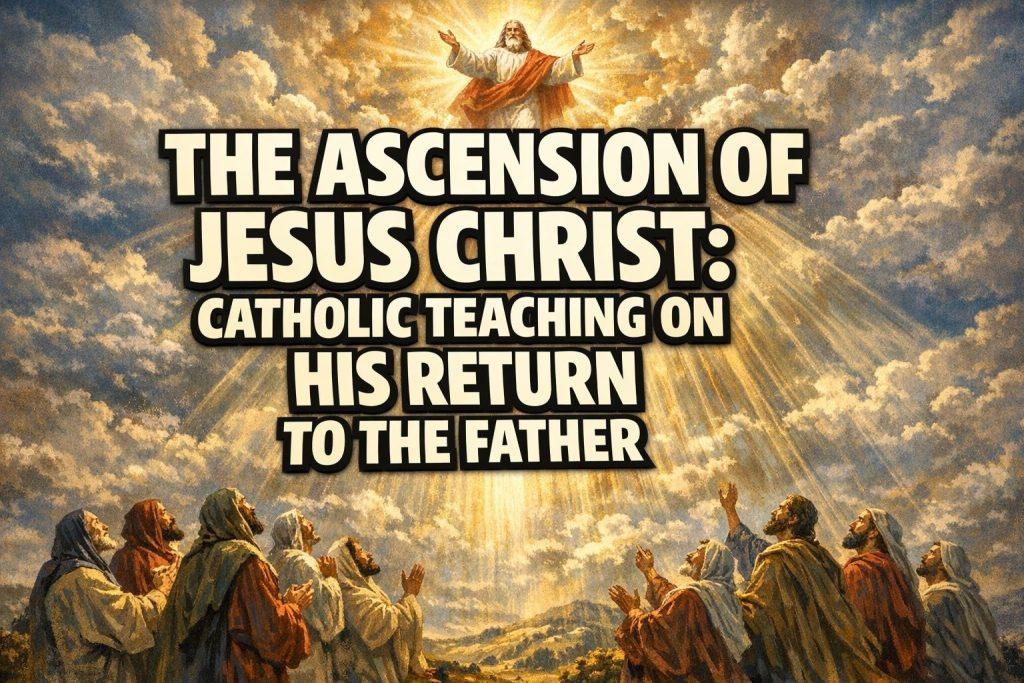
- The Ascension was a real, visible, and bodily event in which the risen Jesus was taken up into heaven forty days after his resurrection, witnessed by his apostles on the Mount of Olives outside Jerusalem, as recorded in the Acts of the Apostles.
- Catholic teaching holds that the Ascension was not the end of Christ’s involvement with the world but the beginning of a new and universal mode of his presence, no longer limited to one body in one place but made available to every person in every age through the Holy Spirit and the sacraments.
- The Church teaches that the Son of God permanently retained his glorified human body at the Ascension, meaning the Incarnation was not a temporary arrangement but an eternal reality, with profound implications for the dignity of every human body.
- Christ’s Ascension to the right hand of the Father established his universal lordship over all creation, all history, and all powers, fulfilling the royal prophecy of Psalm 110 and the commission described in the closing verses of Matthew’s Gospel.
- The Ascension is inseparably linked to the sending of the Holy Spirit at Pentecost, since Jesus himself taught that his physical departure was the necessary precondition for the Spirit’s coming to dwell within the whole Church rather than alongside a small group of disciples.
- The Catholic Church celebrates the Ascension as a Holy Day of Obligation forty days after Easter, situating it as one of the principal feasts of the liturgical year and connecting it directly to the novena of prayer that precedes the Feast of Pentecost.
Introduction
The Ascension of Jesus Christ into heaven stands as one of the most theologically consequential events in the entire history of salvation, yet it receives far less sustained attention in Catholic catechesis and preaching than the Nativity, the Passion, or even the Pentecost that follows it ten days later. The Catholic Church teaches that on the fortieth day after his resurrection, the risen and glorified Christ was lifted up in the sight of his apostles, a cloud took him from their view, and two angels announced that he would return in the same manner as he had departed (Acts 1:9-11). This event is not a mythological way of expressing the disciples’ growing sense of Christ’s absence, nor is it a literary device to signal the conclusion of the resurrection appearances; the Church insists that the Ascension was a real, bodily, historical event in which the glorified humanity of the Son of God permanently entered the fullness of the Father’s glory. The Catechism of the Catholic Church describes the Ascension as “the irreversible entry of Jesus’ humanity into divine glory,” from which the ascended Christ will come again at the end of time (CCC 659). Every article of the Nicene Creed that follows the resurrection, from the session at the Father’s right hand to the promise of the Second Coming and the resurrection of the dead, depends for its coherence on what the Ascension accomplished. Understanding this event in its full theological depth requires attention to its biblical foundations, its place within the theology of salvation, its implications for the nature of Christ’s glorified humanity, its relationship to the mission of the Holy Spirit, and its continuing significance for the prayer, sacramental life, and missionary activity of the Church in every age.
The Ascension occupies a specific and irreplaceable position within the broader sequence of saving events that Catholic theology calls the Paschal Mystery, meaning the entire complex of Christ’s passion, death, resurrection, and glorification through which human beings are redeemed and made capable of sharing in the divine life. While the death and resurrection of Christ accomplish the objective redemption of humanity, the Ascension is the event that formally establishes the risen Christ in his role as the universal Lord and perpetual intercessor, the high priest who has entered the heavenly sanctuary with his own blood to secure an eternal redemption (Hebrews 9:12). The Church Fathers consistently treated the Ascension not as a secondary feast but as the necessary completion of the incarnate Son’s earthly mission, the moment at which his humanity was permanently glorified and his saving work fully presented before the Father. Saint Leo the Great, writing in the fifth century, argued that the Ascension did not diminish Christ’s presence among his disciples but transformed and universalized it, so that what had previously been visible in the Lord passed over into the sacramental life of the Church. The theological precision with which the Church articulates the Ascension developed through the same conciliar process that defined the nature of Christ’s person and natures, and the Councils of Nicaea, Constantinople, and Chalcedon all presupposed the Ascension as the event that completed the trajectory of the Incarnation. Saint Thomas Aquinas, in the Third Part of the “Summa Theologiae,” devoted sustained attention to the Ascension, arguing that it was fitting from multiple theological perspectives: it was fitting for Christ himself as the completion of his exaltation, fitting for the disciples as the preparation for their reception of the Spirit, and fitting for the whole human race as the pledge of their own future glorification. The Catechism situates the Ascension within the Church’s liturgical life as a feast of the highest rank, celebrated forty days after Easter, and connects it directly to the novena of prayer that bridges the Ascension and Pentecost, reminding Catholics that the two events belong to a single unified movement of divine action rather than being separate and disconnected moments in the liturgical calendar.
The Biblical Account and Its Historical Character
The primary narrative account of the Ascension appears at the opening of the Acts of the Apostles, written by the same Luke who had already narrated the event more briefly at the conclusion of his Gospel, and the careful, specific character of Luke’s account reflects his consistent concern for historical credibility throughout his two-volume work. Luke records that Jesus, after commanding the apostles not to depart from Jerusalem but to wait for the promise of the Father, was taken up into heaven while they were watching, and a cloud received him out of their sight (Acts 1:4, 9). The detail of the cloud carries deep theological significance in the biblical tradition, evoking the pillar of cloud that led Israel through the desert, the cloud of divine glory that filled the Temple at its dedication, and the cloud that overshadowed Jesus at the Transfiguration, all of which are manifestations of the divine presence and glory that the Hebrew tradition calls the “Shekinah.” The appearance of the two men in white robes who address the apostles recalls the two figures at the empty tomb in Luke’s resurrection account, and their words establish the connection between the Ascension and the Second Coming that has shaped Christian expectation ever since: the same Jesus who ascended will return in the same manner (Acts 1:10-11). The specificity of place, identified as the Mount of Olives in Luke’s account and as Bethany in his Gospel (Luke 24:50), is consistent with the way Luke handles historical events throughout his narrative, and the convergence of details across the two accounts strengthens rather than undermines their credibility. Saint Paul’s letters, written before the Gospels and Acts reached their final form, consistently presuppose the Ascension as an established fact of the apostolic proclamation, referring to Christ as the one who “is at the right hand of God, who indeed is interceding for us” (Romans 8:34) and describing him as the one who “ascended far above all the heavens, that he might fill all things” (Ephesians 4:10).
The historical character of the Ascension has been contested in modern biblical scholarship by approaches that treat it as a later theological construction rather than a genuine historical event, and the Catholic Church has consistently and firmly rejected these interpretations. Pope Benedict XVI, in his “Jesus of Nazareth: Holy Week,” addressed these revisionist readings directly, arguing that the Ascension accounts in Luke bear the marks of authentic historical memory and that the attempt to dissolve the event into purely symbolic or experiential categories fails to do justice to the texts themselves. The Catechism’s own treatment of the Ascension affirms it as both a genuinely historical event and a mystery of faith that transcends what purely historical methods alone can establish, noting that the resurrection appearances ceased with the Ascension and that this cessation is itself a historically observable fact that requires explanation (CCC 659). The distinction between historical fact and mystery of faith does not mean that the Ascension happened only “spiritually” or “in the disciples’ experience”; it means that the event, while genuinely historical, opens onto a theological reality, namely Christ’s permanent glorification and his universal lordship, that exceeds what historical investigation alone can capture. The forty days of resurrection appearances served, among other purposes, precisely to establish the identity of the ascended one as the same person who had been crucified and buried, so that the Ascension could not be misunderstood as the departure of a different or merely spiritual being but had to be recognized as the glorification of the same embodied person the disciples had known, followed, seen crucified, and encountered risen.
What the Ascension Accomplished for Christ Himself
Catholic theology carefully distinguishes the multiple dimensions of what the Ascension accomplished, beginning with what it meant for the person of Jesus Christ himself as the incarnate Son of God completing the trajectory of the mission he received from the Father. The Ascension was, first and most fundamentally, the definitive exaltation of Christ’s humanity, the permanent and irreversible entry of the human nature he assumed at the Incarnation into the fullness of the divine glory that belongs to him by nature as the eternal Son. The Letter to the Philippians describes this exaltation in one of the most celebrated Christological passages in the New Testament: because Christ “humbled himself by becoming obedient to the point of death, even death on a cross,” God “highly exalted him and bestowed on him the name that is above every name, so that at the name of Jesus every knee should bow, in heaven and on earth and under the earth, and every tongue confess that Jesus Christ is Lord, to the glory of God the Father” (Philippians 2:8-11). The Catechism teaches that this exaltation does not represent a change in the Son’s divine nature, which is eternally and unchangeably divine, but the glorification of his human nature, which through the resurrection and Ascension is permanently raised to the fullness of participation in the divine life (CCC 661). The session at the Father’s right hand, described throughout the New Testament in language drawn from Psalm 110, establishes Christ’s universal dominion over every created power and authority, visible and invisible, and presents his humanity as now permanently the instrument of his divine lordship over all creation.
The Ascension also accomplished the completion of Christ’s priestly work in a specific and important sense that the Letter to the Hebrews develops at length. The entire sacrificial system of the Old Testament, centered on the Levitical priesthood and the annual ritual of Yom Kippur in which the high priest entered the Holy of Holies to offer blood and intercede for Israel, was not abolished by Christ’s death on the cross but fulfilled and surpassed by it. Christ’s death was the sacrifice; his resurrection was the divine acceptance of that sacrifice; and his Ascension was the presentation of that sacrifice before the Father in the heavenly sanctuary that the earthly Temple had only foreshadowed. Hebrews describes Christ as entering “into heaven itself, now to appear in the presence of God on our behalf,” carrying not the blood of bulls and goats but the permanent testimony of his own self-offering (Hebrews 9:24). The Catechism teaches that Christ’s priestly intercession before the Father is not a past event but a present and continuous reality: the ascended Christ permanently presents his sacrifice and intercedes for those who approach God through him (CCC 662). This means that every prayer a Catholic offers, every Mass celebrated, every act of forgiveness dispensed in confession, reaches the Father through the mediation of the ascended high priest who stands permanently in the divine presence on humanity’s behalf. The practical implication for Catholic prayer is significant: prayer is not a matter of a finite human voice reaching an infinitely distant God across an unbridgeable gap; it is a participation in the intercession that the ascended Christ is already and perpetually making at the Father’s right hand.
The Permanent Humanity of the Ascended Christ
One of the most theologically significant and practically consequential aspects of the Ascension is the truth that the Son of God ascended with his glorified human body, permanently retaining the human nature he assumed at the Incarnation. This truth is not always given the prominence it deserves in catechetical presentations of the Ascension, but the Catholic Church holds it as a matter of defined faith with far-reaching implications. The Catechism is explicit: Christ’s body was glorified at the resurrection and entered into the divine glory at the Ascension, but it remained a genuine human body, real and not merely apparent, continuous with the body born of Mary and crucified on Calvary (CCC 659). The wounds of the crucifixion, which the risen Christ showed to Thomas as proof of his identity (John 20:27), are traditionally held in Catholic theology to remain on the glorified body of the ascended Christ as marks of honor rather than of suffering, permanent testimonies to the sacrifice through which humanity was redeemed. Saint Thomas Aquinas argued that it was fitting for Christ to retain these wounds in his glorified body because they serve as the perpetual sign of his victory over sin and death and as the concrete ground of his intercession before the Father. The permanent assumption of human nature by the Son of God, sealed and confirmed by the Ascension, means that there is now and forever a human being at the center of the divine life, a human intellect, a human will, and a human body permanently united to the second Person of the Holy Trinity in the presence of the Father.
The implications of this truth for Catholic anthropology, meaning the Catholic understanding of what a human being is and what human beings are destined for, are enormous and deserve far more attention than they typically receive. If the Son of God permanently retains a human body in the divine glory, then the human body is not a temporary vehicle for the soul that will eventually be discarded in favor of a purely spiritual existence; it is a permanent dimension of human personhood that God himself has chosen to inhabit forever. This grounds the Catholic doctrine of the resurrection of the body, defined in the Nicene Creed, on something more than a divine decree about the afterlife: it grounds it on the fact that the ascended Christ himself is already living the embodied resurrection life that God promises to every human person. The Catechism teaches that Christ’s glorious resurrection and Ascension are the guarantee and the pattern of the general resurrection that awaits all the faithful at the end of time (CCC 655). The glorified body of the ascended Christ is not a curiosity but a promise: it is what God intends to do with every human body that has ever lived, the first fruits of a harvest that will ultimately include every person who has ever drawn breath. Pope John Paul II’s extended reflection on the Theology of the Body, developed across a series of Wednesday audiences and grounded in the Incarnation and the permanent assumption of human nature by the Son of God, drew out many of these implications for the Catholic understanding of human sexuality, marriage, and the dignity of the body, showing how the entire edifice of Catholic teaching on embodied human existence rests ultimately on this Incarnational and Ascension foundation.
The Ascension and the Sending of the Holy Spirit
The relationship between the Ascension and the sending of the Holy Spirit at Pentecost is not a coincidence of the liturgical calendar but a theological necessity that Jesus himself explained to his disciples, and understanding this relationship transforms how a Catholic understands both events. At the Last Supper, Jesus told his disciples with explicit directness: “It is to your advantage that I go away, for if I do not go away, the Advocate will not come to you; but if I go, I will send him to you” (John 16:7). This statement is one of the most counterintuitive in the entire New Testament, since the disciples clearly regarded the prospect of Jesus’s departure as a loss rather than a gain, and Jesus himself acknowledged their grief while insisting that his framing of the situation was correct. The logic behind the statement requires understanding what the physical presence of Jesus during his earthly ministry necessarily involved: presence in one place at one time, available to a small group of disciples in a specific geographical region during a specific historical period. The Spirit whom Jesus would send would not be subject to any such limitations; the Spirit would dwell not alongside believers but within them, would be present simultaneously to every member of the Church in every place and every age, and would guide the whole body of Christ through all of history rather than a handful of Galilean fishermen through three years of ministry. The Catechism describes the Holy Spirit as “the interior Master of Christian life,” the one who leads believers into all truth, distributes gifts across the whole Body of Christ, and animates the Church’s mission in every generation (CCC 687). None of this could occur while Christ remained physically present in one location, because the disciples’ natural dependence on his visible presence would have prevented the development of the interior, Spirit-guided life of faith that the Church’s long mission through history would require.
The connection between the Ascension and Pentecost is built into the structure of the Catholic liturgical year in a way that invites believers to experience the two events as a single movement of divine action rather than two separate occasions. The forty days from Easter to the Ascension are followed by ten days of prayer, and the nine days between the Feast of the Ascension and the Feast of Pentecost constitute the original novena, meaning a period of nine days of prayer, from which all subsequent novenas in the Catholic tradition derive their shape and rationale. Luke records that after the Ascension, the disciples “returned to Jerusalem with great joy, and were continually in the temple blessing God” (Luke 24:52-53), and Acts adds that they “devoted themselves to prayer, together with the women and Mary the mother of Jesus, and his brothers” (Acts 1:14). The disciples’ posture during those ten days, gathered in prayer with Mary, attentive and expectant rather than anxious or despairing, provides a model for the kind of interior disposition that the Ascension is meant to cultivate in the Church: not a nostalgic longing for the visible Jesus who has departed, but a forward-looking, receptive openness to the Spirit he promised to send. The fruit of those ten days of prayer was the Pentecost event described in Acts chapter two, when the Spirit descended on each of the gathered disciples and the Church’s public mission to all nations was inaugurated. The Ascension is therefore not a moment of loss but a moment of transition: the transition from the mode of salvation accomplished in one place and time to the mode of salvation made available to all places and all times through the Spirit and the sacraments of the Church.
The Session at the Right Hand and Universal Lordship
The phrase “seated at the right hand of the Father,” which Catholics recite every Sunday in the Nicene Creed, carries a specific theological meaning that is far richer than its familiarity might suggest, and unpacking that meaning illuminates one of the most important dimensions of what the Ascension accomplished. The image of sitting at the right hand of a king is drawn from the royal court culture of the ancient Near East, where the position at the monarch’s right hand designated the one who shared in the king’s authority, acted as his regent, and held the highest position of honor in the royal household. Psalm 110, the most frequently quoted Old Testament text in the entire New Testament, presents this image in explicitly theological terms: “The Lord says to my Lord: Sit at my right hand, until I make your enemies your footstool” (Psalm 110:1). Jesus himself cited this Psalm in debate with the Pharisees (Matthew 22:44), Peter cited it at Pentecost to explain the meaning of the resurrection and Ascension (Acts 2:34-35), Paul cited it in Romans (Romans 8:34) and in his letter to the Corinthians (1 Corinthians 15:25), and the author of Hebrews returns to it repeatedly as the scriptural anchor of his entire Christological argument. The Catechism teaches that Christ’s session at the Father’s right hand signifies his inauguration of the messianic kingdom, the beginning of his universal lordship over all creation, all history, and all powers, and that this lordship is the source from which all grace flows to the Church (CCC 664). The risen and ascended Christ is therefore not a passive figure awaiting the end of history; he actively governs creation, guides his Church through the Spirit, and draws all things toward their final fulfillment in him.
The universality of Christ’s lordship established at the Ascension is the theological ground of the Church’s missionary mandate, and this connection is explicit in Matthew’s account of the commissioning that preceded the Ascension. Jesus opened his Great Commission with the declaration, “All authority in heaven and on earth has been given to me,” and he immediately followed this declaration with the command to “go therefore and make disciples of all nations” (Matthew 28:18-19). The “therefore” is theologically precise: because the ascended Christ holds universal authority, the mission of the Church extends to every person in every nation, since every person falls within the scope of his lordship. The authority behind the Church’s preaching, her sacramental ministry, and her moral teaching is therefore not the authority of an ancient institution or a venerable tradition; it is the authority of the one to whom all authority in heaven and on earth belongs. Saint Paul develops the cosmic scope of Christ’s lordship in his letter to the Colossians, describing the ascended Christ as the one in whom “all the fullness of God was pleased to dwell,” through whom God reconciles “all things, whether on earth or in heaven, making peace by the blood of his cross” (Colossians 1:19-20). The Second Vatican Council, in the Dogmatic Constitution “Lumen Gentium,” situated the Church’s identity and mission within this framework of Christ’s universal lordship, describing the Church as the instrument through which the ascended Christ continues to extend his kingdom and communicate his saving grace to the whole human family.
The Ascension and the Church’s Sacramental Life
The connection between the Ascension and the sacramental life of the Catholic Church is one of the most practically important dimensions of the feast, and it was articulated with characteristic clarity by Saint Leo the Great in his sermons on the Ascension, in which he wrote that what was visible in our Redeemer has passed over into the sacraments. This patristic insight captures something essential about how the ascended Christ remains genuinely present and active in the world: not through a continued physical presence in one place, but through the sacramental actions of the Church, in which his saving power continues to touch individual souls with the same transforming effect that his physical touch had during his earthly ministry. The Catechism teaches that the sacraments are “the masterworks of God” in the new and everlasting covenant, instituted by Christ and entrusted to the Church as the continuation of his saving activity in every generation (CCC 1116). Each sacrament extends a specific dimension of Christ’s earthly ministry through time and space: baptism extends his death and resurrection, confession extends his forgiveness of sins, the Eucharist extends his self-giving at the Last Supper and on the cross, the anointing of the sick extends his compassionate healing of the suffering, and holy orders extends his apostolic mission and priestly ministry through the succession of ordained ministers. All of this sacramental activity flows from and depends upon the Ascension, because it is the ascended Christ, present through the Spirit and acting through the Church’s ordained ministers, who is the true minister of every sacrament.
The Eucharist deserves particular attention in relation to the Ascension, since the Catholic doctrine of the Real Presence, the teaching that the risen and glorified Christ is truly, really, and substantially present under the appearances of bread and wine after the consecration, is the most direct and intimate extension of the Ascension’s logic into the sacramental life of the Church. The ascended Christ, who entered the fullness of divine glory with his glorified body, is the same Christ who gives himself in the Eucharist, so that the Eucharistic presence is not a lesser or secondary form of Christ’s presence but a genuine, real, and substantial encounter with the one who sits at the Father’s right hand. The Catechism affirms that the mode of Christ’s Eucharistic presence is unique and surpasses all other modes of his presence in the Church (CCC 1374), and that in receiving the Eucharist, the faithful receive not a symbol of the ascended Christ but the ascended Christ himself, body and blood, soul and divinity, under the sacramental signs of bread and wine. Saint Cyril of Alexandria, one of the most important Christological theologians of the patristic era, insisted that the Eucharistic body of Christ is the life-giving flesh of the Word of God made flesh, inseparable from the divine power of the one who ascended and who now gives himself to believers through the sacramental action of the Church. The annual celebration of Corpus Christi, the feast of the Body and Blood of Christ that follows the liturgical season of the Ascension and Pentecost, invites the Church to contemplate this connection between the glorified body of the ascended Lord and his Eucharistic presence as the two modes of the same divine condescension through which God makes himself available to every human person in every age.
The Ascension and the Theology of Prayer
The Ascension transforms the Catholic understanding of prayer in ways that are both theologically precise and practically significant, and the Letter to the Hebrews draws the connection most directly. Having established that Jesus is “the great high priest who has passed through the heavens,” the author immediately draws out the implication for prayer: “Let us then with confidence draw near to the throne of grace, that we may receive mercy and find grace to help in time of need” (Hebrews 4:14, 16). The word “confidence” is not a psychological encouragement; it is a theological statement grounded in the specific reality of who is now interceding at the Father’s right hand. Every Catholic who prays approaches the Father through the mediation of an ascended human being who has genuinely experienced hunger, exhaustion, rejection, temptation, grief, suffering, and death in a real human body, and who presents that human experience as the ground of his intercession. This gives Catholic prayer a specificity and a confidence that no abstract conception of God as a distant divine force could support, because the mediator is not an impersonal cosmic principle but a person who knows human experience from the inside. The traditional Catholic formula of ending prayers “through Christ our Lord” or “through Jesus Christ, who lives and reigns with you and the Holy Spirit” is not a liturgical convention to be recited without thought; it expresses the Church’s understanding that Christ’s heavenly intercession is the channel through which all prayer reaches the Father, and that praying “through Christ” means aligning one’s own prayer with the perpetual intercession he is already making on behalf of every soul.
Saint Paul’s instruction to “pray without ceasing” (1 Thessalonians 5:17) makes its deepest sense in light of the Ascension: if the ascended Christ is permanently and continuously interceding for believers at the Father’s right hand, then the most natural response of faith is to align one’s own prayer with that perpetual intercession rather than treating prayer as an occasional effort to initiate contact with a God who might otherwise be inattentive. The Catholic tradition of contemplative prayer, developed and articulated most profoundly by Saint John of the Cross and Saint Teresa of Avila and summarized in the Catechism as an intimate sharing in Christ’s own prayer (CCC 2709), draws its deepest rationale from the Ascension: it is a deliberate entering into the prayer that the ascended Christ is already offering, a resting in the intercession that requires no human technique to initiate because it is already and always in progress. The practice of adoration of the Blessed Sacrament, in which Catholics spend time in silent prayer before the Eucharist reserved in the tabernacle or exposed in a monstrance, is perhaps the most direct expression of Ascension faith available outside of Mass itself: it is an act of worship directed at the genuinely present ascended Christ, offered in the mode of sacramental encounter that his Ascension made universally possible. For Catholics who experience prayer as difficult, dry, or apparently unanswered, recovering the Ascension theology of Christ’s permanent intercession is often more practically useful than any technique or method, because it relocates the fundamental act of prayer from a human effort to reach a distant God to a human participation in what the ascended Christ is already doing on their behalf.
The Ascension’s Relationship to the Second Coming
The Ascension and the Second Coming of Christ form a pair of events that bracket the entire present age of the Church, and the Catholic understanding of Christian life cannot be fully grasped without seeing how these two events define the time in which the Church exists and the posture she is called to maintain. The angels at the Ascension made the connection explicit: “This Jesus, who was taken up from you into heaven, will come in the same way as you saw him go into heaven” (Acts 1:11). The same embodied, glorified, historically identifiable person who ascended will return, and his return will be visible, public, and definitive in a way that corresponds to the visible, public, and historically specific character of his departure. The Catechism situates the entire present age of the Church between these two events, describing this as the “time of waiting and watching,” during which the Church lives in the hope of the Lord’s return while being sustained by the sacramental and Spirit-mediated presence of Christ (CCC 672). This eschatological awareness, meaning awareness that history has a definite end toward which the ascended Christ is actively directing all things, is not meant to generate anxiety or preoccupation with speculative end-times scenarios; the Catechism explicitly notes that Jesus himself refused to reveal the hour of his return and that the appropriate posture for the Church is faithful discipleship rather than idle curiosity about the timing of the end (CCC 673). What eschatological awareness does generate is a seriousness about the present moment, a recognition that human life is not an indefinitely extended sequence of opportunities but a specific, graced period during which the invitation to conversion and discipleship is open.
The parable of the servants entrusted with talents during their master’s absence, situated in Matthew’s Gospel immediately after the discourse on the Second Coming, presents the practical shape of the life the Church is called to live between Ascension and Parousia, meaning the Second Coming (Matthew 25:14-30). The servants who invested their master’s money and produced returns are commended not for dramatic heroism but for faithful, active engagement with the mission entrusted to them; the servant who buried his talent is condemned precisely for using the master’s absence as an excuse for disengagement and passivity. The Church in the present age is in exactly the position of those servants: entrusted with the Gospel, the sacraments, the apostolic tradition, and the commission to make disciples of all nations, she is called to be actively faithful in carrying out that mission during the time of the Lord’s physical absence, with the certain knowledge that he will return to bring all things to their completion and to render an account of what was done with what was entrusted. The Catechism teaches that the Church’s mission in this in-between time is not merely to maintain herself but to extend the kingdom of God, proclaiming the Gospel to every person and culture, celebrating the sacraments that make the saving work of Christ available to every soul, and working for justice and peace as visible signs of the kingdom that is coming (CCC 670). The Ascension is therefore not a moment of suspension or waiting in the passive sense; it is the moment that launched the most sustained and far-reaching mission in the history of the world, a mission that continues with undiminished urgency until the one who ascended returns in glory.
The Ascension in the Church’s Liturgical and Devotional Life
The Church’s liturgical celebration of the Ascension, and the devotional practices associated with it, provide Catholics with concrete and accessible means of entering more deeply into the theological reality of the event and allowing it to form their faith in practical ways. The Feast of the Ascension is celebrated forty days after Easter Sunday, placing it always on a Thursday in the traditional calendar, and is observed as a Holy Day of Obligation in many dioceses, reflecting the Church’s judgment that this feast belongs to the core of Catholic faith and not merely to the periphery of liturgical observance. In some episcopal conferences, the feast is transferred to the following Sunday to facilitate wider participation, but the theological content of the celebration remains the same regardless of the calendar arrangement. The Mass of the Ascension draws on a particularly rich set of Scripture readings, combining the narrative account from Acts with the Christological theology of Paul’s letter to the Ephesians and the commissioning accounts from the Gospels, and together these readings present a comprehensive theological picture of the event and its significance that repays careful attention. The Preface of the Ascension Mass, proclaimed by the priest during the Eucharistic Prayer, articulates the central theological claim of the feast with economy and precision: Christ ascended not to abandon humanity but to be “our hope,” since where he has gone as our head and Savior, we his members are confident of following. The liturgical texts of the Ascension consistently connect the departure of Christ with the destiny of the faithful, presenting the feast not as a commemoration of something that happened to Jesus alone but as a promise and a pledge addressed to every person who is united to him through baptism and faith.
The novena of prayer that bridges the Ascension and Pentecost, the nine days during which the disciples gathered with Mary in the upper room awaiting the promised Spirit, is the original novena from which every subsequent novena in the Catholic tradition derives its form and rationale. The Catechism presents Mary’s presence at this gathering as deeply significant, describing her as the one in whom the mystery of the Incarnation was most perfectly realized and as the model of the Church’s receptive, prayerful openness to the action of the Spirit (CCC 726). Catholics who observe this annual novena of prayer, joining themselves spiritually to the apostolic community gathered around Mary in the upper room, find that the Ascension and Pentecost come alive as genuinely connected moments in a single drama rather than two separate liturgical occasions to be observed in sequence without internal connection. The traditional Catholic practice of including the Ascension mysteries in the Glorious Mysteries of the Rosary, alongside the resurrection, the descent of the Spirit, the Assumption of Mary, and the Coronation of Mary in heaven, situates the Ascension within a contemplative sequence that moves from the resurrection through the glorification of Christ to the glorification of his mother and the final fulfillment of all things. Saint Louis de Montfort, in his “True Devotion to Mary,” described Mary as the path through which the Spirit forms Christ in souls, and her presence at the Ascension and the subsequent novena connects her maternal intercession directly to the event through which the Spirit’s universal mission was inaugurated. The regular, attentive celebration of the Ascension within the rhythm of the Catholic liturgical year is therefore not merely a matter of liturgical observance; it is one of the principal means by which the Church ensures that this decisive event in the history of salvation continues to form, orient, and sustain the faith of her members across every generation.
See Also
- The Resurrection of Jesus Christ: Historical Event and the Foundation of Catholic Faith
- The Holy Spirit and the Gifts of God in Catholic Teaching
- The Paschal Mystery: The Death and Resurrection of Christ as the Center of Catholic Faith
- Pentecost: The Descent of the Holy Spirit and the Birth of the Church
- The Second Coming of Christ: Catholic Teaching on the End of History
- The Eucharist: The Real Presence of Christ in Catholic Teaching
- The Resurrection of the Body: Catholic Teaching on the Last Things
What the Ascension Means for the Life of Every Catholic Today
The doctrine of the Ascension is not a piece of historical information to be acknowledged once and set aside; it is a living theological reality that speaks directly to the most persistent questions that challenge Catholic faith in daily life and that, when genuinely understood, reshapes the way a person prays, suffers, hopes, and acts in the world. The most immediate practical consequence of the Ascension is the truth that the ascended Christ is at this moment actively interceding for every person who calls upon his name, presenting before the Father the infinite merit of his sacrifice and the specific needs of every soul who turns to him in prayer. A Catholic who understands this truth does not experience prayer as an effort to attract the attention of an indifferent or distant God; they experience it as a participation in an intercession that is already in progress, already accepted, already effective, because it is the intercession of the Son of God himself offered in the glorified humanity he permanently retains. The connection between the Ascension and the Eucharist is equally important for daily Catholic life: every Mass celebrated anywhere in the world is a real encounter with the ascended Christ, who gives himself under the appearances of bread and wine in the same glorified body with which he ascended, so that the Catholic who receives communion in genuine faith is receiving the ascended Lord himself rather than a symbol or a memory of him. This means that Sunday Mass is not a weekly commemoration of a past event but a regular, real encounter with the living, reigning, interceding Christ who governs all of creation from his place at the Father’s right hand.
The Ascension also speaks with great directness to Catholics who struggle with the experience of God’s apparent absence, the seasons of spiritual dryness and desolation that the Catholic mystical tradition acknowledges as genuine and common features of the interior life. The disciples themselves experienced the Ascension as loss before they understood it as gain, and the angels’ gentle rebuke, asking why they stood staring at the sky, is addressed by implication to every believer who mourns the absence of the felt consolations of an earlier season of faith. The Catechism’s description of the present age as the “time of waiting and watching” acknowledges that the mode of Christ’s presence in this age is genuinely different from the visibility of his earthly ministry, mediated through sacrament, Scripture, and the interior action of the Spirit rather than through the direct physical encounter that the first disciples enjoyed (CCC 672). This difference is real, and the Catholic tradition neither denies it nor tries to paper over it with easy reassurance; instead, the tradition situates it within the framework of the Ascension’s purpose, recognizing that the mediated, Spirit-guided, sacramental mode of Christ’s presence is the form appropriate to a Church living in mission between two definitive moments of visible divine action. Catholics who deepen their understanding of the Ascension find in it a resource for perseverance that sustains faith through difficulty far more reliably than emotional consolation, because it grounds hope not in felt experience but in the objective reality of who is ascended, what he accomplished, what he now does at the Father’s right hand, and what he has promised to those who remain faithful to him until he comes again.
About This Article
CatholicWiki is an unofficial, independently maintained Catholic encyclopedia. It is not affiliated with, endorsed by, or representative of the Holy See, the Vatican, any diocese, any Catholic religious order, or any official body of the Catholic Church. While every effort is made to ensure that all content faithfully reflects Catholic teaching as expressed in Sacred Scripture, Sacred Tradition, the Magisterium, and other authoritative Catholic sources, readers are encouraged to consult official Church documents, their local pastor, or a qualified theologian for matters of personal faith and practice. CatholicWiki is committed to accuracy, fidelity, and continuous improvement. If you believe any content on this page contains an error, please consider contributing a correction in the spirit of truth and charity.