
Quick Insights
- The Holy Spirit is the third Person of the Holy Trinity, fully and equally God with the Father and the Son, not a force, an influence, or a created intermediary, but a distinct divine Person who possesses the complete divine nature.
- Catholic teaching holds that the Holy Spirit proceeds eternally from the Father and the Son, a truth expressed in the Nicene Creed by the Latin word “Filioque,” meaning “and from the Son,” which the Western Church added to clarify the Spirit’s eternal origin within the inner life of God.
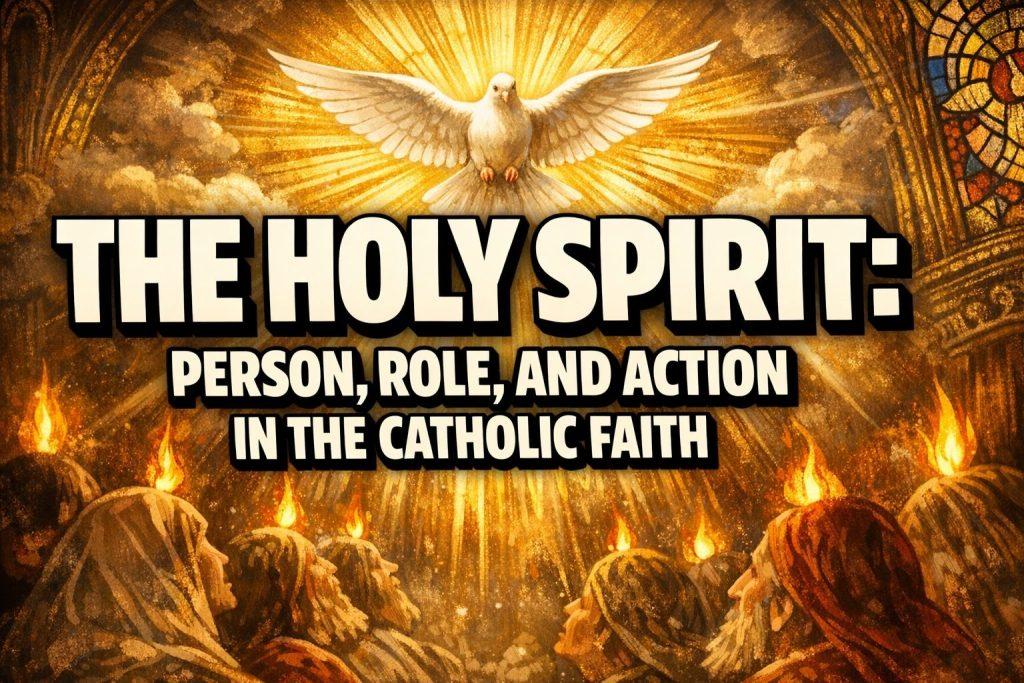
- The Holy Spirit descended visibly upon the apostles at Pentecost in the form of tongues of fire and a rushing wind, inaugurating the Church’s public mission and permanently indwelling her as the principle of her unity, holiness, and continued life.
- The seven gifts of the Holy Spirit, wisdom, understanding, counsel, fortitude, knowledge, piety, and fear of the Lord, are received in baptism and strengthened in confirmation, equipping every Catholic for a life of virtue and faithful witness.
- The Holy Spirit is the primary author of Sacred Scripture, inspiring the human authors to write what God intended without overriding their individual personalities, literary styles, or historical circumstances.
- Catholic teaching identifies the twelve fruits of the Holy Spirit, which include charity, joy, peace, patience, kindness, goodness, generosity, gentleness, faithfulness, modesty, self-control, and chastity, as the visible signs of the Spirit’s active presence and work in a soul.
Introduction
The Holy Spirit is, in the Catholic understanding of God, the third Person of the Holy Trinity, co-equal and co-eternal with the Father and the Son, and the one through whom the saving work accomplished by the Father and the Son in history is applied to individual souls in every age. Catholic faith in the Holy Spirit is not a supplementary or peripheral element of Christian doctrine; it is as central and non-negotiable as faith in God the Father and faith in Jesus Christ, and the Catechism of the Catholic Church places the treatment of the Holy Spirit at the very heart of its presentation of the articles of the Creed (CCC 683). The Nicene Creed, recited by Catholics every Sunday at Mass, confesses the Holy Spirit as “the Lord, the giver of life, who proceeds from the Father and the Son, who with the Father and the Son is adored and glorified, who has spoken through the prophets,” and every phrase of that concise confession contains a depth of theological meaning that the Catholic tradition has been unpacking for two thousand years. Despite the centrality of the Holy Spirit in Catholic faith, many Catholics find the third Person of the Trinity the most difficult to relate to personally, partly because the Spirit does not possess a human face or a biographical narrative in the way that Jesus does, and partly because the Spirit’s mode of action tends to be interior, hidden, and gradual rather than visible, dramatic, and historically datable. The result is that many Catholics know the standard list of the Spirit’s gifts and fruits without having a clear sense of who the Holy Spirit actually is as a divine Person, how the Spirit acts in their daily lives, and what it means to live in a genuine relationship with the Spirit rather than simply acknowledging the Spirit’s existence as an article of faith. This article aims to address that deficit by presenting the full Catholic teaching on the Holy Spirit with the clarity, depth, and accuracy that the subject deserves.
The history of the Church’s theological reflection on the Holy Spirit follows a development similar to the development of Trinitarian and Christological doctrine, moving from the rich but implicit testimony of Scripture through a period of patristic reflection and controversy to the precise conciliar definitions that remain the Church’s authoritative standard. The Council of Nicaea in 325 AD, convened primarily to address the Arian denial of the Son’s full divinity, confined its treatment of the Holy Spirit to a brief acknowledgment without developing a detailed pneumatology, meaning a systematic theology of the Spirit’s nature and role. The subsequent decades produced a serious theological controversy about the Spirit’s divine status, with a group known as the Pneumatomachians, meaning “fighters against the Spirit,” led by figures such as Macedonius of Constantinople, accepting the full divinity of the Son as defined at Nicaea while refusing to extend the same confession to the Holy Spirit. The theologians who opposed this position, especially Basil the Great, Gregory of Nazianzus, and Gregory of Nyssa, the three Cappadocian Fathers, produced a sustained and brilliant theological defense of the Spirit’s full divinity, drawing on both Scripture and the Church’s liturgical and sacramental tradition. Gregory of Nazianzus observed that divine revelation had proceeded progressively: the Old Testament proclaimed the Father clearly while intimating the Son, the New Testament proclaimed the Son clearly while intimating the Spirit, and the Spirit’s full divinity was becoming increasingly clear as the Church reflected on her own experience of his action. The First Council of Constantinople in 381 AD responded to the Pneumatomachian controversy by expanding the Nicene Creed with the full confession of the Holy Spirit as “Lord and giver of life,” establishing the language that the Church uses to this day. The subsequent controversy over the Filioque, meaning the Western addition to the Creed stating that the Spirit proceeds “from the Father and the Son” rather than “from the Father” alone, became one of the contributing factors to the Great Schism of 1054 AD between the Eastern and Western Churches, and it remains a significant point of discussion in ecumenical dialogue. Saint Augustine’s extended reflection on the Holy Spirit in his “De Trinitate,” where he described the Spirit as the mutual love of the Father and the Son made subsistent as a divine Person, provided the Western theological tradition with its most influential framework for understanding the Spirit’s identity and role within the inner life of God.
The Identity of the Holy Spirit as a Divine Person
The most fundamental thing Catholic theology insists upon regarding the Holy Spirit is that the Spirit is a Person, not a power, not a force, not an influence, not an impersonal divine energy, but a genuine, distinct divine Person who possesses the complete divine nature and who acts with intelligence, will, and freedom. This insistence is not a technical philosophical nicety; it determines everything else the Church teaches about how the Spirit acts, how the Spirit can be related to personally, and what it means for the Spirit to dwell within the soul of a baptized Christian. The Gospel of John presents the Holy Spirit consistently in personal terms, using the masculine pronoun to refer to the Spirit even though the Greek word “pneuma” is grammatically neuter, a deliberate choice by the evangelist to communicate the Spirit’s personal character rather than allowing the grammar to suggest impersonality. Jesus describes the Spirit in John’s farewell discourses as “the Advocate,” the Paraclete, one who “will teach you all things and bring to your remembrance all that I have said to you” (John 14:26), using language that attributes to the Spirit the personal activities of teaching, reminding, guiding, and advocating that only a person with intellect and will can perform. The Acts of the Apostles presents the Spirit as a personal agent throughout its narrative: the Spirit speaks to Philip (Acts 8:29), forbids Paul and Silas to speak the word in Asia (Acts 16:6), and tells the community at Antioch to set apart Barnabas and Saul for the work to which he has called them (Acts 13:2), all of which are the actions of a personal agent directing the mission of the Church with intelligence and purpose. The Catechism affirms explicitly that the Holy Spirit is not an anonymous force but a Person, the third Person of the Blessed Trinity, who is genuinely other than the Father and the Son while sharing the one divine nature completely and without division (CCC 689).
The theological tradition offers several important ways of understanding what makes the Holy Spirit distinctively the Holy Spirit within the inner life of the Trinity, as distinct from what is common to all three Persons, and the most influential of these is the account developed by Saint Augustine and systematized by Saint Thomas Aquinas. Augustine observed that within the human soul, created as an image of the Trinity, the capacity for love corresponds most naturally to the Holy Spirit, just as the capacity for self-knowledge corresponds to the Son as the Father’s eternal Word. He proposed that the Holy Spirit is the eternal love of the Father and the Son for each other, the mutual gift that each gives to the other, subsistent in the divine life as a Person precisely because the love shared between the Father and the Son is itself infinite and divine and therefore personal rather than merely emotional or relational. Thomas Aquinas developed this Augustinian insight with greater philosophical precision, describing the Holy Spirit as proceeding from the Father and the Son not by way of intellect, as the Son proceeds as the eternal Word, but by way of will and love, so that the Spirit is the eternal love of God, God’s own self-gift made personal within the divine life. This framework, while not a complete explanation of the mystery, provides a way of understanding why the New Testament so consistently associates the Holy Spirit with love, joy, peace, and the fruit of charity: these are not arbitrary associations but reflections of the Spirit’s deepest identity as the personification of the divine love that flows eternally between the Father and the Son. The Catechism notes that the names and titles given to the Holy Spirit in Scripture, Advocate, Spirit of Truth, Spirit of holiness, Spirit of promise, Spirit of adoption, Spirit of Christ, Spirit of the Lord, Spirit of God, and others, each illuminate a different facet of the one Spirit’s inexhaustible personal richness without exhausting his identity (CCC 692).
The Holy Spirit in the Old Testament
While the full revelation of the Holy Spirit as the third Person of the Trinity belongs to the New Testament, the Old Testament contains a rich witness to the Spirit’s activity in creation, in the history of Israel, and in the prophetic tradition, and Catholic theology reads this witness as a genuine, if partial, anticipation of the fuller revelation to come. The very first verses of Genesis present the Spirit of God, the divine “ruah,” a Hebrew word meaning breath or wind, as hovering over the waters of the formless void before the creative acts of God begin (Genesis 1:2), establishing from the outset of Scripture the Spirit’s involvement in the work of creation and the Spirit’s role as the one who brings order, life, and beauty out of chaos and nothingness. The Book of Job presents God’s Spirit as the direct source of human life itself: “The Spirit of God has made me, and the breath of the Almighty gives me life” (Job 33:4), connecting the Spirit’s creative activity to the most intimate and essential dimension of human existence. Throughout the historical books of the Old Testament, the Spirit comes upon specific individuals to equip them for specific missions: the judges receive the Spirit to lead Israel in battle, craftsmen receive the Spirit to build the Tabernacle with wisdom and skill (Exodus 31:3), and the kings of Israel receive the Spirit at their anointing, most notably Saul, whose rejection of God is described in terms of the Spirit departing from him, and David, whose great penitential prayer in Psalm 51 includes the anguished petition, “Cast me not away from your presence, and take not your Holy Spirit from me” (Psalm 51:11). The prophetic tradition presents some of the richest Old Testament pneumatology, meaning teaching about the Spirit, with Isaiah’s description of the Servant of the Lord as one upon whom the Lord has put his Spirit (Isaiah 42:1) and his prophecy of a figure upon whom “the Spirit of the Lord shall rest, the spirit of wisdom and understanding, the spirit of counsel and might, the spirit of knowledge and the fear of the Lord” (Isaiah 11:2), which the Catholic tradition recognizes as pointing forward to Christ and as the scriptural foundation for the seven gifts of the Holy Spirit.
The most significant Old Testament anticipation of the New Testament’s pneumatology is the series of prophetic promises regarding a future outpouring of the Spirit upon all of God’s people rather than upon selected individuals alone. The prophet Joel records the divine promise, “I will pour out my spirit on all flesh; your sons and your daughters shall prophesy, your old men shall dream dreams, and your young men shall see visions” (Joel 2:28), and Peter cited this text explicitly at Pentecost to interpret what was happening as the fulfillment of Joel’s prophecy (Acts 2:17). The prophet Ezekiel received the promise of a new covenant in terms of interior transformation through the Spirit: “I will give you a new heart, and a new spirit I will put within you. And I will remove the heart of stone from your flesh and give you a heart of flesh. And I will put my Spirit within you, and cause you to walk in my statutes” (Ezekiel 36:26-27). This promise represents a decisive advance in the Old Testament’s understanding of the Spirit: the Spirit will not merely come upon certain persons for specific tasks but will dwell within every member of the renewed people of God, transforming them from the inside and making possible an obedience and a holiness that external law alone could never produce. The Catholic Church reads these prophetic promises as pointing directly to the Pentecost event and to the sacraments of initiation through which every baptized believer receives the indwelling of the Holy Spirit, understanding the entire New Testament dispensation as the age of the Spirit in which Joel’s and Ezekiel’s promises are being fulfilled in the life of the Church and in the souls of believers. This continuity between Old and New Testament pneumatology reflects the Catholic conviction that the same Spirit who hovered over the waters of creation, spoke through the prophets, and promised a future outpouring upon all flesh is the same Spirit who descended at Pentecost and who continues to act in the Church and the world today.
The Holy Spirit in the Life and Ministry of Jesus
The connection between the Holy Spirit and the person and mission of Jesus Christ is one of the most densely woven themes in the entire New Testament, and understanding it is essential for grasping what the Catholic Church means when she speaks of the Spirit as the one who makes the saving work of Christ available in every age. The Spirit’s involvement in the life of Jesus begins before his birth: Luke records that the angel Gabriel told Mary that “the Holy Spirit will come upon you, and the power of the Most High will overshadow you; therefore the child to be born will be called holy, the Son of God” (Luke 1:35), establishing the Incarnation itself as a pneumatological event, meaning an event accomplished through the action of the Holy Spirit. The Baptism of Jesus in the Jordan River is the scene in which the Spirit’s relationship to Jesus is most dramatically and publicly revealed: “When Jesus was baptized, immediately he went up from the water, and behold, the heavens were opened to him, and he saw the Spirit of God descending like a dove and coming to rest on him; and behold, a voice from heaven said, ‘This is my beloved Son, with whom I am well pleased’” (Matthew 3:16-17). This scene presents the entire Trinity in a single moment of history, establishing the Trinitarian structure of salvation in a form that is vivid, concrete, and historically grounded: the Father speaks from heaven, the Son stands in the water, and the Spirit descends visibly as a dove. The descent of the Spirit upon Jesus at his baptism does not imply that Jesus lacked the Spirit before this moment; rather, in Catholic theological understanding, it signifies the formal inauguration of his public messianic mission, the moment at which he is publicly revealed as the Anointed One, the Messiah, the Christ, whose very name means “the anointed,” because he has been anointed with the Spirit for his saving mission.
Jesus’s entire public ministry unfolds under the Spirit’s anointing and direction: Luke records that “Jesus returned in the power of the Spirit to Galilee” after his temptation in the desert (Luke 4:14), and in the synagogue at Nazareth he opened the scroll of Isaiah and read, “The Spirit of the Lord is upon me, because he has anointed me to proclaim good news to the poor,” applying the prophetic text to himself with the declaration, “Today this Scripture has been fulfilled in your hearing” (Luke 4:18, 21). The exorcisms that Jesus performed were, in his own interpretation, signs of the Spirit’s power at work: “If it is by the Spirit of God that I cast out demons, then the kingdom of God has come upon you” (Matthew 12:28). The Letter to the Hebrews connects the cross itself to the Spirit’s action, stating that Christ “offered himself without blemish to God through the eternal Spirit” (Hebrews 9:14), meaning that the entire redemptive movement of the Incarnate Son from birth through death was accomplished in and through the Spirit’s anointing. The resurrection of Jesus, the definitive act of divine power that vindicated his identity and mission, is also connected to the Spirit in Saint Paul’s theology: “If the Spirit of him who raised Jesus from the dead dwells in you, he who raised Christ Jesus from the dead will also give life to your mortal bodies through his Spirit who dwells in you” (Romans 8:11), establishing a direct causal connection between the Spirit who raised Jesus and the Spirit who now dwells in believers as the pledge of their own future resurrection. The Catholic Church teaches that the entire earthly life of Jesus was the definitive event in which the Spirit was fully at work in a human being, and that what the Spirit accomplished in Jesus, his anointing, his teaching, his healing, his death, his resurrection, is precisely what the Spirit now works in the members of his Body, the Church, through the sacraments and the interior life of grace.
Pentecost and the Mission of the Holy Spirit in the Church
The event of Pentecost, described in the second chapter of Acts, marks the decisive transition in the Spirit’s activity from his presence with Jesus during the earthly ministry to his permanent indwelling of the whole Church as the animating principle of her life, mission, and holiness. Jesus had explicitly promised the gift of the Spirit as the consequence of his own departure, and he had instructed the apostles to remain in Jerusalem and wait for what the Father had promised (Acts 1:4). The fulfillment came on the Jewish feast of Shavuot, the harvest festival that also commemorated the giving of the Law at Sinai, fifty days after Passover, when “suddenly a sound like a mighty rushing wind came from heaven and filled the entire house where they were sitting. And divided tongues as of fire appeared to them and rested on each one of them. And they were all filled with the Holy Spirit and began to speak in other tongues as the Spirit gave them utterance” (Acts 2:2-4). The imagery of wind and fire is deliberate and theologically loaded: wind recalls the divine breath that animated Adam at creation (Genesis 2:7) and the Spirit who hovered over the primordial waters, while fire recalls the burning bush through which God revealed himself to Moses, the pillar of fire that led Israel through the desert, and the purifying fire associated with the divine presence throughout the prophetic tradition. The speaking in tongues, understood by the Catholic tradition as a miraculous sign enabling the apostles to be understood by the diverse crowd of Jewish pilgrims from every nation gathered in Jerusalem for the feast, reversed in a small but significant way the confusion of languages at Babel (Genesis 11:7-9), signaling that the age of the Spirit is the age of a new unity offered to all peoples through the Gospel.
The Catholic Church understands Pentecost as her birthday, the moment at which the community of disciples, previously gathered in fear and uncertainty, was transformed by the Spirit’s descent into a boldly proclaiming, sacrament-celebrating, martyr-producing apostolic community capable of carrying the Gospel to the ends of the earth. The Catechism describes the Holy Spirit as the “soul” of the Church, the principle of her unity, her holiness, her catholicity, and her apostolicity, the one who sustains and animates the entire Body of Christ in every age and every place (CCC 797). Just as the human soul animates the body, giving it life, integration, and the capacity for purposeful action, the Holy Spirit animates the Church, holding together in a single living organism the enormous diversity of peoples, cultures, charisms, and vocations that constitute the universal Catholic community. The Second Vatican Council, in the Dogmatic Constitution “Lumen Gentium,” drew on the image of the soul extensively in its theology of the Church, describing the Spirit as the one who “unifies the Church in fellowship and service, endows her with various hierarchic and charismatic gifts, and directs her through these.” The Spirit’s action in the Church is both institutional and charismatic: institutional in the sense that the Spirit guides the Magisterium, meaning the Church’s teaching authority, in its faithful transmission of the apostolic faith, and charismatic in the sense that the Spirit distributes gifts freely to individual members of the Body according to his own sovereign will for the building up of the whole. Saint Paul describes this distribution of gifts in his First Letter to the Corinthians, listing a remarkable variety of spiritual gifts, including wisdom, knowledge, faith, healing, miracles, prophecy, discernment of spirits, speaking in tongues, and the interpretation of tongues, and insisting that all of these gifts, however different, come from the same Spirit and serve the same purpose of building up the one Body of Christ (1 Corinthians 12:4-11).
The Holy Spirit and the Sacraments
The Catholic Church’s sacramental life is, in its most fundamental dimension, a pneumatological reality, meaning it is the Holy Spirit’s action, not merely human ceremony or ecclesiastical ritual, that makes the sacraments genuinely effective instruments of divine grace. The Catechism teaches that the Holy Spirit is the “artisan of God’s masterworks” in the sacraments, the one who, acting through the ordained ministry, transforms ordinary material elements and human words into genuine encounters with the saving action of Christ (CCC 1091). Every celebration of the Eucharist includes a prayer called the Epiclesis, meaning an invocation or calling down, in which the priest prays for the Holy Spirit to transform the bread and wine into the body and blood of Christ and to unite those who receive communion into the one Body of Christ, and this prayer reflects the Church’s ancient and consistent understanding that the Eucharist is accomplished by the Spirit’s action rather than by the priest’s words alone. The Eastern Catholic and Orthodox traditions have always given particular emphasis to the Epiclesis, and the liturgical reforms following the Second Vatican Council restored a more prominent Epiclesis to the revised forms of the Roman Rite, reflecting a renewed appreciation for the Spirit’s role in the Eucharistic celebration. Baptism, the sacrament of Christian initiation, is explicitly described in the New Testament as a baptism “in the Holy Spirit” (Matthew 3:11), and the Catholic rite of baptism includes an anointing with the oil of catechumens, an immersion or pouring of water with the Trinitarian formula, and an anointing with Sacred Chrism that anticipates the gift of the Spirit given more fully in confirmation. The Catechism teaches that baptism incorporates the believer into Christ’s death and resurrection and communicates the gift of the Holy Spirit as the first fruits of the new life that will reach its fullness in the resurrection (CCC 1279).
The Sacrament of Confirmation, which the Catholic Church understands as the completion and strengthening of baptismal grace, is the sacrament most directly associated with the Holy Spirit in the Catholic catechetical tradition. The Catechism describes confirmation as giving “the full outpouring of the Holy Spirit as once granted to the apostles on the day of Pentecost,” imprinting a permanent spiritual seal on the soul of the recipient and equipping them more perfectly to be a witness of Christ in the world (CCC 1302). The essential rite of confirmation consists of the anointing of the forehead with Sacred Chrism, accompanied by the laying on of the bishop’s hand and the words “Be sealed with the Gift of the Holy Spirit,” and this anointing connects the confirmed Catholic to the anointing of Christ himself, the Anointed One, whose mission they are now more fully equipped to share. The seven gifts of the Holy Spirit, wisdom, understanding, counsel, fortitude, knowledge, piety, and fear of the Lord, traditionally associated with the prophecy of Isaiah (Isaiah 11:2-3) and with the grace of confirmation, are understood in Catholic theology not as extraordinary charisms for special individuals but as stable dispositions given to every confirmed Catholic to make them capable of following the promptings of the Spirit in their ordinary lives. Saint Thomas Aquinas provided the most systematic analysis of the seven gifts in the Catholic tradition, arguing that they perfect the theological and moral virtues by making the soul docile, meaning receptive and responsive, to the Spirit’s guidance in situations that exceed the capacity of ordinary human prudence and virtue to handle well. Understanding confirmation in the light of the Spirit’s identity and action transforms it from an adolescent graduation ceremony, as it is sometimes regrettably experienced in pastoral practice, into what the Church intends it to be: a genuine deepening of the believer’s relationship with the personal God who dwells within them and who equips them for a life of mature, courageous, and fruitful Christian witness.
The Gifts and Fruits of the Holy Spirit
Catholic theology distinguishes carefully between the gifts of the Holy Spirit, the fruits of the Holy Spirit, and the charisms of the Holy Spirit, and understanding these distinctions helps Catholics grasp the full scope of the Spirit’s action in their lives and in the Church. The seven gifts of the Holy Spirit, received in baptism and deepened in confirmation, are permanent dispositions that perfect the soul’s capacity to respond to the Spirit’s guidance, and they function as a kind of spiritual sensitivity that enables the believer to perceive and follow the Spirit’s movements in conscience, in prayer, in moral decision-making, and in the discernment of God’s will. The gift of wisdom, the highest of the seven, gives the soul a capacity to see created things in their proper relationship to God and to judge all things from the perspective of their ultimate end in God rather than from the narrow perspective of immediate utility or pleasure. The gift of understanding enables a deeper penetration of the truths of faith, not the discursive analysis of theological argument but an intuitive grasp of the inner coherence and beauty of revealed truth that goes beyond what logical reasoning alone can reach. The gift of counsel equips the soul to make right judgments in specific moral situations, particularly when the application of general moral principles to concrete circumstances is unclear or difficult, supplementing the virtue of prudence with a kind of divine illumination that the Spirit provides in moments of genuine moral need. The gift of fortitude strengthens the will to persevere in doing good and avoiding evil under conditions of difficulty, danger, or prolonged suffering, going beyond the natural virtue of courage to provide a specifically spiritual strength rooted in the soul’s union with the Spirit who empowered Christ in his own passion. The Catechism groups these gifts together as graces that belong to every member of the Church and that are oriented toward personal holiness rather than toward the building up of the Church in the more public or dramatic ways that characterize the charisms (CCC 1830).
The twelve fruits of the Holy Spirit, drawn from Saint Paul’s letter to the Galatians where he contrasts “the works of the flesh” with “the fruit of the Spirit,” represent the visible results of the Spirit’s active presence in a soul that is genuinely cooperating with grace. Paul lists the fruit of the Spirit as “love, joy, peace, patience, kindness, goodness, faithfulness, gentleness, self-control” (Galatians 5:22-23), and the Catholic tradition, drawing on the Latin Vulgate translation of this passage, expanded the list to twelve by adding generosity, modesty, and chastity. The Catechism describes these fruits as “perfections that the Holy Spirit forms in us as the first fruits of eternal glory,” meaning they are genuine foretastes of the transformed existence that the Spirit is working toward in every believer (CCC 1832). Charity, the first and greatest of the fruits, is identified by Saint Paul elsewhere as the supreme gift of the Spirit and the one without which all other gifts, including the most dramatic charisms, are worthless: “If I speak in the tongues of men and of angels, but have not love, I am a noisy gong or a clanging cymbal” (1 Corinthians 13:1). The fruits of the Spirit provide a practical and accessible criterion for discerning the Spirit’s genuine action in a soul or a community, distinguishing authentic spiritual growth from emotional enthusiasm, psychological projection, or religious novelty. A spiritual director or confessor who wants to help someone discern whether a spiritual experience or movement is genuinely from the Holy Spirit will consistently look for the presence of these fruits, especially peace, humility, obedience to the Church’s teaching, and growth in charity, as the reliable signs of authentic pneumatological, meaning Spirit-driven, experience. The charisms, meanwhile, are gifts distributed by the Spirit for the benefit of the whole Church rather than primarily for the sanctification of the individual recipient, and they include such diverse manifestations as prophecy, healing, teaching, administration, tongues, and discernment of spirits, all of which serve the building up of the Body of Christ in its common life and mission.
The Holy Spirit and Sacred Scripture and Tradition
One of the most important and practically consequential aspects of the Holy Spirit’s action in the Catholic understanding is his role as the primary author of Sacred Scripture and the guarantor of the living Tradition through which the Gospel is transmitted in the Church. The Catholic Church teaches that God is the principal author of Sacred Scripture and that the human authors, while genuinely and fully the authors of their own texts, wrote under the inspiration of the Holy Spirit in such a way that what they wrote was what God intended to communicate (CCC 105). This doctrine of biblical inspiration does not mean that the human authors were mere secretaries taking divine dictation, that God overrode their personalities and literary styles, or that every statement in Scripture must be read as a direct divine assertion about history, science, or geography. It means that the Spirit worked through the genuine human authorship of the biblical writers, in all its historical particularity and literary diversity, to ensure that the Sacred Books contain all and only what God intended them to contain for the sake of our salvation. The Second Vatican Council, in the Dogmatic Constitution on Divine Revelation “Dei Verbum,” articulated this understanding of inspiration with great care, insisting that Scripture must be read and interpreted in the same Spirit in which it was written, meaning that the Spirit who inspired the text is also the one who illuminates its meaning for readers in every age. This Spirit-guided reading of Scripture is not a purely individual or private matter; it takes place within the Church, guided by the Magisterium which the Spirit assists in its task of authentically interpreting the Word of God (CCC 113). The Catholic understanding of the relationship between Scripture, Tradition, and the Magisterium is therefore fundamentally pneumatological: it is the Holy Spirit who inspired the Scriptures, who is active in the living Tradition through which the apostolic faith is transmitted, and who assists the Church’s teaching authority in its faithful interpretation of both.
The Holy Spirit’s role in Sacred Tradition extends beyond the inspiration of Scripture to the entire living transmission of the faith in the Church’s worship, prayer, doctrine, and moral teaching. The Catechism describes Sacred Tradition and Sacred Scripture as forming “one sacred deposit of the word of God,” entrusted to the Church and transmitted through the Spirit’s ongoing guidance of the apostolic succession (CCC 97). This means that the Spirit’s work in the Church is not confined to the apostolic age when the Scriptures were written but continues actively in the Church’s liturgical celebration, her theological reflection, her conciliar definitions, and her pastoral guidance, ensuring that the full truth of the Gospel is maintained, understood, and applied in every generation. The dogmatic definitions of the ecumenical councils, which the Catholic Church regards as binding and irreformable statements of divinely revealed truth, are understood as the Spirit’s guarantee that the Church cannot err in matters of faith and morals when the whole body of bishops, in union with the Pope, teaches definitively. This charism of infallibility, meaning the Spirit’s protection of the Church’s teaching authority from error in its solemn definitions of faith and morals, is not a claim that individual Catholics or individual bishops are incapable of error; it is a claim about the Spirit’s faithfulness to the promise of Jesus that “the Spirit of truth” would guide his Church “into all truth” (John 16:13). For the ordinary Catholic, this means that the Holy Spirit is not an abstract theological concept but a personally active divine presence who is simultaneously inspiring Scripture, guiding the Church’s authoritative teaching, and working interior transformation in every soul that opens itself to his grace, making him the most intimately present and constantly active of the three divine Persons in the daily experience of Catholic life.
The Holy Spirit and the Interior Life of the Soul
The most intimately personal dimension of the Holy Spirit’s action in Catholic theology and spirituality is his indwelling of the soul of every baptized person in the state of grace, his presence within the human person as a genuine inhabitant rather than merely an external influence or an occasional visitor. The basis for this teaching is the explicit declaration of Jesus at the Last Supper that the Father and the Son would come to make their dwelling with the believer who keeps Jesus’s commandments (John 14:23), and Saint Paul’s corresponding declaration that “your body is a temple of the Holy Spirit within you, whom you have from God” (1 Corinthians 6:19). The Catechism teaches that the indwelling of the Trinity in the soul of the justified person is a genuine, real, and personal presence, not merely a metaphorical way of describing God’s general omnipresence, but a specific mode of presence proper to those who have been sanctified by grace (CCC 1997). The Holy Spirit, as the third Person of the Trinity, is personally and really present within every soul in the state of grace, sanctifying that soul, praying within it, bearing witness to its divine adoption, and gradually transforming it into the likeness of Christ. Saint Paul describes the Spirit’s interior intercession in terms that convey both its intimacy and its transcendence: “The Spirit helps us in our weakness. For we do not know what to pray for as we ought, but the Spirit himself intercedes for us with groanings too deep for words. And he who searches hearts knows what is the mind of the Spirit, because the Spirit intercedes for the saints according to the will of God” (Romans 8:26-27). This means that the Spirit does not merely assist the Catholic’s prayer from the outside but prays from within, offering before the Father an intercession that goes beyond what words can express and that perfectly aligns the believer’s deepest needs with the will of God.
The Catholic mystical tradition, represented by figures such as Saint John of the Cross, Saint Teresa of Avila, Saint Catherine of Siena, and Blessed Elizabeth of the Trinity, has reflected with great depth and precision on the experience of the Spirit’s indwelling and its transforming effects in the interior life of the soul. Blessed Elizabeth of the Trinity, a Carmelite nun of the late nineteenth and early twentieth centuries, developed a spirituality centered specifically on the indwelling of the Trinity in the soul, describing the goal of the interior life as a deep and continuous awareness of the divine Persons who inhabit the soul and a growing surrender to their transforming presence. Saint John of the Cross analyzed the progressive stages of the Spirit’s purifying and illuminating action in the soul, describing the “dark night of the soul” not as an experience of God’s absence but as the Spirit’s active work of detaching the soul from disordered attachments so that it can receive the fullness of divine love. The Catechism describes this progressive transformation of the soul by the Spirit as “divinization” or “theosis,” the process by which the human person is drawn ever more deeply into participation in the divine life through union with Christ in the Spirit (CCC 1999). This transformation is not the annihilation of human personality or the loss of individual identity; it is its most complete realization, since the soul becomes most fully what it was created to be when it is most fully united to God through the Spirit’s indwelling. The practical implication for every Catholic is that the interior life is not a private psychological domain but a theological space, the temple of the Holy Spirit, in which the divine Person who is love itself is actively at work, praying, purifying, illuminating, and drawing the soul toward its final union with God in the eternal life that awaits it.
The Holy Spirit and Ecumenical Dialogue
The Catholic Church’s understanding of the Holy Spirit has been both a source of rich ecumenical conversation and a point of genuine theological difference with other Christian traditions, and honest engagement with both dimensions reflects the Catholic commitment to truth and charity in dialogue. The most significant doctrinal difference regarding the Holy Spirit between the Catholic Church and the Eastern Orthodox Churches concerns the Filioque clause in the Western version of the Nicene Creed, the addition that states the Holy Spirit proceeds “from the Father and the Son” rather than “from the Father” alone as the original Council of Constantinople formulation reads. The Eastern Orthodox Churches hold that this addition was made unilaterally by the Western Church without the authority of an ecumenical council, and that theologically it distorts the proper understanding of the Trinity by making the Father’s monarchy, meaning his role as the sole unoriginate source within the Godhead, less clear. The Catholic Church acknowledges the unilateral addition of the Filioque to the Latin text of the Creed as a historical fact and has expressed regret about the manner of its introduction, while maintaining that the theological content it expresses, namely that the Spirit proceeds from the Father and the Son as from a single principle, is a genuine truth of revelation that was more gradually perceived in the West than in the East. The International Catholic-Orthodox theological dialogues have produced significant convergences on this question, with both sides recognizing that the Eastern formula “from the Father through the Son” and the Western formula “from the Father and the Son” are expressing complementary aspects of the same mystery rather than flatly contradictory positions. The dialogue has been sustained and patient, reflecting the Catholic conviction that genuine ecumenical progress must be grounded in rigorous theological honesty rather than in a premature minimization of real differences.
The differences between Catholic and mainline Protestant understandings of the Holy Spirit tend to center less on the Spirit’s divine identity, about which most Protestant confessions agree with Catholic teaching in its essentials, and more on the Spirit’s relationship to the Church, her Magisterium, the sacraments, and the interpretation of Scripture. Many Protestant traditions hold that the Spirit guides every individual believer in reading and interpreting Scripture directly and personally, without the need for an authoritative ecclesiastical interpreter, a position sometimes summarized as the “inner testimony of the Holy Spirit.” The Catholic Church does not deny that the Spirit illuminates the minds and hearts of individual believers as they read Scripture, but she insists that this personal illumination is always subject to the Spirit’s prior guidance of the whole Church and her authoritative Magisterium, because the same Spirit who inspired the Scriptures also guides the Church’s official interpretation of them and does not contradict himself by leading individuals to conclusions contrary to the Church’s defined teaching. The charismatic renewal within the Catholic Church, which emerged in the late 1960s following the Second Vatican Council and has grown into one of the most significant renewal movements in modern Catholic life, has generated significant ecumenical encounter by drawing Catholics and Protestants, particularly Pentecostal and charismatic Protestants, into shared prayer, shared experience of spiritual gifts, and shared reflection on the Spirit’s action in the contemporary Church. Pope Paul VI and Pope John Paul II both expressed cautious but genuine encouragement for the charismatic renewal, affirming its fruits of renewed prayer, Scripture reading, and commitment to the sacraments while also insisting that authentic Catholic charismatic experience must always remain grounded in the Church’s sacramental life, subject to the guidance of the Magisterium, and oriented toward the building up of the whole Body rather than the spiritual gratification of individuals.
See Also
- The Holy Trinity: Father, Son, and Holy Spirit in Catholic Teaching
- Pentecost: The Descent of the Holy Spirit and the Birth of the Church
- The Sacrament of Confirmation: Seal of the Holy Spirit in Catholic Teaching
- The Gifts and Fruits of the Holy Spirit in Catholic Spiritual Theology
- Sacred Scripture and Sacred Tradition: How God’s Word Comes to the Church
- The Filioque Controversy: East and West on the Procession of the Holy Spirit
- The Charismatic Renewal: The Holy Spirit and Catholic Renewal Movements
- Prayer and the Interior Life: Catholic Teaching on Union with God
What the Teaching on the Holy Spirit Means for Catholics Today
The Catholic teaching on the Holy Spirit is among the most practically transforming doctrines in the entire faith, and grasping it with genuine depth changes how a Catholic understands their own interior life, their experience of the sacraments, their reading of Scripture, and their participation in the mission of the Church. The most immediately applicable truth is also the most personal: every Catholic who has been baptized and lives in the state of grace is a genuine temple of the Holy Spirit, the indwelling place of the third Person of the Holy Trinity, who prays within them, purifies them, illuminates their understanding, and works unceasingly toward their final transformation into the likeness of Christ. This truth, taken seriously, transforms the way a Catholic approaches each day: not as a series of tasks to be managed by human effort alone, but as a context in which the Spirit of God is actively at work, available to be consulted in prayer, responsive to the soul’s surrender, and consistently present in the sacraments that Christ instituted precisely as channels of the Spirit’s grace. The regular reception of the sacraments, especially the Eucharist and confession, is therefore not merely a religious obligation but the most direct and consistent encounter with the Spirit’s transforming action available to a Catholic in ordinary life, since each sacrament is an Epiclesis, a calling down of the Spirit, upon the soul of the one who receives it. The practice of beginning each morning with a conscious invocation of the Holy Spirit, asking for the Spirit’s guidance, illumination, and strength for the day ahead, is one of the simplest and most effective ways of actualizing what confirmation formally bestowed and what the Spirit is always ready to give more abundantly to those who ask.
Catholics who wish to deepen their relationship with the Holy Spirit have access to a rich tradition of spiritual practices, theological resources, and liturgical observances that the Church has developed precisely for this purpose across twenty centuries of pneumatological experience. The celebration of Pentecost Sunday, treated with the same solemnity as Christmas and Easter, provides an annual opportunity to return to the founding event of the Spirit’s outpouring with fresh attention, to renew the commitment made at confirmation, and to ask for a new and deeper opening to the Spirit’s gifts and fruits. The novena between Ascension and Pentecost, the original novena prayed by the apostles in the upper room with Mary, is the most fitting annual preparation for this renewal, and praying it with genuine attention to the Spirit’s promised coming builds the posture of receptive expectation that the Spirit consistently rewards with genuine interior gift. Praying the Veni Creator Spiritus, an ancient hymn to the Holy Spirit traditionally sung at the opening of important Church gatherings, ordinations, conclaves, and councils, is a time-tested form of invoking the Spirit’s presence and guidance for any significant undertaking of the Christian life. The discernment of spirits, the practice of testing one’s interior movements, impulses, and decisions against the criteria of authentic spiritual experience, including the presence of the Spirit’s fruits, conformity with the Church’s teaching, and the counsel of a wise spiritual director, is one of the most practically important skills the Catholic tradition offers and one that grows through regular prayer and faithful sacramental life. Living attentively in the presence of the Holy Spirit is, in the end, not a specialized vocation for mystics or religious; it is the normal, intended condition of every baptized Catholic who takes seriously the astonishing truth that the third Person of the eternal Trinity has chosen to make a home within the human soul and to work from that interior dwelling place toward the soul’s final, complete, and irreversible transformation into the image of Christ.
About This Article
CatholicWiki is an unofficial, independently maintained Catholic encyclopedia. It is not affiliated with, endorsed by, or representative of the Holy See, the Vatican, any diocese, any Catholic religious order, or any official body of the Catholic Church. While every effort is made to ensure that all content faithfully reflects Catholic teaching as expressed in Sacred Scripture, Sacred Tradition, the Magisterium, and other authoritative Catholic sources, readers are encouraged to consult official Church documents, their local pastor, or a qualified theologian for matters of personal faith and practice. CatholicWiki is committed to accuracy, fidelity, and continuous improvement. If you believe any content on this page contains an error, please consider contributing a correction in the spirit of truth and charity.