
Quick Insights
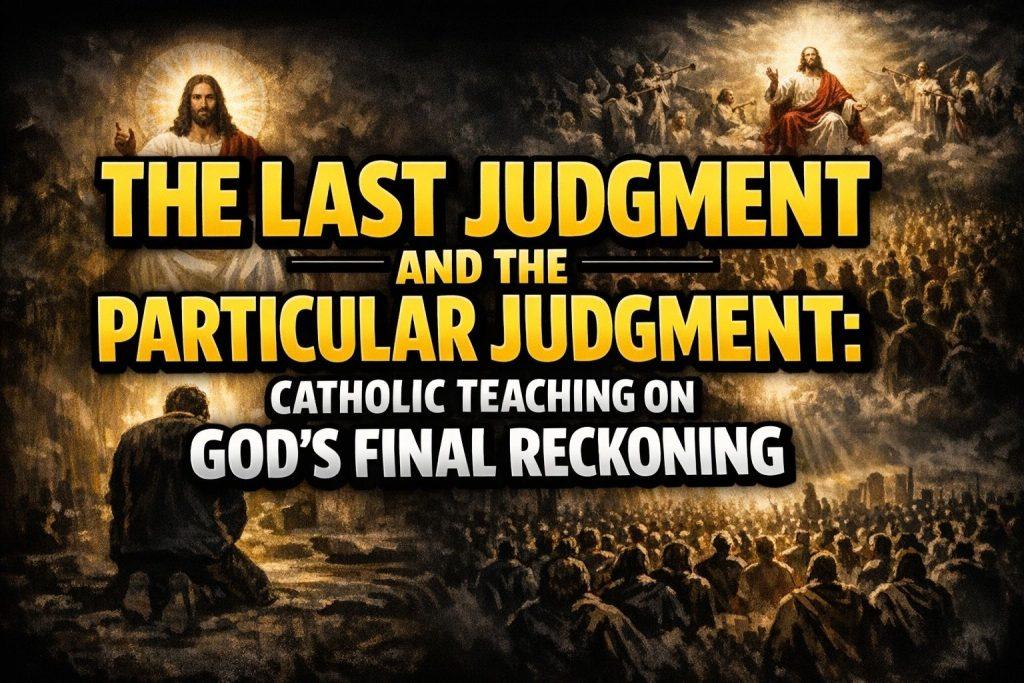
- The Catholic Church teaches two distinct judgments after death: the particular judgment, which occurs immediately for each individual soul at the moment of death, and the Last Judgment, which occurs at the end of history when Christ returns in glory.
- At the particular judgment, each soul faces God alone and receives an immediate verdict that determines whether it goes to heaven, purgatory, or hell.
- The Last Judgment, also called the General Judgment, will make the full truth of every human life publicly manifest before the whole of creation, confirming the verdicts of all the particular judgments.
- Jesus Christ himself serves as the Judge at the Last Judgment, a truth affirmed in the Gospels, the Apostles’ Creed, and the consistent teaching of the Church throughout history.
- The resurrection of the body is directly connected to the Last Judgment, since at the end of time the soul and body of every person who ever lived will be reunited before the final verdict is proclaimed.
- The Catholic teaching on judgment is not meant to produce anxiety but to foster genuine conversion, moral seriousness, and a confident trust in the mercy of God offered in Jesus Christ.
Introduction
The Catholic Church’s teaching on judgment after death stands among the most serious and most practically relevant doctrines of the Christian faith, touching as it does on the ultimate accountability of every human person before the living God who created and redeemed them. The Church distinguishes carefully between two moments of divine judgment: the particular judgment, in which each individual soul stands before God at the instant of death and receives a definitive verdict about its eternal destiny, and the Last Judgment, also called the General Judgment, in which Christ returns at the end of history to judge all the living and all the dead in a public and universal manifestation of divine justice and mercy. These two judgments are not contradictory or redundant; they serve distinct purposes within the economy of God’s justice, and together they complete the full Catholic picture of what awaits every human person at the end of life and at the end of time. The Catechism of the Catholic Church addresses both judgments with precision, grounding them in Sacred Scripture, the testimony of the Church Fathers, and the solemn definitions of the Magisterium (CCC 1021-1041). Understanding these teachings correctly requires moving beyond vague cultural images of a courtroom in the clouds and entering into the theologically rich and scripturally grounded account of divine justice that the Church has developed and preserved across twenty centuries. The doctrine of judgment is not peripheral to Catholic faith; it belongs to the very core of the gospel, because the proclamation that Christ will come again to judge the living and the dead forms part of every major Christian creed from the earliest centuries.
The history of the Church’s reflection on these two judgments reveals a teaching that developed organically from the witness of Scripture and the practice of the earliest Christian communities. The New Testament contains explicit and extended teaching on judgment from the lips of Jesus himself, particularly in the Gospel of Matthew, and the letters of Saint Paul add further theological depth to the biblical portrait of a God who will render to each person according to their works. The Church Fathers, including Tertullian, Saint Cyprian, Saint Augustine, and Saint John Chrysostom, all affirmed both the immediacy of the particular judgment and the future reality of a universal judgment at the end of history. Pope Benedict XII, in his apostolic constitution Benedictus Deus of 1336, provided a formal and authoritative clarification of the particular judgment, defining that each soul receives its definitive verdict immediately after death, without waiting for the Last Judgment. The Fourth Lateran Council in 1215 had already affirmed the Last Judgment as a defined truth of faith, stating that Christ will come at the end of time to judge all the living and the dead and to render to each person a recompense according to their deeds. The Council of Trent reaffirmed these teachings, and the Second Vatican Council in Lumen Gentium and Gaudium et Spes situated them within a broader theology of the human person, the Church, and the final destiny of creation. This article presents the full Catholic teaching on both judgments, drawing on all of these sources, so that the reader may understand not only what the Church teaches but why these doctrines flow necessarily from the deepest convictions of the Christian faith about God, humanity, freedom, and love.
The Particular Judgment: Each Soul Before God at Death
The particular judgment is the immediate, personal, and definitive assessment of each individual soul by God at the very moment of death, and the Catholic Church holds this truth with the full weight of her doctrinal authority. Pope Benedict XII’s apostolic constitution Benedictus Deus, issued in 1336, formally defined that souls who die in a state of grace and are fully purified go immediately to heaven, that souls who die in grace but require further purification go to purgatory, and that souls who die in a state of mortal sin go immediately to hell, all of this happening at death without any waiting period before the Last Judgment. This definition was important in its historical context because certain theological positions had suggested that souls sleep or rest in an unconscious state between death and the Last Judgment, a view the Church rejected in favor of the immediacy of the soul’s encounter with God. The particular judgment is not a courtroom proceeding with arguments and appeals; it is the moment in which the soul, stripped of all self-deception and laid entirely open before the infinite light of divine truth, sees itself as God sees it and receives the verdict that its own freely chosen life has determined. Saint John of the Cross captured this truth when he wrote that at the end of life we will be judged on love, meaning that the measure of the particular judgment is the degree to which the person has opened their heart to God’s love and allowed that love to transform their choices and their character.
The Catholic tradition has consistently understood the particular judgment as an act of perfect justice and perfect mercy simultaneously, not as a cold legal proceeding but as the culminating moment of a lifelong conversation between the soul and God. Every human person reaches death having written, through the sum total of their freely chosen acts, a kind of moral autobiography, and at the particular judgment that autobiography is read in its entirety, in the light of perfect truth, by the One who knows the soul more intimately than the soul knows itself. The Catechism describes this as each person receiving his or her retribution in the soul immediately after death in a particular judgment that refers life to Christ (CCC 1022). The phrase “refers life to Christ” is theologically significant: it situates the particular judgment not within an abstract framework of law and punishment, but within the personal relationship between the redeemed soul and its Redeemer, in whose light alone the truth of a human life can be fully seen. Those who have chosen Christ and allowed his grace to work in them throughout their lives will find the particular judgment to be the moment of their final and definitive welcome into the family of God. Those who have closed themselves to grace and died in that closure will find the particular judgment to be the confirmation of the choice they freely and definitively made. The particular judgment, in other words, does not impose an external verdict on a passive soul; it reveals and confirms the interior direction the soul has given itself through a lifetime of moral choices.
The Scriptural Basis for the Particular Judgment
While the term “particular judgment” does not appear explicitly in Scripture, the reality it names is present throughout the New Testament in several passages that describe the immediate accountability of the soul at death and the definitive character of the verdict rendered at that moment. The most direct scriptural foundation for the particular judgment appears in the parable of the rich man and Lazarus in Luke 16:19-31, where both characters pass immediately from death into their respective eternal states, with no intermediate waiting period described between their deaths and their arrival in either Abraham’s bosom or the place of torment. Jesus speaks of this immediate transition as a fact that requires no special justification, suggesting that his audience understood the immediacy of the soul’s post-mortem fate as a given truth. Similarly, in Luke 23:43, Jesus promises the repentant thief on the cross, “Today you will be with me in paradise,” and the word “today” carries enormous theological weight, indicating that the thief’s entry into the blessed state happens immediately, on the very day of his death, without any delay. Saint Paul, writing to the Philippians, expresses his personal conviction that “to die is gain” and that he desires “to depart and be with Christ, for that is far better” (Philippians 1:21-23), a passage that only makes sense if Paul expects an immediate entry into Christ’s presence at death rather than a long unconscious sleep until the Last Day.
The Letter to the Hebrews adds a further dimension when it states plainly that “it is appointed for men to die once, and after that comes judgment” (Hebrews 9:27), a verse that the Church has consistently read as describing the particular judgment, the judgment that follows immediately upon the single death that each person dies. The Book of Revelation, though rich in symbolic imagery that the Church does not read with wooden literalism, also presents scenes of souls in their definitive states before the end of history, which supports the understanding that individual souls reach their final destinations before the Last Day arrives. Saint Paul’s description of the believer’s life as a race run toward a prize (1 Corinthians 9:24-25) and his reflection in his second letter to the Corinthians that “we must all appear before the judgment seat of Christ, so that each one may receive good or evil, according to what he has done in the body” (2 Corinthians 5:10) both point toward a personal and definitive accounting that corresponds to what the Church teaches about the particular judgment. The biblical portrait, taken as a whole, strongly supports the Church’s consistent and formally defined teaching that each soul meets its divine Judge at the moment of death and receives the verdict that its life has earned, a verdict from which no appeal is possible because the Judge is perfect justice and perfect mercy at once.
The Last Judgment: Christ’s Universal and Public Reckoning
The Last Judgment, which the Catechism also calls the General Judgment, refers to the final and universal event at the end of history in which Jesus Christ returns in glory to render a definitive and public verdict on the whole of human history, confirming all the particular judgments of every soul and making manifest before the whole of creation the full truth of every human life (CCC 1038-1041). Unlike the particular judgment, which is intensely personal and invisible to all but God and the soul being judged, the Last Judgment is cosmic and public in character, involving the resurrection of every person who has ever lived and the declaration of divine justice in a form that the entire created order can witness. Jesus describes this event with great vividness in the Gospel of Matthew, presenting himself as the Son of Man coming in glory with all his angels, sitting on a glorious throne, and gathering all the nations before him to separate them as a shepherd separates the sheep from the goats (Matthew 25:31-46). The criteria he announces for this separation are striking in their concreteness: feeding the hungry, giving drink to the thirsty, welcoming the stranger, clothing the naked, visiting the sick and the imprisoned, all works of charity toward “the least of these my brethren,” who Christ identifies with himself. The Last Judgment thus reveals that the whole of moral life, including its most ordinary and apparently private dimensions, carries eternal significance and stands permanently recorded before the eyes of God.
The Last Judgment serves several purposes that the particular judgment, by its nature, cannot serve, and understanding these purposes helps clarify why the Church holds both doctrines together rather than collapsing them into one. The particular judgment determines the eternal destiny of each individual soul immediately and definitively, but it does not publicly manifest the full truth of each person’s life to the whole of creation. Many good actions performed in secret remain unknown to others during this life, and many injustices go undetected, unacknowledged, or unpunished in the earthly order. The Last Judgment corrects this imbalance by bringing everything into the open, so that the full pattern of every person’s moral life, including the hidden motivations, the secret charities, and the concealed wrongs, stands revealed before all. Saint Thomas Aquinas argued in his Summa Theologica that this public manifestation of justice is fitting because human beings are social creatures whose acts affect not only themselves but the whole community of persons through history, and that the full truth of how each person lived can only be seen when the entire web of historical cause and effect is complete. The Last Judgment also confirms the vindication of the just, whose fidelity to God may have appeared foolish, costly, or even defeated during their earthly lives, and the just condemnation of those whose earthly prosperity was built on injustice, deception, or the exploitation of others. In this sense, the Last Judgment is not a frightening surprise but the final and public seal of a justice that has been building throughout all of human history.
The Role of Christ as Judge
The Catholic Church teaches with absolute clarity that Jesus Christ, the Second Person of the Trinity made man, serves as the Judge at the Last Judgment, and this teaching carries profound theological significance that goes far beyond the simple image of a powerful figure on a throne rendering verdicts. Christ’s role as Judge flows directly from his role as Redeemer and from the authority the Father gave him through his death and resurrection, a connection that Saint Peter makes explicit in his speech in the Acts of the Apostles when he declares that God has appointed Jesus “to be judge of the living and the dead” (Acts 10:42). Jesus himself asserts this authority in the Gospel of John, where he tells his listeners that “the Father judges no one, but has given all judgment to the Son” (John 5:22), and that the Son possesses the power to execute judgment because he is also the Son of Man (John 5:27), meaning that his humanity qualifies him to judge the human race with an intimacy and understanding that transcends all human judges. The Apostles’ Creed, prayed by Catholics throughout the world at every Sunday Mass and at every Baptism, includes the declaration that Christ “will come again to judge the living and the dead,” situating the truth of Christ as Judge within the very core of the Christian confession of faith. The Nicene Creed amplifies this declaration with further detail, affirming that he “will come again in glory to judge the living and the dead,” and that “his kingdom will have no end,” framing the Last Judgment within the context of Christ’s eternal and triumphant reign.
The theological richness of Christ as Judge lies in the paradox that the one who judges humanity is also the one who died for humanity, so that the Judge and the Savior are the same person. Saint Augustine reflected on this with characteristic depth, observing that the one who came the first time in hiddenness and humility to be judged by sinful human beings will come the second time in manifest glory to judge all who ever lived, and that this reversal is the ultimate expression of divine justice. The wounds of Christ’s passion, which tradition holds the glorified Christ retains in his risen body as marks of his redemptive love, will be visible at the Last Judgment, presenting to every person who ever lived the full truth of what God offered for their salvation. For those who accepted that offer, the wounds of Christ will be the sign of their redemption and their joy. For those who rejected it, they will stand as the most searching indictment possible, not a condemnation imposed from outside but the soul’s own recognition of what it refused. The Catechism teaches that Christ’s lordship over the universe and history is manifested precisely in the act of judgment, because the Last Judgment is the moment at which the full meaning of all history becomes clear and the victory of Christ over sin, death, and evil is definitively and publicly proclaimed (CCC 1040). To believe in Christ as Judge is therefore not to believe in a stern tribunal but in the ultimate triumph of a love that takes human choices with absolute seriousness.
Resurrection of the Body and Its Connection to the Last Judgment
The resurrection of the body is directly and necessarily connected to the Last Judgment in Catholic teaching, because the Church holds that the full person, body and soul, will face the final verdict, and that the eternal destiny awaiting each person after the Last Judgment belongs to the complete human being and not merely to a disembodied soul. The Catechism teaches that the resurrection of the dead is a truth believed from the beginning, that Christ’s own bodily resurrection from the dead is the first fruits and the pledge of the resurrection of all who belong to him (CCC 989-991). Saint Paul makes this connection with great force in his first letter to the Corinthians, arguing that if the dead are not raised, then Christ has not been raised, and if Christ has not been raised, then faith is in vain; the resurrection of Christ and the resurrection of all the dead stand or fall together (1 Corinthians 15:13-17). The Book of Revelation presents the Last Judgment in explicitly bodily terms, describing “the dead, great and small, standing before the throne” and the sea and death and Hades giving up the dead that were in them (Revelation 20:12-13), images that evoke the universality and bodily reality of the final resurrection. At the Last Judgment, every person who ever lived, from the first human beings to the last generation, will stand in their complete humanity, body and soul together, before the judgment seat of Christ.
The glorified body that the just receive at the resurrection differs profoundly from the earthly body they inhabited during life, even as it remains the same body genuinely raised and transformed rather than replaced. Saint Paul uses the image of a seed planted in the ground that grows into something far more glorious than the original seed, and he lists four qualities that distinguish the risen body from the mortal body: it is raised in incorruption, in glory, in power, and as a spiritual body (1 Corinthians 15:42-44), meaning a body fully subject to and expressive of the spirit, no longer subject to decay, weakness, or death. The glorified bodies of the blessed after the Last Judgment will share in the radiance of the Beatific Vision that their souls have already been enjoying since their particular judgment, so that the resurrection does not change the soul’s fundamental orientation toward God but completes and extends the experience of beatitude to the whole person. For the condemned, the body reunited with the soul at the Last Judgment will share in the suffering of eternal separation from God, a sobering truth the Church holds alongside the joy of the resurrection of the just. The connection between the resurrection and the Last Judgment thus expresses a deep truth about the Catholic understanding of the human person: body and soul together constitute the human being, and the final verdict of divine justice addresses the complete person in the fullness of their humanity, not merely a spiritual fragment of what they once were.
The Criteria of Judgment: Works, Faith, and the Logic of Love
Catholic teaching on the criteria by which God judges each person must be understood carefully, because simplistic formulations in either direction, whether “faith alone” or “works alone,” fail to capture the full truth of what Scripture and Tradition together affirm. The Church teaches that God judges each person according to their works, their interior dispositions, and their fundamental orientation toward or away from him, and that genuine faith, properly understood, always expresses itself in love and in the concrete acts of charity that love produces. Jesus makes the criteria of judgment startlingly concrete in the parable of the sheep and the goats in Matthew 25:31-46, identifying the decisive actions with the most ordinary works of human mercy: feeding the hungry, giving drink to the thirsty, welcoming the stranger, clothing the naked, caring for the sick, and visiting the imprisoned. The remarkable theological move Jesus makes in this passage is the identification of himself with “the least of these my brethren,” so that every act of charity toward any human person in need is, in the logic of the gospel, an act directed toward Christ himself, and every failure of charity is a failure directed toward Christ. This identification is not merely a rhetorical device; it reflects the deep Catholic conviction, rooted in the theology of the Mystical Body of Christ, that the risen Lord is genuinely present in every human person and especially in those who suffer.
The Catechism of the Catholic Church teaches that at the Last Judgment we will know the ultimate meaning of the whole work of creation and of the entire economy of salvation, and will understand the marvelous ways in which God’s providence led everything toward its final end (CCC 1040). This cosmic dimension of the Last Judgment means that the criteria of judgment are not applied in a narrow individualistic sense, as though God were checking a list of personal moral ledger entries, but in the full context of each person’s concrete historical existence, their relationships, their social responsibilities, their use of the gifts and opportunities God gave them, and their contribution, positive or negative, to the human community around them. Saint John of the Cross’s insight that at the end of life we will be judged on love captures the essence of this teaching: love in the Catholic sense is not a feeling but a practical commitment to the genuine good of the other, expressed in the concrete acts of charity that Scripture calls the works of mercy. A person whose life was characterized by a genuine, if imperfect, orientation of love toward God and neighbor will find that orientation confirmed and perfected in the judgment. A person whose life was fundamentally closed to love, however outwardly respectable it may have appeared, will find that fundamental closure revealed in all its truth and confirmed in all its consequences.
The Last Judgment and the Meaning of History
One of the most profound dimensions of the Catholic doctrine of the Last Judgment is its assertion that history has a meaning, a direction, and a final destination that God himself will make manifest at the end of time, a conviction that sets Catholic faith apart from every worldview that treats history as a random series of events with no ultimate significance. The Second Vatican Council, in its Pastoral Constitution Gaudium et Spes, reflected deeply on the relationship between human history and the Kingdom of God, teaching that while earthly progress is not to be simply identified with the growth of God’s Kingdom, the values of human dignity, solidarity, and freedom, which are the fruit of nature and of human effort, will be found again after having been cleansed of every stain, illumined, and transfigured when Christ delivers to his Father a kingdom of truth and life, holiness and grace, justice, love, and peace. The Last Judgment is thus not the annihilation of history but its fulfillment and completion, the moment at which the full significance of everything that has ever happened, every act of love and every act of injustice, every prayer and every betrayal, every moment of heroic virtue and every moment of moral cowardice, stands revealed in the light of infinite truth. This vision of history as moving toward a definitive judgment and consummation gives Catholic moral life a seriousness and a hope that purely secular worldviews cannot supply, because it means that nothing truly good is ever wasted or lost, and that no injustice is ever finally beyond accountability.
The connection between the Last Judgment and the meaning of history also has important implications for the Catholic understanding of justice in this world. The Church has always taught that Christians must work actively for justice in the present order, that the corporal and spiritual works of mercy are not optional additions to the Christian life but essential expressions of it, and that the political, economic, and social dimensions of human life fall within the scope of the gospel’s demands. The Last Judgment’s revelation that God identifies himself with the poor, the sick, the stranger, and the imprisoned gives an ultimate urgency and significance to the Church’s social teaching, because what is done or left undone for the vulnerable in this life will stand revealed at the end of time as what was done or left undone for Christ himself. Pope John Paul II, throughout his pontificate and especially in his encyclical Sollicitudo Rei Socialis, grounded the Church’s commitment to social justice in precisely this theological vision: human beings bear a responsibility to one another that is not merely political or humanitarian but ultimately theological, rooted in the dignity of each person as made in the image of God and as someone for whom Christ died. The Last Judgment does not make earthly justice unnecessary; it makes it infinitely important, because the verdict on earthly justice rendered at the end of time will be final, universal, and entirely transparent.
Common Misunderstandings and the Church’s Clarifications
Several widespread misunderstandings about the Catholic teaching on judgment deserve careful attention, since they distort both the pastoral impact and the doctrinal content of the Church’s position. One common misconception holds that Catholics believe they earn their salvation by accumulating sufficient good works to tip the scales of divine judgment in their favor, a quasi-commercial picture of judgment in which deeds are tallied like financial accounts. This picture fundamentally misrepresents Catholic teaching, which holds that salvation is always a gift of God’s grace, that no person can “earn” the Beatific Vision by their own efforts, and that even the best human actions are only salvific insofar as they flow from the grace of Christ working in the person (CCC 1987-2011). Good works matter enormously in Catholic teaching, but they matter as the fruit and expression of sanctifying grace, which is the life of God in the soul, rather than as independent human achievements that purchase divine favor. A second misunderstanding, common in popular culture, treats the Last Judgment as a kind of embarrassing public reading of sins before a celestial audience, designed primarily to humiliate the condemned. The Church’s teaching has a far more theologically serious purpose: the Last Judgment manifests the complete truth of each person’s life in the full context of history and relationship, revealing not only the wrongs done but also the graces refused, the loves that were genuine, and the ultimate pattern of the soul’s fundamental orientation.
A third misunderstanding concerns the relationship between divine mercy and divine judgment, with some people concluding that a merciful God cannot really judge anyone harshly, and others concluding that a just God cannot really show mercy to serious sinners. Catholic teaching holds both truths in their full force: God’s mercy is real, immense, and poured out lavishly in the redemptive work of Christ and the sacramental life of the Church, and God’s justice is equally real, perfect, and incapable of simply ignoring or overriding the freely chosen moral direction of a person’s life. The two are not in competition; they are two dimensions of the same infinite divine love, which is so serious about the reality and dignity of human freedom that it both offers the grace of conversion with inexhaustible generosity and confirms the permanent consequences of the definitive refusal of that grace. Pope Francis, in his apostolic exhortation Evangelii Gaudium, stressed the priority of mercy in the Church’s proclamation while never suggesting that mercy eliminates the seriousness of moral choice and its consequences. The proper Catholic response to the teaching on judgment is therefore neither presumption, which treats grace as automatic and moral seriousness as unnecessary, nor despair, which treats one’s own sinfulness as beyond God’s mercy. The proper response is the same response the Church has always proposed: genuine conversion, regular use of the sacraments, active charity, persevering prayer, and a humble confidence in the mercy of a God who judges with the same love with which he created and redeemed.
See Also
- Heaven: The Catholic Doctrine of Eternal Life with God
- Hell: The Catholic Teaching on Eternal Separation from God
- Purgatory: The Catholic Doctrine of Purification After Death
- The Resurrection of the Body: Catholic Doctrine on the Glorified Human Person
- The Second Coming of Christ: Catholic Teaching on the Parousia
- Mortal and Venial Sin: Understanding the Catholic Teaching on Degrees of Sin
- The Works of Mercy: Catholic Teaching on Charity Toward Body and Soul
- Death and Dying: The Catholic Church’s Teaching on the End of Earthly Life
What the Catholic Teaching on Judgment Means for Catholics Today
The Catholic doctrine of the particular judgment and the Last Judgment, received in its full theological richness, calls every Catholic to a life of moral seriousness, active charity, and confident hope, not in that order of importance, but as three inseparable dimensions of a single faithful response to the truth God has revealed. The particular judgment makes clear that every human life matters, that every freely chosen act contributes to the fundamental orientation of the soul, and that the moment of death is definitive in a way that nothing in earthly life prepares people to expect. This truth should motivate Catholics to treat each day as genuinely significant, each moral choice as carrying real weight, and each opportunity for repentance, conversion, and growth in virtue as a gift not to be wasted. The regular practice of the sacrament of Reconciliation, the daily examination of conscience, the cultivation of prayer, and the generous embrace of acts of charity are not merely pious customs; they are the practical means by which a Catholic prepares, in the present moment, for the encounter with God that awaits every person at death. The particular judgment is not a surprise inspection for those who have been faithful to these practices but the confirmation of a relationship with God that they have been tending throughout their lives with care and love.
The Last Judgment, in turn, calls Catholics to a broader vision of their moral responsibility that extends beyond their private spiritual lives and into their relationships, their work, their civic participation, and their treatment of the most vulnerable members of society. If Christ himself is present in “the least of these,” then the Catholic who takes the Last Judgment seriously cannot regard poverty, injustice, loneliness, or suffering as someone else’s problem. The works of mercy, both corporal and spiritual, are the concrete daily form in which the love Christ will look for at the Last Judgment takes practical shape in ordinary human lives. Visiting a sick neighbor, contributing to a food bank, teaching a child the faith, forgiving a persistent wrong, praying for enemies, and speaking the truth with charity are not acts performed for their own sake or even primarily to pass a future test; they are the natural overflow of a heart that has genuinely received the love of Christ and allows that love to flow outward toward others. The consoling dimension of the teaching on judgment is equally important: Catholics face the final accounting not as strangers before an unknown judge, but as children before a Father who knows them completely, who died for them personally, and whose deepest desire is to hear them say, with the whole of their lives, “yes” to the love he has offered without reservation. The Church’s teaching on judgment, far from being a cause of anxiety, is one of the most powerful reasons for the peace, the moral energy, and the indestructible hope that have characterized Catholic life at its best throughout the centuries.
About This Article
CatholicWiki is an unofficial, independently maintained Catholic encyclopedia. It is not affiliated with, endorsed by, or representative of the Holy See, the Vatican, any diocese, any Catholic religious order, or any official body of the Catholic Church. While every effort is made to ensure that all content faithfully reflects Catholic teaching as expressed in Sacred Scripture, Sacred Tradition, the Magisterium, and other authoritative Catholic sources, readers are encouraged to consult official Church documents, their local pastor, or a qualified theologian for matters of personal faith and practice. CatholicWiki is committed to accuracy, fidelity, and continuous improvement. If you believe any content on this page contains an error, please consider contributing a correction in the spirit of truth and charity.