
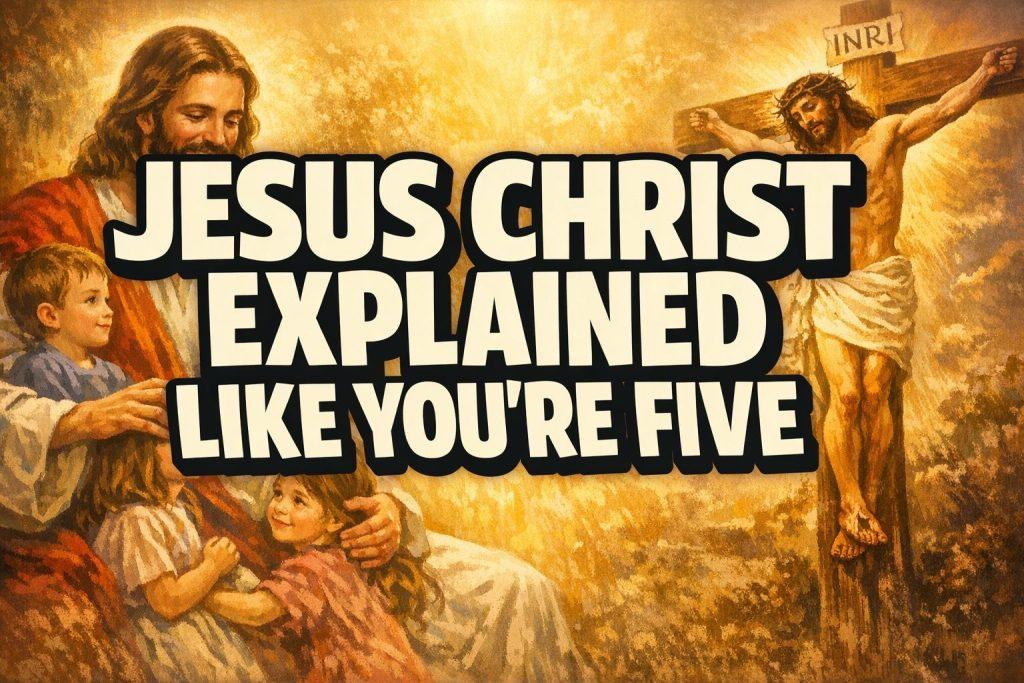
Quick Insights
- Jesus Christ is the Son of God who became a real human being and was born from the Virgin Mary about two thousand years ago in Bethlehem.
- Jesus is both fully God and fully human at the same time, which means He understands everything about being human while still being God.
- Jesus died on the cross to take away the sins of all people and to open the way back to God for everyone who had turned away from Him.
- Three days after He died and was buried, Jesus rose from the dead, and His Resurrection is the most important event in all of human history.
- Jesus started the Catholic Church by choosing twelve apostles and giving them the mission to teach, baptize, and care for all people in His name.
- Jesus is alive right now in Heaven and also truly present in the Eucharist at every Mass celebrated anywhere in the world.
Who Jesus Christ Is
Jesus Christ stands at the very center of the Catholic faith, and everything the Church believes, teaches, and does flows from the person and work of Jesus. He is not simply a great moral teacher, a wise philosopher, or an inspiring historical figure, though He is certainly all of those things in the most complete sense imaginable. The Catholic Church teaches that Jesus Christ is the eternal Son of God, the Second Person of the Most Holy Trinity, who took on a real human nature in the womb of the Virgin Mary and was born into the world approximately two thousand years ago. His identity is unique in all of human history: no one before Him and no one after Him has been both fully God and fully human at the same time. The theological term for this mystery is the “hypostatic union,” which means the union of two complete natures, one divine and one human, in the single Person of the eternal Son of God. In simpler terms: Jesus did not become God when He was born, because He was already God from all eternity. And He did not merely pretend to be human while secretly remaining untouched by ordinary human experience. He genuinely became human, with a real body, a real human mind, real emotions, and real experiences of hunger, tiredness, friendship, grief, and joy. The Catechism of the Catholic Church teaches that the unique and altogether singular event of the Incarnation, meaning God becoming flesh, does not mean that Jesus Christ is part God and part man, nor that He is a confused mixture of the two, but that He is truly and completely both (CCC 464). Understanding who Jesus is forms the starting point for understanding everything else in the Catholic faith.
The Eternal Son Before the Incarnation
Before Jesus was born in Bethlehem, before the universe itself existed, the Son of God existed eternally in the life of the Most Holy Trinity. The Gospel of John opens with one of the most magnificent theological statements in all of Scripture: “In the beginning was the Word, and the Word was with God, and the Word was God” (John 1:1). John calls Jesus the “Word,” a translation of the Greek “Logos,” meaning the divine reason and expression through which God reveals Himself. The Word was not created at some point in time. He has always existed, co-eternal and co-equal with the Father, without beginning and without end. The Letter to the Colossians describes the Son as “the image of the invisible God, the firstborn of all creation,” and goes on to say that “in him all things were created, in heaven and on earth, visible and invisible” (Colossians 1:15-16). This means that the same Jesus who walked the roads of Galilee and ate fish with His disciples is the eternal Person through whom the Father created the entire universe. Every star, every mountain, every blade of grass, and every human soul owes its existence to the creative action of the Son working in unity with the Father and the Holy Spirit. The pre-existence of the Son is not a theological abstraction with no practical consequences. It means that when Jesus speaks to us in the Gospels, it is God Himself speaking, with the full authority and knowledge of the Creator addressing His creation. The Catechism teaches that the Son of God is consubstantial, meaning of the same divine substance or nature, with the Father, and that this equality is the bedrock of everything the Church confesses about Jesus (CCC 242).
The Incarnation — God Becomes Human
The Incarnation is the event in which the eternal Son of God took on a human nature by being conceived by the power of the Holy Spirit in the womb of the Virgin Mary. The word “incarnation” comes from the Latin “caro,” meaning flesh, and it refers to the profound truth that God became flesh, that the infinite entered the finite, and that the eternal took on a life lived within time. The angel Gabriel appeared to Mary in the town of Nazareth and announced to her that she would conceive and bear a son and that she should name him Jesus, because He would save His people from their sins (Luke 1:30-31). Mary’s response to Gabriel, “Let it be done to me according to your word” (Luke 1:38), was a free and courageous act of faith that opened the door for God to enter human history in the most personal way imaginable. Jesus was conceived without a human father, because His conception was a direct act of God the Holy Spirit. This virginal conception does not mean that Jesus was less than fully human; it means that His origin was from God in a way that no other human being’s origin has been or ever will be. Mary carried Jesus in her womb for nine months, felt Him move and grow, and gave birth to Him in Bethlehem in circumstances of real poverty and simplicity. The setting of the birth, a stable or cave used for animals, is itself a profound theological statement: the God who made the universe chose to enter it in the most vulnerable and humble way possible. The Catechism teaches that the Incarnation is the mystery of the wonderful union of the divine and human natures in the one Person of the Word, accomplished for our salvation (CCC 483). God did not send an angel, a prophet, or a message. He came Himself.
The Hidden Years — Jesus in Nazareth
After His birth in Bethlehem, the Gospels record that Jesus spent the vast majority of His earthly life in Nazareth, a small and unremarkable town in the region of Galilee in northern Israel. This period, stretching from His infancy until the beginning of His public ministry around the age of thirty, is often called the “hidden years” because the Gospels tell us very little about it. Luke records that after the finding of Jesus in the Temple at the age of twelve, He “went down with them and came to Nazareth, and was obedient to them” (Luke 2:51), and then advances the narrative all the way to Jesus’ adult life. These hidden years are not a theological vacuum. They are theologically rich because they remind us that Jesus fully assumed the whole of ordinary human life, including its quiet, unspectacular dailiness. He learned to walk, to talk, and to read. He studied the Hebrew Scriptures in the synagogue. He worked alongside Joseph as a craftsman, learning the trade that would sustain the family and shaping wood with His own hands. He experienced the rhythms of Jewish religious life, celebrating the great feasts, praying the Psalms, and attending the synagogue on the Sabbath. The one episode the Gospels do preserve from His childhood, the finding in the Temple, reveals that even at twelve years of age Jesus had a profound awareness of His relationship to God the Father, whom He calls “my Father” with a directness that astonishes even His parents (Luke 2:49). The Catechism teaches that the hidden life of Jesus in Nazareth allows every person, whatever their state in life, to find in Him a model for their own daily existence, and that His obedience during these years was itself a participation in His redemptive mission (CCC 533).
The Baptism and Temptation of Jesus — Beginning of Public Life
The public ministry of Jesus began at the Jordan River with His baptism by John, and this event is rich with theological significance on multiple levels. John was baptizing people in the Jordan as a sign of their repentance and their preparation for the coming of the Messiah. Jesus had no sin to repent of and no need for purification, yet He came to John and asked to be baptized. When John protested, Jesus replied: “Let it be so now; for it is fitting for us to fulfill all righteousness” (Matthew 3:15). Jesus submitted to baptism not because He needed it but in order to identify Himself completely with sinful humanity, to stand in the place of the sinners He came to save. At the moment of His baptism, the Holy Spirit descended on Jesus in the form of a dove, and the voice of the Father spoke from heaven: “This is my beloved Son, with whom I am well pleased” (Matthew 3:17). This event is one of the clearest manifestations of the Holy Trinity in the entire New Testament: the Son is in the water, the Spirit descends from above, and the Father speaks from heaven. Immediately after His baptism, the Spirit led Jesus into the desert for forty days and forty nights of fasting, at the end of which the devil came and tempted Him three times. Jesus resisted each temptation by quoting Sacred Scripture, showing that the Word of God is the definitive answer to every lie and every false offer the enemy can make. The forty days in the desert recall the forty years Israel spent in the desert after the Exodus, but where Israel repeatedly failed and complained, Jesus remained faithful and obedient. The Catechism teaches that Jesus’ temptations in the desert recapitulate the whole of humanity’s struggle against sin and the devil, and that Jesus overcomes where humanity had failed (CCC 539).
The Teaching of Jesus — The Kingdom of God
When Jesus began His public ministry, the central theme of His preaching was the Kingdom of God, a phrase that appears more than one hundred times in the Gospels and that describes the central concern of His entire mission. The Kingdom of God, sometimes called the Kingdom of Heaven in Matthew’s Gospel, is not primarily a place or a political territory. It is the active rule of God over creation, the state of affairs in which God’s will is done completely and His love governs all relationships. Jesus announces at the beginning of His ministry: “The time is fulfilled, and the kingdom of God is at hand; repent, and believe in the gospel” (Mark 1:15). This announcement means that in Jesus Himself, the Kingdom is breaking into the present world in a new and decisive way. Where Jesus is, God reigns. Where Jesus acts, healing, forgiveness, and new life follow. The parables of Jesus are His primary teaching tool for explaining the nature of the Kingdom, and they are among the most innovative and compelling forms of religious teaching in all of human history. Through stories about farmers, merchants, fathers and sons, wedding banquets, and lost sheep, Jesus communicates truths about God’s love, the demands of discipleship, and the surprise of divine grace that straight propositions could never capture with the same force. The Sermon on the Mount, recorded in Matthew chapters five through seven, presents the moral vision of the Kingdom in its fullest form, calling His followers to a standard of love, purity, and mercy that goes far beyond the minimum requirements of the Law of Moses. Jesus does not abolish the Law but fulfills it, raising the standard from external compliance to interior transformation. The Catechism teaches that Jesus is Himself the heart of His own teaching, and that the Kingdom He preaches is inseparable from His own Person (CCC 543).
The Miracles of Jesus — Signs of the Kingdom
The miracles of Jesus are not incidental embellishments added to His story to make it more impressive. They are integral to His mission and function as visible signs that God’s Kingdom is truly present in Him. Jesus heals the sick, restores sight to the blind, makes the deaf hear and the mute speak, raises the dead, calms storms, walks on water, multiplies bread and fish, and drives out demons, and each of these acts communicates something specific about who He is and what He came to do. The healing miracles show that God’s will for human beings is wholeness, not suffering, and that in Jesus the Creator’s original intention for humanity begins to be restored. The exorcisms, meaning the driving out of evil spirits, show that Jesus has authority over the spiritual powers that oppress and enslave human beings, and that His coming means the defeat of the devil’s hold on the world. The raising of the dead, particularly the raising of Lazarus in John chapter eleven, points directly toward Jesus’ own Resurrection and reveals that He has power over death itself. Jesus tells Martha before raising her brother: “I am the resurrection and the life; whoever believes in me, though he die, yet shall he live” (John 11:25). The multiplication of the loaves and fish in the accounts preserved in all four Gospels foreshadows the Eucharist, where Jesus will feed an even greater multitude with His own Body and Blood under the appearances of bread and wine. Jesus Himself describes His miracles as testimony to His divine identity: “The works that the Father has given me to accomplish, these very works that I am doing, testify about me that the Father has sent me” (John 5:36). The Catechism teaches that the miracles of Jesus confirm that the Kingdom of God has come in His Person and that they invite faith in Him (CCC 548).
The Passion of Jesus — His Suffering and Death
The suffering and death of Jesus on the cross is the central event of human history according to the Catholic faith, and the Church has never allowed this truth to fade into the background or be softened into something more comfortable. In the final days of His earthly life, Jesus entered Jerusalem in a manner that deliberately fulfilled the prophecy of Zechariah, riding on a donkey while the crowds spread cloaks and branches before Him and cried out “Hosanna to the Son of David!” (Matthew 21:9). He cleansed the Temple of merchants and money changers, debated with the religious authorities, and delivered His final discourses to His disciples. On the night before His death, Jesus gathered with His twelve apostles for what we now call the Last Supper, and there He instituted the Eucharist, taking bread and wine and giving them to His disciples as His Body and Blood, saying: “Do this in memory of me” (Luke 22:19). After the supper, He went to the Garden of Gethsemane, where He prayed in agony, sweating blood, and accepted the Father’s will that He should drink the cup of suffering that lay before Him. He was arrested, brought before the Jewish high priest and then the Roman governor Pontius Pilate, mocked, beaten, crowned with thorns, and condemned to death by crucifixion. He carried His cross through the streets of Jerusalem to the hill called Golgotha and was nailed to the cross between two criminals. He hung on the cross for approximately three hours, and His final words, recorded in the various Gospels, include a prayer for the forgiveness of those who crucified Him, a promise of paradise to the repentant criminal beside Him, words of care for His mother Mary, and a final cry of trust in the Father. The Catechism teaches that the death of Christ was not an accident but the fulfillment of a plan of love by which God chose to redeem humanity through the free self-offering of His Son (CCC 599).
Why Jesus Died — The Meaning of the Cross
The death of Jesus on the cross is the answer to a question as old as human existence: how can a just God forgive sin without simply pretending that sin does not matter? Sin is not a minor social inconvenience or a personal mistake that can be brushed aside with a divine wave of the hand. Sin is a real rupture in the relationship between the creature and the Creator, a turning away from the source of all love and all life, with real consequences for the sinner, for other people, and for the right order of creation. The Catholic faith teaches that Jesus died as a sacrifice, that is, as a freely chosen offering of Himself that atoned for the sins of all humanity and restored the broken relationship between God and mankind. The theological concept of atonement, meaning the making of amends or reconciliation for wrongdoing, lies at the heart of how the Church understands the cross. The Letter to the Hebrews explains that in the old covenant, the priests of Israel offered animal sacrifices year after year to atone for the sins of the people, but that these sacrifices could never fully accomplish what they symbolized because no animal could truly substitute for a human person (Hebrews 10:4). Jesus, as both the perfect High Priest and the perfect sacrificial offering, accomplished in one unrepeatable act what centuries of animal sacrifice could only point toward. He is both the one who offers and the one who is offered, both the priest and the victim. Saint Paul writes: “For our sake he made him to be sin who knew no sin, so that in him we might become the righteousness of God” (2 Corinthians 5:21). This means that Jesus, who was completely without sin, took upon Himself the full weight of human sin so that human beings might receive His righteousness as a gift. The Catechism teaches that Jesus’ redemptive death fulfills the prophetic mission of the suffering servant described by Isaiah and is the unique sacrifice that accomplishes the definitive redemption of humanity (CCC 601).
The Resurrection — The Cornerstone of Faith
Three days after His death and burial, Jesus Christ rose from the dead, and this event is not merely the happy ending of a story that almost went wrong. The Resurrection is the cornerstone of the entire Christian faith, the event without which everything else the Church teaches would be meaningless. Saint Paul states this with absolute clarity: “If Christ has not been raised, then our preaching is in vain and your faith is in vain” (1 Corinthians 15:14). The Resurrection is not a legend, a wish-fulfillment fantasy, or a symbolic way of saying that Jesus’ memory lives on in the hearts of His followers. The New Testament witnesses to the Resurrection with remarkable consistency and detail: the tomb was empty, Jesus appeared to Mary Magdalene, to the other women, to Peter, to the eleven apostles, and to more than five hundred disciples at one time, many of whom were still alive when Paul wrote those words. The risen Jesus was not a ghost or a spiritual vision. He was physically present: He invited Thomas to touch His wounds, He ate breakfast with His disciples on the shore of the Sea of Galilee, and He walked and talked with two disciples on the road to Emmaus. At the same time, His risen body was transformed beyond what any ordinary body can do: He passed through locked doors, appeared and disappeared, and was not always immediately recognizable even to those who had known Him well. The Resurrection confirms everything Jesus claimed about Himself, vindicates His entire mission, and opens the way for every human being to share in His risen life through faith and baptism. The Catechism teaches that the Resurrection is above all a transcendent event, one that goes beyond and surpasses history, yet it truly occurred within history and left unmistakable marks upon it (CCC 647).
The Ascension and Session — Jesus Enthroned in Glory
Forty days after His Resurrection, Jesus led His disciples to the Mount of Olives near Jerusalem, gave them His final instructions, and was taken up into heaven in their sight. The Acts of the Apostles records that as they were watching, “a cloud took him out of their sight” (Acts 1:9), and two angels appeared to the astonished disciples to tell them that this same Jesus would come again in the same way they had seen Him go. The Ascension is not an exit or a farewell. It is the moment when Jesus in His glorified humanity takes His rightful place at the right hand of the Father, assuming the fullness of the kingly authority that belongs to Him as the Son of God and the risen Lord. The phrase “seated at the right hand of the Father” comes from Psalm 110, which Jesus Himself had applied to the Messiah, and it means the position of highest honor, authority, and power in the entire universe. Jesus did not leave His human nature behind when He ascended. He took it with Him, transformed and glorified, into the eternal life of the Trinity, and this means that for the first time in history a human body, the body of Mary’s Son, exists within the inner life of God. The implications of this truth for how we understand the human body, material reality, and the destiny of every person are profound. The Catechism teaches that the Ascension definitively marks the entry of Jesus’ humanity into God’s heavenly domain, from which He will come again, and that He now intercedes for us before the Father as our eternal High Priest (CCC 665). His ascension is therefore not an absence but a new and deeper form of presence, one that will be completed when He comes again at the end of time.
Jesus as Priest, Prophet, and King
The Catholic tradition has long described the mission of Jesus using three titles that were applied in the Old Testament to three categories of people who served as God’s appointed representatives: priests, prophets, and kings. Each of these three roles reveals a distinct dimension of what Jesus came to do and who He is, and together they provide a complete picture of His saving mission. As Prophet, Jesus speaks the definitive Word of God to humanity. The prophets of the Old Testament were messengers who delivered God’s word to the people, often at great personal cost. Jesus goes further than any prophet: He does not merely speak a word from God, He is the Word of God made flesh. His teaching does not come from a source outside Himself. It comes from the direct knowledge of the Father that He shares by virtue of being the eternal Son. He teaches with an authority that astonishes His contemporaries: “You have heard that it was said… but I say to you” (Matthew 5:21-22), a formula He uses repeatedly in the Sermon on the Mount to show that He speaks not as a commentator on the Law but as its Author. As Priest, Jesus offers the perfect sacrifice of Himself on the cross, bridging the gap between sinful humanity and the holy God. Every priest in Israel’s history was a figure pointing forward to this one definitive priesthood. As King, Jesus is the Son of David whose kingdom has no end, as the angel Gabriel promised Mary (Luke 1:33). His kingship is not like the kingdoms of the world. He told Pilate: “My kingdom is not of this world” (John 18:36), meaning His rule is exercised through love, truth, and service rather than through military force or political coercion. The Catechism teaches that Jesus fulfills all three of these messianic offices in a way that surpasses every anticipation the Old Testament could have provided (CCC 436).
The Names and Titles of Jesus
The names and titles given to Jesus in the New Testament are not merely honorary labels or affectionate nicknames. Each one reveals a genuine truth about who He is and what He accomplishes, and meditating on them provides one of the richest pathways into understanding the full significance of His Person. The name “Jesus” is the most personal and intimate of all His titles. Given to Him by the angel Gabriel before His birth, it comes from the Hebrew “Yeshua,” meaning “God saves” or “the Lord saves.” This name tells us what Jesus came to do before it tells us anything else about His character or His teaching. The title “Christ,” as noted earlier, means “the Anointed One” or Messiah, the long-awaited King and Savior of Israel. When Peter confesses “You are the Christ, the Son of the living God” (Matthew 16:16), Jesus affirms that this confession is a revelation from the Father Himself. The title “Lord” or “Kyrios” in Greek carries the full weight of divine identity, since it was the word used in the Greek translation of the Old Testament to render the sacred name of God. Early Christians who called Jesus “Lord” were making a claim about His divine identity that was both radical and costly in a world where “Caesar is Lord” was the expected loyalty oath of the Roman Empire. The title “Son of God” appears throughout the Gospels and carries the fullest possible weight in Catholic theology: it means not that Jesus was specially favored by God or particularly close to God, but that He shares in God’s own nature as the eternal divine Son. The Catechism gathers all of these names together and teaches that they are all inseparably connected, each illuminating a different facet of the one great reality that is the Person of Jesus Christ (CCC 430).
Jesus and the Church He Founded
Jesus did not come simply to preach a set of ideas and leave human beings to organize themselves as best they could. He founded a Church, a visible community with a specific structure, specific sacraments, and a specific mission to carry His work forward in history until He returns. The foundation of the Church was laid in the calling and formation of the twelve apostles, whom Jesus chose after spending the night in prayer (Luke 6:12-13). He called them to be with Him, to learn from Him, to share in His authority over unclean spirits and sickness, and ultimately to be sent out as His representatives to the whole world. To Simon, He gave the new name Peter, meaning “rock,” and said to him: “You are Peter, and on this rock I will build my church, and the gates of hell shall not prevail against it” (Matthew 16:18). This promise establishes Peter as the first leader of the Church and guarantees that the Church will endure against every opposition until the end of time. Jesus gave the apostles the authority to forgive sins, to baptize, to celebrate the Eucharist in His memory, and to teach all nations everything He had commanded. The Catholic Church understands itself as the direct continuation of the community Jesus founded, maintaining an unbroken succession of bishops from the apostles to the present day. The Catechism teaches that the Church is the body of Christ, with Christ as her head, and that she receives from Him her life, her mission, and her indestructibility (CCC 779). Every Catholic who is baptized and receives the sacraments participates in the life of this body and shares in the mission that Jesus entrusted to the apostles.
Jesus in the Eucharist — The Real Presence
One of the most distinctive and central teachings of the Catholic faith concerns the presence of Jesus in the Eucharist, the sacrament of the Body and Blood of Christ celebrated at every Mass. Jesus promised this gift at the synagogue in Capernaum when He said: “I am the living bread that came down from heaven. If anyone eats of this bread, he will live forever. And the bread that I will give for the life of the world is my flesh” (John 6:51). Many of His disciples found this teaching impossible to accept and walked away, but Jesus did not soften or retract His words. He allowed them to leave rather than compromise the truth of what He was saying. At the Last Supper, He fulfilled this promise when He took bread, gave thanks, broke it, and gave it to His disciples saying: “This is my body, which is given for you” (Luke 22:19), and then took the cup of wine and said: “This cup that is poured out for you is the new covenant in my blood” (Luke 22:20). The Catholic Church teaches that in the Eucharist, through the action of the priest at Mass, the bread and wine truly become the Body and Blood of Christ. This is not a symbol, a memorial, or a spiritual metaphor. Jesus is truly and substantially present in the Eucharist, body, blood, soul, and divinity. The Church uses the term “transubstantiation,” meaning a change in substance, to describe what happens: the outward appearances of bread and wine remain, but the underlying reality is completely changed into the Body and Blood of Christ. The Catechism teaches that the Eucharist contains the whole spiritual good of the Church, that is, Christ Himself, and that the Eucharistic celebration is the source and summit of the entire Christian life (CCC 1324). Every Mass on every altar in every country of the world is the same sacrifice of Calvary made present in an unbloody manner.
Jesus as the Way, the Truth, and the Life
On the night before His death, when His disciples were confused and frightened about what was going to happen, Jesus spoke words that have become one of the most important statements in all of Christian theology: “I am the way, and the truth, and the life. No one comes to the Father except through me” (John 14:6). This statement is one of the seven great “I am” declarations in John’s Gospel, and it makes an absolute and exclusive claim about the identity and role of Jesus in God’s plan of salvation. When Jesus says He is the “way,” He means that He is not merely one option among many paths that human beings might take to reach God. He is the only path, because He is the only one who has the divine authority and the perfect human obedience to bridge the gap between sinful humanity and the holy God. He is the “truth” not in the sense that He teaches true propositions, though He certainly does, but in the sense that He is the fullness and the source of all truth. The Catechism teaches that truth finds its fullness in Jesus, who is himself the Truth (John 14:6), and that this means the human search for truth finds its ultimate answer not in a doctrine but in a Person (CCC 2466). When Jesus says He is the “life,” He means that He is the source of divine life, the life that He shares with the Father and the Holy Spirit within the Trinity, which He now offers to share with every human being through faith and the sacraments. Human beings are alive in the biological sense, but in Jesus they can become alive in a deeper and more real sense, a sense that transcends physical life and endures beyond physical death. The entire Catholic moral and spiritual life is organized around the project of staying in union with Jesus, who is the source of all life and all love.
Jesus’ Return at the End of Time
The Catholic faith holds firmly to the teaching that Jesus Christ, who ascended into heaven in His glorified humanity, will return at the end of time in power and glory to bring history to its final and definitive conclusion. This event, which the tradition often calls the Second Coming or the Parousia, a Greek word meaning “arrival” or “presence,” is not a vague spiritual hope but a concrete doctrinal affirmation found in the Nicene Creed and the Apostles’ Creed alike. The angels who spoke to the disciples at the Ascension said: “This Jesus, who was taken up from you into heaven, will come in the same way as you saw him go into heaven” (Acts 1:11). Jesus Himself speaks of this coming in the Gospels, warning His disciples to remain alert and faithful because the time of His return is known to no one except the Father. The purpose of His return will be the final judgment of all people, the living and the dead, and the complete establishment of God’s Kingdom in its fullness. The Catechism teaches that at the Last Judgment, the full truth about every person’s relationship with God will be revealed, that every act of love, every work of mercy, and every failure will come to light, and that God’s justice and mercy will together determine the eternal state of each human being (CCC 1039). For those who have lived in faith, hope, and love, the return of Christ is the completion of every hope the Christian life has nurtured. For those who have definitively turned away from God, it is the confirmation of the choice they freely made. The Church does not know when Jesus will return. She knows only that He will, and she prepares for His coming through prayer, sacramental life, and faithful witness.
Jesus and the Human Person — What His Existence Reveals About Us
One of the most profound and often underappreciated implications of the Catholic faith in Jesus is what His existence reveals about the nature and dignity of the human person. Because the eternal Son of God chose to take on a human nature and to live a fully human life, the Catholic Church teaches that human nature itself has been honored and elevated in a way it had never been before. The Second Vatican Council, in its pastoral constitution Gaudium et Spes, made this point with great force: “The truth is that only in the mystery of the incarnate Word does the mystery of man take on light.” This means that to understand what a human being truly is and what a human being is truly for, we must look at Jesus. In Jesus we see what human beings look like when they are fully alive, fully obedient to God, fully loving, and fully free. We see that human beings are made for God, that our deepest longings are fulfilled not by wealth or pleasure or power but by relationship with the Father. We see that suffering, honestly faced and freely accepted in union with God’s will, can be redemptive rather than merely destructive. We see that forgiveness is stronger than resentment, that love is more real than hatred, and that death does not have the last word. The Catechism teaches that by His Incarnation, Jesus united Himself with every human being, and that this union grounds the infinite dignity that every human person possesses from conception to natural death (CCC 521). This is why the Catholic Church opposes abortion, euthanasia, capital punishment, and every form of oppression: because every human being carries within them the dignity of a nature that the Son of God Himself chose to share.
Following Jesus Today — Discipleship in the Catholic Life
The Gospels use a very concrete word to describe the relationship Jesus calls people into: He calls them to “follow” Him. When He called Peter and Andrew from their fishing nets, He did not invite them to a lecture series or hand them a scroll of religious teaching. He said: “Follow me, and I will make you fishers of men” (Matthew 4:19). Following Jesus is an active, ongoing, daily commitment that involves bringing one’s whole life, not just one’s Sunday morning hour, into conformity with His teaching, His values, and His love. For Catholics today, this following of Jesus happens above all through the sacramental life of the Church, through regular reception of the Eucharist, through the sacrament of Penance and Reconciliation, through daily prayer, through reading and meditating on the Scriptures, and through the active love of neighbor that Jesus identifies as the second greatest commandment. The moral life of a Catholic is not a list of rules imposed from outside by an authority demanding compliance. It is the natural shape of a life oriented toward Jesus, the natural expression of love for the God who loved us first. The Beatitudes, which Jesus proclaimed at the beginning of the Sermon on the Mount, describe the character of a true disciple: poor in spirit, merciful, pure of heart, and willing to suffer for the sake of righteousness (Matthew 5:3-10). These are not requirements to be met before Jesus will accept a person. They are the fruit of a life spent in His company, shaped by His grace and His Holy Spirit. The Catechism teaches that the way of Christ is both demanding and joyful, and that it leads through the narrow gate of self-renunciation to the fullness of life that God desires for every human being (CCC 1696).
What This All Means for Us
Everything the Catholic Church believes and everything a Catholic does in their daily life connects directly to the Person and work of Jesus Christ, and this connection is not theoretical but intensely personal and practical. Jesus is not a historical hero to be admired from a distance or a religious symbol to be displayed on a wall. He is the living Son of God who died for each person individually, who rose from the dead to open the way to eternal life for each person, and who is present in the Eucharist at every Mass, waiting to feed each person with His own Body and Blood. The Catholic faith rests entirely on the truth that Jesus is who He claimed to be: the eternal Son of God, the Savior of the world, and the Lord of history. If that claim is false, then the Church has no foundation and no message worth hearing. If it is true, then it changes everything about how we understand ourselves, how we treat other people, how we face suffering, and what we are ultimately living for. The Incarnation tells us that human beings matter infinitely to God, that our lives are not accidents, and that our bodies and souls together carry a dignity that no one has the right to violate. The cross tells us that God takes sin seriously and that His mercy is serious enough to pay the highest possible price to overcome sin’s consequences. The Resurrection tells us that death is not the end and that the God who raised Jesus from the dead will raise all those who are united to Him through faith and baptism. The promise of His return tells us that history is not a meaningless cycle but a purposeful story moving toward a destination of justice, love, and fullness of life. To know Jesus, to love Him, to receive Him in the sacraments, to follow Him in the moral life, and to share Him with others through witness and service: this is the Catholic life in its fullness, and it is the most meaningful existence any human being can live.
⚠ Disclaimer: This article presents Catholic teaching for educational purposes only. The content shared on CatholicAnswers101.com is intended to inform and support the faithful in their understanding of the Catholic faith, and does not constitute official Church teaching or magisterial authority. For authoritative and official Church teaching, we encourage readers to consult the Catechism of the Catholic Church and relevant magisterial documents. For personal spiritual guidance, pastoral advice, or matters of conscience, please consult your parish priest or a qualified spiritual director. For any questions, corrections, or inquiries regarding the content on this site, please contact us at editor@catholicanswers101.com.