
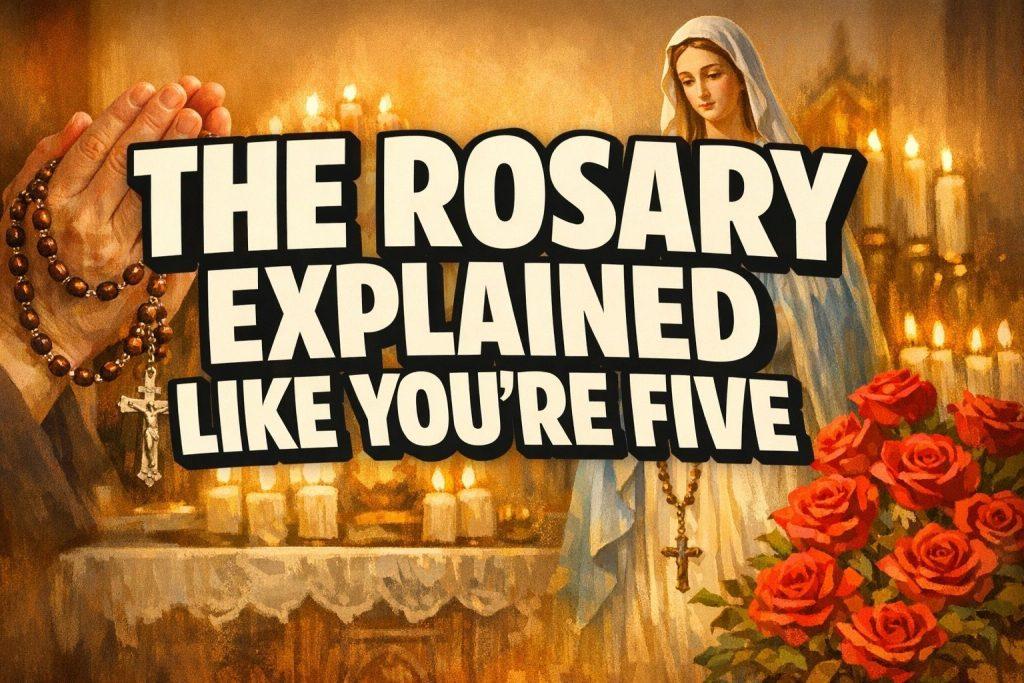
Quick Insights
- The Rosary is a prayer where Catholics count beads while thinking about the life of Jesus and Mary.
- It combines vocal prayers like the Hail Mary and the Our Father with quiet thinking about the Gospel stories.
- The word “rosary” comes from a Latin word meaning “garland of roses,” and Mary is often called the rose of heaven.
- The Church teaches that the Rosary is one of the most powerful prayers a Catholic can pray.
- It is divided into four sets of mysteries that cover the whole life of Christ from the Annunciation to his glory in heaven.
- Pope Saint John Paul II called the Rosary his favorite prayer and added five new mysteries to it in 2002.
What the Rosary Is
The Rosary is a form of prayer that combines spoken words with interior meditation, asking those who pray it to hold two things in their hearts at the same time: the vocal recitation of familiar prayers and the quiet contemplation of scenes from the life of Jesus Christ and his mother Mary. It is, in the fullest sense, a Gospel prayer, a structured way of spending time with the stories that lie at the heart of Christian faith. The Catechism of the Catholic Church describes the Rosary as one of the most beautiful and richest of all the prayers that the Church recommends to her faithful children, noting that it is both contemplative and vocal, suited equally to personal meditation and communal recitation (CCC 2678). The physical structure of the Rosary consists of a string or chain of beads arranged in a specific pattern, with each bead corresponding to a specific prayer, so that the fingers can keep count while the mind and heart focus on the mysteries being contemplated. At the center of the Rosary sits a crucifix, from which hangs a short section of five beads leading to a medal or centerpiece, and from that centerpiece extends the main circle of beads divided into five groups of ten, called decades. Each decade consists of one large bead, on which the Our Father is prayed, followed by ten small beads, on which ten Hail Marys are prayed, and concluding with the Glory Be. Before each decade, the pray-er announces the mystery being contemplated that day and holds an image of it in the mind throughout the ten Hail Marys. The combined effect of vocal prayer, physical movement through the beads, and interior contemplation of Gospel scenes creates a remarkably rich form of prayer that satisfies both the intellectual and the affective dimensions of the human person. Pope Saint John Paul II described the Rosary as a kind of “compendium of the Gospel,” a summary of the whole of Christian faith expressed in the language of prayer and meditation. Thomas Merton, the American Trappist monk and spiritual writer of the twentieth century, wrote warmly about the Rosary as a prayer that allows the mind to rest in Christ rather than strain toward him, making it particularly suited to modern people who are overwhelmed by noise and distraction.
The Origins and History of the Rosary
The Rosary as Catholics know it today did not appear in a single moment of inspiration; it developed gradually over many centuries through the organic growth of the Church’s prayer life, drawing on older traditions of repetitive prayer and Marian devotion. The practice of counting prayers on beads or knotted cords is ancient and widespread, found in the prayer traditions of many cultures, but the specifically Catholic form of the Rosary grew from the medieval practice of reciting 150 Hail Marys as a substitute for the 150 Psalms of the Psalter. Monks and priests were obligated to pray all 150 Psalms each week as part of the Divine Office; laypeople who could not read Latin or follow the complex psalter sometimes substituted 150 Ave Marias, counting them on strings of beads. This “psalter of the Blessed Virgin” was already well established in the eleventh and twelfth centuries, and the tradition that Saint Dominic of Guzman received the Rosary directly from Mary in a vision in the thirteenth century became very widely accepted in popular Catholic piety, though modern historians regard this story as a later legend that arose after Dominic’s time. What is historically certain is that the Dominican Order became the primary promoters of the Rosary through the fifteenth century, particularly through the preaching of Blessed Alan de la Roche, a Dominican friar who established the first Confraternity of the Rosary around 1470 and wrote extensively about the prayer’s spiritual power. The practice of meditating on specific mysteries from the life of Christ while reciting the Hail Marys developed gradually, with different lists of mysteries in use across different regions and periods until the form settled into the familiar fifteen mysteries of the Joyful, Sorrowful, and Glorious decades that Catholics used for several centuries. Pope Pius V formally approved the standard structure of the Rosary in the sixteenth century following the naval Battle of Lepanto in 1571, crediting the Christian victory over the Ottoman fleet to the intercession of Mary obtained through the Rosary, and instituting the feast of Our Lady of the Rosary on October 7. Pope Saint John Paul II added the Luminous Mysteries in his apostolic letter Rosarium Virginis Mariae in 2002, completing the Rosary’s coverage of Christ’s entire public ministry.
The Physical Rosary and Its Meaning
The physical object of the Rosary beads is more than a counting device; every element of its structure carries theological meaning that reinforces the prayer’s content. The crucifix at the bottom of the Rosary is the starting point, reminding the one who prays that everything in the Rosary ultimately flows from and returns to the sacrifice of Christ on the Cross. Before beginning the decades, the Catholic holds the crucifix and prays the Apostles’ Creed, the ancient summary of the Christian faith, which roots the entire Rosary in the foundational beliefs of the Church. The short section of beads between the crucifix and the main circle consists of one large bead for the Our Father, three small beads for three Hail Marys traditionally offered for the virtues of faith, hope, and charity, and another large bead for the Glory Be. The main circle of fifty beads, arranged in five decades, gives the full Rosary its familiar shape and provides the structure for the five mysteries prayed in a single sitting. The large beads separating the decades, on which the Our Father is prayed, act as hinges between one mystery and the next, marking the transition from one scene of the Gospel to another and allowing a brief pause for intention before beginning the next set of Hail Marys. The medal or centerpiece at the junction of the short section and the main circle often bears an image of Mary or of a particular devotion important to the owner, connecting the personal history of the pray-er to the universal Church. Many Catholics carry their Rosary beads in a pocket or purse, wear them as a bracelet, or keep them on a bedside table, making the physical presence of the beads a constant reminder to pray and a tangible connection to the prayer that shaped their faith. Blessed Carlo Acutis, the Italian teenager beatified in 2020 who loved video games and technology and is often called the “patron of the internet generation,” prayed the Rosary every day and was known for keeping his beads always within reach. The physical rosary beads serve as a sacramental, a blessed object through which the Church invites its members into prayer and through which God’s grace works in response to faith (CCC 1670).
The Prayers of the Rosary
Before turning to the mysteries themselves, it is worth examining each of the prayers that make up the Rosary, since together they form a complete catechesis, a summary of Catholic faith and practice expressed in the language of prayer. The Apostles’ Creed, prayed at the beginning, is the oldest summary of Christian belief, affirming faith in the Trinity, the Incarnation, the Church, the sacraments, and eternal life; praying it at the start of the Rosary sets the whole meditation within the framework of the Church’s faith. The Our Father, which Jesus himself taught his disciples in Matthew 6:9-13, is prayed once at the beginning of each decade, directing the meditation toward God the Father before the ten Hail Marys turn attention toward his mother and her Son. The Hail Mary, prayed ten times in each decade, weaves together the words of the Angel Gabriel from Luke 1:28, the words of Elizabeth from Luke 1:42, and the Church’s petition asking Mary’s intercession now and at the hour of death. The Glory Be, prayed at the end of each decade, lifts the meditation out of the particular mystery being contemplated and offers the whole prayer to the eternal Trinity in an act of pure praise. The Fatima Prayer, added to the Rosary after the apparitions of Our Lady of Fatima in 1917, is prayed by many Catholics after each Glory Be, asking God to lead all souls to heaven and to have mercy on those most in need of his mercy. The Hail Holy Queen, or Salve Regina in Latin, is one of the great Marian antiphons of the medieval Church and serves as the closing prayer of the Rosary, addressing Mary as the queen of heaven and begging her intercession for the Church still in exile in this valley of tears. Together, these prayers create a complete act of worship that honors the Trinity, meditates on the life of Christ through the lens of Mary’s faith, asks for Mary’s intercession, and entrusts the pray-er and the whole Church to God’s mercy. The Catechism affirms that the Rosary is a genuinely contemplative prayer rooted in the Gospel, not a mechanical repetition of formulas (CCC 2708).
The Joyful Mysteries
The Joyful Mysteries of the Rosary encompass five scenes from the beginning of the Gospel story, from the moment of the Incarnation to the finding of the boy Jesus in the Temple, and they call the person who prays to enter into the joy of God becoming human. The first Joyful Mystery is the Annunciation, described in Luke 1:26-38, where the Angel Gabriel appears to Mary in Nazareth and announces that she will conceive and bear the Son of God. Mary’s response, “Let it be to me according to your word,” is the model of perfect faith and obedience, and meditating on this mystery invites the pray-er to cultivate the same humble surrender in their own life. The second Joyful Mystery is the Visitation, drawn from Luke 1:39-56, where Mary travels to visit her elderly cousin Elizabeth, who is pregnant with John the Baptist; the meeting of the two mothers is a scene of joy, prophecy, and mutual encouragement that the Church has treasured for centuries. The third Joyful Mystery is the Nativity of Jesus, found in Luke 2:1-20 and Matthew 2:1-12, the birth of the Son of God in a stable in Bethlehem, adored by shepherds and later by wise men from the East. The fourth Joyful Mystery is the Presentation of Jesus in the Temple, from Luke 2:22-38, where Mary and Joseph bring the infant Jesus to Jerusalem to fulfill the Law of Moses, and where the elderly Simeon takes the child in his arms and prophesies both glory and suffering. The fifth Joyful Mystery is the Finding of Jesus in the Temple, from Luke 2:41-52, where the twelve-year-old Jesus stays behind in Jerusalem while his parents return home, and is found three days later in the Temple, sitting among the teachers and astonishing them with his understanding. Each of these mysteries invites the pray-er to encounter a specific quality of the Christian life, from obedience and humility in the Annunciation, to charity and service in the Visitation, to simplicity and wonder in the Nativity, to faithful observance of God’s law in the Presentation, and to the priority of God’s business over all other concerns in the Finding. The Joyful Mysteries are traditionally prayed on Mondays and Saturdays.
The Sorrowful Mysteries
The Sorrowful Mysteries of the Rosary bring the pray-er into the heart of Christ’s Passion, the suffering and death that accomplished the redemption of the human race. They are among the most powerful meditations in the Catholic tradition, because they ask the person praying to sit with the suffering of the Son of God and to let that suffering speak to the sufferings of their own life. The first Sorrowful Mystery is the Agony in the Garden, drawn from Luke 22:39-46 and Matthew 26:36-46, where Jesus prays in the Garden of Gethsemane the night before his death, sweating blood in his anguish and yet surrendering his will entirely to the Father. The second Sorrowful Mystery is the Scourging at the Pillar, from John 19:1 and Matthew 27:26, where Jesus is flogged by Roman soldiers, an act of brutal violence that the Church meditates on as an expression of Christ’s willingness to bear the physical consequences of human sin in his own body. The third Sorrowful Mystery is the Crowning with Thorns, from Matthew 27:29 and John 19:2-3, where the soldiers mock Jesus as a false king by pressing a crown of thorns onto his head, and the Church sees in this mystery an invitation to meditate on Christ’s true kingship, which consists not in domination but in sacrificial love. The fourth Sorrowful Mystery is the Carrying of the Cross, from Luke 23:26-32 and John 19:17, where Jesus carries the instrument of his own execution through the streets of Jerusalem, and which the Church has associated with Christ’s invitation to every disciple to take up their own cross and follow him, as he stated in Matthew 16:24. The fifth Sorrowful Mystery is the Crucifixion and Death, drawn from Luke 23:33-46 and John 19:17-37, the central event of salvation history, the moment when the Son of God freely gave his life for the sins of the world. Meditating on the Sorrowful Mysteries does not encourage unhealthy dwelling on suffering; rather, it teaches the pray-er that suffering united to Christ’s suffering is never meaningless but always redemptive, as Saint Paul affirmed in Colossians 1:24. The Sorrowful Mysteries are traditionally prayed on Tuesdays and Fridays.
The Glorious Mysteries
The Glorious Mysteries of the Rosary carry the pray-er from the death of Christ through the Resurrection, the Ascension, the coming of the Holy Spirit, and finally to the glorification of Mary in heaven, completing the arc of salvation history that the Joyful and Sorrowful Mysteries began. The first Glorious Mystery is the Resurrection, from Matthew 28:1-10, Mark 16:1-8, Luke 24:1-12, and John 20:1-18, the foundational event of Christian faith, the moment when Jesus rose from the dead in a glorified body, defeating sin and death and opening the way to eternal life. Saint Paul declares in 1 Corinthians 15:14 that if Christ has not risen, then Christian faith is empty, showing that the Resurrection is not one truth among many but the central truth on which everything else rests. The second Glorious Mystery is the Ascension, from Acts 1:6-11 and Luke 24:50-53, where the Risen Christ is taken up into heaven forty days after his Resurrection, taking his glorified humanity to the right hand of the Father and promising to return. The third Glorious Mystery is the Descent of the Holy Spirit at Pentecost, from Acts 2:1-13, when the Spirit came upon the apostles and Mary gathered in the upper room, filling them with power and sending them out to proclaim the Gospel to all nations. The fourth Glorious Mystery is the Assumption of Mary, the Church’s teaching that at the end of her earthly life, Mary was taken body and soul into heaven, a truth solemnly defined by Pope Pius XII in the apostolic constitution Munificentissimus Deus in 1950. The fifth Glorious Mystery is the Coronation of Mary as Queen of Heaven and Earth, reflecting the Church’s tradition that Mary, as the mother of the King of Kings, shares in her Son’s glory in a unique and preeminent way, as Revelation 12:1 suggests with its image of a woman clothed with the sun, crowned with twelve stars. Each Glorious Mystery invites the pray-er to lift their eyes from the sufferings of earth toward the destiny that God has prepared for those who love him. The Glorious Mysteries are traditionally prayed on Wednesdays and Sundays.
The Luminous Mysteries
The Luminous Mysteries, also called the Mysteries of Light, are the newest addition to the Rosary, introduced by Pope Saint John Paul II in his apostolic letter Rosarium Virginis Mariae in October 2002. Before their addition, the Rosary’s fifteen traditional mysteries moved from the Incarnation and childhood of Jesus directly to his Passion and death, skipping entirely the three years of his public ministry during which the Gospels record his teaching, miracles, and decisive encounters with ordinary people. John Paul II recognized this gap and proposed five mysteries drawn from Jesus’ public ministry to fill it, noting that the Rosary would be enriched by meditations on the moments when Christ shone most brilliantly as the light of the world. The first Luminous Mystery is the Baptism of Jesus in the Jordan, from Matthew 3:13-17 and Mark 1:9-11, where the Holy Spirit descends on Jesus like a dove and the Father’s voice declares him beloved, the event that inaugurated his public ministry and revealed the Trinity to human eyes. The second Luminous Mystery is the Wedding at Cana, from John 2:1-11, where at Mary’s intercession Jesus performed his first sign by turning water into wine, revealing his glory and inspiring faith in his disciples, and where Mary’s instruction to the servants, “do whatever he tells you,” stands as her permanent message to the whole Church. The third Luminous Mystery is the Proclamation of the Kingdom of God, drawing on the whole of Jesus’ preaching ministry as recorded in the Synoptic Gospels, in which he called people to repentance, announced the Good News of God’s mercy, and demonstrated the Kingdom’s arrival through his miracles and his fellowship with sinners. The fourth Luminous Mystery is the Transfiguration, from Matthew 17:1-8, Mark 9:2-8, and Luke 9:28-36, where Jesus took Peter, James, and John to a high mountain and was transfigured before them, his face shining like the sun, his clothes blazing white, revealing the divine glory hidden within his human form. The fifth Luminous Mystery is the Institution of the Eucharist, from Matthew 26:26-28, Mark 14:22-24, Luke 22:19-20, and 1 Corinthians 11:23-26, where at the Last Supper Jesus took bread and wine, declared them to be his body and blood, and commanded his disciples to repeat this action in his memory, giving the Church the gift that would sustain it until the end of time. The Luminous Mysteries are traditionally prayed on Thursdays.
Mary’s Role in the Rosary
A common question asked about the Rosary by Catholics and non-Catholics alike concerns the role of Mary: is the Rosary a prayer to Mary, about Mary, or through Mary to Christ? The answer the Church gives is both simple and precise. The Rosary is fundamentally a Christocentric prayer, meaning that Christ is its center, subject, and goal; but it approaches Christ through the eyes and heart of his mother, making Mary’s faith and experience the lens through which the mysteries are seen. Pope Saint John Paul II described this beautifully in Rosarium Virginis Mariae when he wrote that to pray the Rosary is “to contemplate the face of Christ with Mary.” Mary was present at every mystery that the Rosary meditates on: she received the angel’s announcement of the Incarnation, she gave birth to Jesus in Bethlehem, she stood at the foot of the Cross, she received the Holy Spirit at Pentecost, and she now reigns with her Son in heaven. Her perspective on these events is therefore not that of a distant observer but of the person most intimately involved, the mother who pondered all these things in her heart, as Luke 2:19 tells us. Asking Mary to guide the meditation on the mysteries of her Son is like asking a witness who was actually there to help you understand what you are reading about; her proximity to the events gives her guidance a quality that no other human being can offer. The Catechism affirms that Mary’s role in the Church is inseparable from her union with Christ and flows entirely from it, meaning that every form of authentic Marian devotion ultimately returns to Christ as its source and center (CCC 964). When a Catholic prays ten Hail Marys while meditating on the Crucifixion, they are not turning away from Christ to honor someone else; they are asking the woman who stood at the foot of the Cross to help them understand and receive what happened there. The Rosary thus honors Mary precisely by placing her in her proper relationship to her Son, not as a rival to Christ but as his most devoted follower and the model for every Christian disciple.
The Rosary and Scripture
One of the most important things to understand about the Rosary is the depth of its scriptural roots, because some Christians from non-Catholic traditions have questioned whether the Rosary has a solid biblical basis. The answer is that the Rosary is saturated with Scripture at every level. The Apostles’ Creed that begins the Rosary is a summary of the New Testament proclamation of Christ. The Our Father comes directly from Matthew 6:9-13, given by Jesus himself. The first half of the Hail Mary comes from Luke 1:28 and Luke 1:42, both direct quotations from the Gospel. The mysteries of the Rosary are each drawn from specific Gospel narratives, making the Rosary a structured meditation on the New Testament. The Glorious Mysteries draw on the accounts of the Resurrection in all four Gospels, on the Ascension in Acts 1, and on the Pentecost narrative in Acts 2. The Luminous Mysteries added by John Paul II bring in the Baptism from Matthew 3, the Wedding at Cana from John 2, the Transfiguration from Matthew 17 and Luke 9, and the Last Supper from all three Synoptic Gospels and 1 Corinthians 11. The Sorrowful Mysteries move through the Passion narratives of all four Gospels. Far from being a tradition that drifts away from Scripture, the Rosary is a school of Gospel meditation, a way of spending structured time with the texts that lie at the heart of Christian faith. Saint Louis de Montfort, writing in the early eighteenth century, described the Rosary as “the summary of the whole Gospel” and urged his readers to see in it not a rival to Scripture but a doorway into it. The practice of meditating on a specific Gospel scene while praying repeated Hail Marys is itself a form of lectio divina, the ancient practice of reading Scripture slowly and prayerfully to let it speak to the heart. Understanding the scriptural basis of the Rosary removes any anxiety that praying it represents a departure from the Word of God.
The Rosary and Apparitions of Mary
The history of the Rosary is deeply connected to several significant approved apparitions of Mary in which she specifically requested that Catholics pray the Rosary faithfully. The most significant of these is Our Lady of Fatima, the series of apparitions that took place from May to October 1917 in Fatima, Portugal, to three shepherd children named Lucia, Francisco, and Jacinta. In each apparition, Mary identified herself as Our Lady of the Rosary, held a Rosary in her hands, and urgently requested that Catholics pray the Rosary every day for peace and the conversion of sinners. The apparitions included a public miracle witnessed by approximately seventy thousand people on October 13, 1917, when the sun appeared to dance and spin in the sky for several minutes, a phenomenon reported by journalists and eyewitnesses of varied religious backgrounds who happened to be present. Pope Benedict XV was so moved by the events at Fatima that he added the invocation “Queen of the Most Holy Rosary, pray for us” to the Litany of Loreto in 1915, even before the apparitions formally concluded. The Church’s careful process of discernment eventually approved the apparitions as worthy of belief, meaning that Catholics are free to accept them as genuine supernatural events though not obligated to do so. Our Lady of Lourdes, who appeared to the young Bernadette Soubirous in Lourdes, France, in 1858, was also seen holding a Rosary and inviting Bernadette to pray it. Our Lady of the Miraculous Medal, who appeared to Saint Catherine Labouré in Paris in 1830, gave a medal whose reverse shows the letter M surrounded by twelve stars, connecting Marian devotion to the prayerful tradition of the Rosary. These apparitions reflect the Church’s conviction that Mary, as the Mother of the Church, exercises a genuine maternal care for her children on earth and desires to lead them to her Son through the prayer of the Rosary.
Spiritual Fruits of the Rosary
The Catholic tradition is rich with testimony to the spiritual fruits that faithful and attentive prayer of the Rosary produces in the lives of those who take it up, and these testimonies span every century from the medieval period to the present day. Saint Louis de Montfort wrote extensively in his “Secret of the Rosary” about the transforming power of this prayer, arguing that no other prayer is as effective at softening hardened hearts, bringing sinners to repentance, and deepening the devotion of those already committed to the faith. Pope Leo XIII, who reigned from 1878 to 1903 and is sometimes called the “pope of the Rosary” because he wrote twelve encyclicals on the subject, consistently taught that the Rosary is among the most powerful weapons the Church possesses against the forces of unbelief, materialism, and moral confusion. Pope Saint Pius X, who followed Leo XIII, continued the same tradition of promoting the Rosary as the family prayer most capable of forming children in the faith and sustaining parents through the difficulties of raising a Christian household. The spiritual fruits that repeated meditation on the mysteries of Christ produces include, among others, a deepened understanding of the Gospel, a growing compassion for human suffering seen in the light of Christ’s Passion, a stronger habit of prayer that carries over into other areas of life, and an increasing love for Mary that in turn deepens love for her Son. The Catechism teaches that contemplative prayer, which the meditative dimension of the Rosary embodies, is a form of intimate personal prayer in which the mind and heart are fixed on God and the soul begins to be transformed by his grace (CCC 2709). Many Catholics who have experienced spiritual crises or periods of doubt have testified that returning to the daily Rosary provided an anchor that held them in the faith when other forms of prayer felt inaccessible. The regularity and simplicity of the Rosary make it especially suited to sustained fidelity, because it does not require extraordinary spiritual gifts or advanced theological knowledge but only a willing heart and a few minutes of time.
The Rosary as Family Prayer
Among all the ways that the Rosary can be prayed, the practice of praying it as a family holds a particularly cherished place in Catholic tradition, and the Church has consistently encouraged this practice as one of the most effective means of forming children in the faith. Venerable Patrick Peyton, the Irish-American Servite priest who became famous in the mid-twentieth century for his crusade to restore family prayer, coined the phrase “the family that prays together stays together,” and his advocacy of the family Rosary reached millions of Catholic families across five continents through radio broadcasts, television programs, and parish missions. Pope Pius XII warmly endorsed Father Peyton’s work and affirmed that the family Rosary is one of the most powerful safeguards of Christian family life. The Catechism describes the family as the “domestic church,” the primary community where children first encounter God and learn to pray (CCC 2685). When a family gathers each evening to pray the Rosary together, even if only a single decade rather than the full five, they are enacting the domestic church in one of its most recognizable forms. Children who grow up hearing their parents pray the Hail Mary regularly absorb not only the words of the prayer but also the posture of trust in God’s mother that the prayer embodies, and this formation at the level of habit and memory often persists through the various challenges of adolescence and young adulthood. The rhythm of the Rosary, simple enough for a five-year-old to follow along, provides a form of prayer that genuinely includes everyone from the youngest to the oldest members of a household. Grandparents who pray the Rosary with grandchildren pass on a living tradition of faith that no catechism class alone can replicate, because the transmission happens not through instruction but through the shared experience of prayer. Many prominent Catholics, from saints to popes to ordinary faithful, have credited the family Rosary with keeping them in the Church during the most difficult periods of their lives.
Common Misunderstandings About the Rosary
A number of sincere and well-intentioned misunderstandings about the Rosary circulate among both non-Catholics and Catholics who have not studied the prayer carefully, and addressing them honestly helps clarify what the Rosary is and what it is not. The most persistent misunderstanding is that the Rosary violates Jesus’ warning against “vain repetitions” in Matthew 6:7, where he says “in praying do not heap up empty phrases as the Gentiles do, for they think they will be heard for their many words.” This objection misreads the text; Jesus was warning against empty, mindless repetition offered in the belief that God would be impressed by volume, not against any and all repetition. The Psalms themselves are full of repeated refrains, and Jesus prayed the same prayer three times in Gethsemane, as Matthew 26:44 records. The Rosary is not repetition for its own sake; the repeated Hail Marys serve as a background of vocal prayer that frees the mind to meditate on the mysteries, just as repeated refrains in a hymn create an atmosphere that supports contemplation. A second misunderstanding is that Catholics “worship” Mary when they pray the Rosary, a concern that arises from not distinguishing between worship, which belongs to God alone, and veneration, which is the honor given to holy persons. Every Hail Mary begins by repeating the words of an angel and a Spirit-filled woman from Scripture; asking Mary to pray for us is no more an act of worship than asking a friend to pray for you. A third misunderstanding holds that the mysteries of the Rosary are based on legends or apocryphal texts rather than Scripture, but as the previous section demonstrated, every mystery of the Rosary corresponds to specific and central narratives of the New Testament. Clearing away these misunderstandings reveals the Rosary as a thoroughly scriptural, thoroughly Christocentric, and thoroughly orthodox prayer that draws on the deepest wells of Catholic tradition.
Praying the Rosary Well
Learning the mechanics of the Rosary, the sequence of beads, the order of the prayers, and the assignment of the mysteries to specific days, is only the beginning of the practice; praying it well requires attention, patience, and a willingness to grow in contemplation over a long period of time. Many people who begin praying the Rosary find that their minds wander almost immediately, that the repetition of the Hail Marys quickly becomes automatic while the attention drifts to a grocery list or a work problem rather than the mystery being contemplated. This experience is entirely normal and should not discourage the beginner; the saints and spiritual masters unanimously agree that distraction in prayer is not a failure but an opportunity, a moment of recognizing one’s own weakness and gently returning the attention to God. Saint Teresa of Avila, who wrote extensively on prayer and was declared a Doctor of the Church in 1970, acknowledged frankly that she herself found the vocal prayers of the Church difficult to pray without distraction for much of her life, and she urged her readers to accept their limitations with humility and keep returning to the prayer rather than abandoning it. A practical approach to praying the Rosary well begins with announcing each mystery explicitly before beginning the decade and spending a moment calling to mind the scene from the Gospel, even briefly imagining it as if reading the text for the first time. Praying slowly and deliberately, pausing slightly after the name of Jesus in the middle of each Hail Mary, gives the heart a moment of contact with the center of the prayer before continuing to the petition for intercession. Offering each decade for a specific intention, a family member in need, a difficult situation, a person who seems far from God, gives the pray-er a concrete act of love to accompany the vocal prayer and deepens the engagement of the heart. Over time, the practice of the Rosary shapes the pray-er’s inner life so gradually and so deeply that the Gospel stories begin to feel familiar and personal in a way that no other form of Scripture study quite achieves.
The Rosary and the Church’s Mission
The Catholic Church has consistently presented the Rosary not merely as a personal devotion for the spiritually inclined but as a prayer with genuine significance for the Church’s universal mission of proclaiming the Gospel, serving the poor, and praying for peace in the world. Pope Leo XIII, writing at the end of the nineteenth century in a world shaken by industrialization, rising atheism, and social conflict, insisted that the Rosary was a spiritual remedy for the diseases of the age, capable of renewing Christian family life and restoring a sense of the sacred in a culture that was rapidly forgetting God. Pope Paul VI, in his apostolic exhortation Marialis Cultus issued in 1974, gave a thorough theological treatment of the Rosary, affirming its value while also calling for it to be prayed with genuine attention to the Gospel content of its mysteries rather than reduced to a mechanical exercise. Pope Saint John Paul II, in Rosarium Virginis Mariae, described the Rosary as a prayer of peace and asked all Catholics to pray it as a contribution to the cause of peace in a world troubled by terrorism, war, and violence. He spoke from personal experience: he prayed the Rosary every day throughout his pontificate and credited it, along with his devotion to Mary under the title “Totus Tuus,” with sustaining him through the many crises of his thirty-six-year reign. The Church’s “October devotions,” in which the entire month of October is dedicated to the Rosary in honor of the feast of Our Lady of the Rosary on October 7, reflect the conviction that the Rosary has a communal and ecclesial dimension, a power that grows when the whole Church prays it together with the same intention. Parishes across the world gather for communal Rosary devotions, particularly during October, during times of crisis, and during the Marian months of May and October, making the prayer a visible expression of the Church’s unity and trust in God’s providential care.
The Rosary in the Lives of the Saints
The Rosary has shaped the spiritual lives of some of the most remarkable and holy men and women in the history of the Church, and their witness to its power provides some of the most compelling testimony for its value. Saint Alphonsus Liguori, the eighteenth-century founder of the Redemptorists and a Doctor of the Church, wrote enthusiastically about the Rosary in his spiritual writings, describing it as the most effective means of obtaining the grace of final perseverance, the grace of dying in God’s friendship. Saint Padre Pio of Pietrelcina, the twentieth-century Capuchin friar who bore the wounds of Christ’s Passion in his own body and was canonized in 2002, prayed as many as fifteen decades of the Rosary each day and described his beads as his “weapon,” carried always in his hands even when greeting visitors and hearing confessions. Saint Bernadette Soubirous, to whom Our Lady appeared at Lourdes, prayed the Rosary in the presence of the apparition itself, following the lead of Mary who held a Rosary of golden beads and joined in the Glory Be at the end of each decade. Blessed Franz Jägerstätter, the Austrian farmer who was beheaded in 1943 for refusing to serve in Hitler’s army, prayed the Rosary in his prison cell during the months before his execution, finding in it the strength to maintain his moral witness in the face of death. Saint Gianna Beretta Molla, the Italian physician and mother who was canonized in 2004 and who chose to sacrifice her own life rather than terminate a pregnancy that threatened her health, prayed the Rosary as a central part of her daily spiritual life. These saints came from vastly different backgrounds, nations, centuries, and vocations, yet the Rosary was a common thread in their prayer lives, suggesting that this form of prayer has a particular power to form souls in the likeness of Christ regardless of the specific circumstances in which those souls find themselves.
What This All Means for Us
The Rosary is, in the end, an invitation: an invitation to spend time with Jesus through the eyes of the woman who knew him better than anyone else who has ever lived. It is not a complicated prayer; a child can learn it in an afternoon, and millions of children across the centuries have done exactly that. Yet the same prayer that a five-year-old can pray by counting beads contains within it the whole mystery of the Incarnation, Passion, Death, Resurrection, and glorification of the Son of God, along with a complete school of Marian devotion and a Trinitarian act of praise at the end of every decade. The Joyful Mysteries teach the pray-er how to receive God’s gifts with humility and joy, following Mary’s example of complete openness to whatever God asks. The Sorrowful Mysteries teach the pray-er how to face suffering with faith and courage, keeping their eyes on Christ crucified rather than turning away from pain in despair. The Glorious Mysteries teach the pray-er to live in hope, knowing that the death and sorrow of this life are not the final word and that the risen Christ has opened a way to eternal life. The Luminous Mysteries teach the pray-er to recognize Christ present and active in the world, speaking through his Church, present in the Eucharist, and at work in every act of mercy and truth. Together, the four sets of mysteries cover the entire life of Christ and the whole range of human experience, making the Rosary a prayer suited to every season of life and every condition of the human heart. Praying it faithfully, even imperfectly, even with a wandering mind, is an act of trust in God’s grace and in Mary’s intercession that the Church has encouraged for centuries with good reason. Every person who picks up a Rosary and begins to pray joins the vast company of the faithful who have prayed this prayer across two millennia, finding in its simple beads a path back to the Gospel, a school of prayer, and a meeting place with the Mother of God and her Son.
⚠ Disclaimer: This article presents Catholic teaching for educational purposes only. The content shared on CatholicAnswers101.com is intended to inform and support the faithful in their understanding of the Catholic faith, and does not constitute official Church teaching or magisterial authority. For authoritative and official Church teaching, we encourage readers to consult the Catechism of the Catholic Church and relevant magisterial documents. For personal spiritual guidance, pastoral advice, or matters of conscience, please consult your parish priest or a qualified spiritual director. For any questions, corrections, or inquiries regarding the content on this site, please contact us at editor@catholicanswers101.com.