
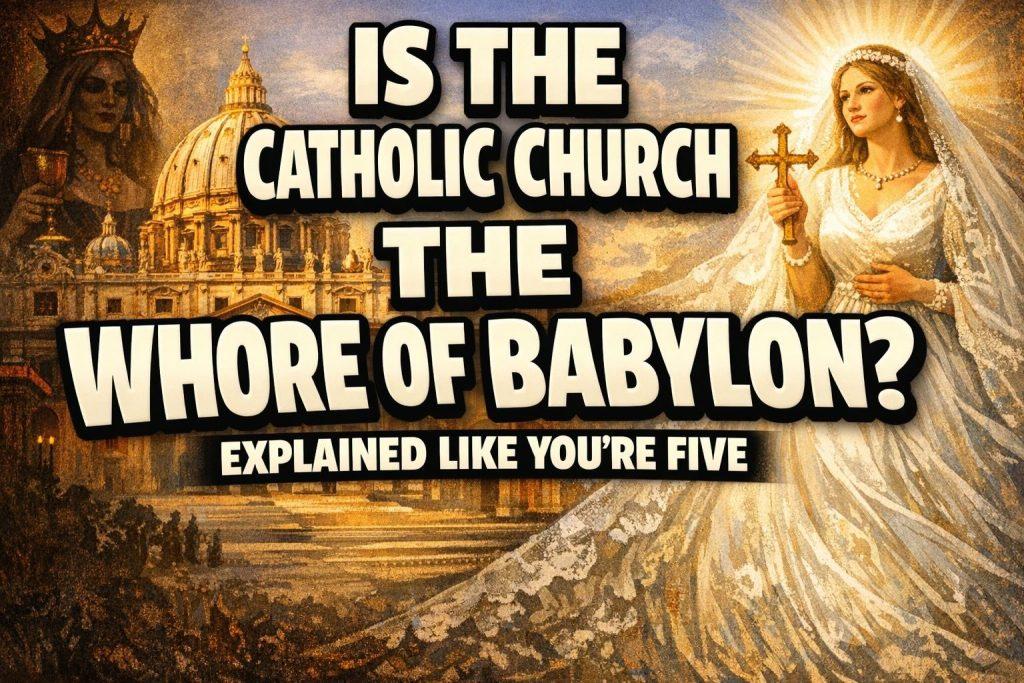
Quick Insights
- The “Whore of Babylon” is a figure from the Book of Revelation written in a special kind of symbolic language, and scholars across many traditions agree it refers to the city of Rome in the first century, not to the Catholic Church.
- The Book of Revelation was written during a time when the Roman Empire was persecuting and killing Christians, and its symbolic images were coded messages of hope for those suffering believers.
- The accusation that the Catholic Church is the Whore of Babylon became common during the Protestant Reformation, but many serious Protestant scholars today reject this interpretation.
- The Catholic Church has produced thousands of saints, martyrs, and missionaries who gave their lives for Jesus Christ, which is the opposite of what a church led by a corrupt enemy of God would produce.
- Reading the Book of Revelation correctly requires understanding its literary style, its historical context, and the way early Christians would have understood its symbols.
- Catholics can answer this charge calmly and confidently, because careful Biblical scholarship and honest history show that the accusation does not hold up under serious examination.
What This Accusation Is and Where It Comes From
The charge that the Catholic Church is the Whore of Babylon described in the Book of Revelation is one of the most serious and most inflammatory accusations ever leveled against the Catholic faith, and it deserves a thoughtful, serious, and historically informed response rather than dismissal or defensiveness. The accusation claims that the vision of a great harlot, seated on a scarlet beast, drunk with the blood of saints, and identified as “the great city that has dominion over the kings of the earth” (Revelation 17:18), is in fact a prophetic description of the Roman Catholic Church and its papacy. To many Catholics encountering this charge for the first time, it sounds almost too absurd to take seriously, but millions of sincere Protestant Christians across several centuries have held it with genuine conviction, and treating it with intellectual respect is both fair to those who hold it and the most effective way of addressing it. The accusation did not originate in casual conversation or popular imagination. It grew directly out of the theological and polemical battles of the Protestant Reformation in the sixteenth century, when reformers including Martin Luther and John Calvin, in seeking to justify their complete rupture with Rome, reached for the most powerful theological condemnation available in the Biblical vocabulary. Luther, who had studied the Book of Revelation carefully, came to identify the Roman Church with the Babylon of Revelation, and his followers embedded this identification in confessional documents and catechisms that shaped Protestant education for generations. The identification served a powerful rhetorical purpose: if Rome is Babylon, then leaving Rome is not schism, meaning sinful division, but righteous flight from corruption. Understanding this historical origin does not settle the Biblical question on its own, but it does reveal that the charge arose in the heat of a particular historical conflict rather than from calm, dispassionate Biblical exegesis, meaning systematic study of the text. The Catechism of the Catholic Church teaches that the Church approaches the reading of Sacred Scripture through careful attention to literary genre, historical context, and the continuous tradition of interpretation (CCC 116).
Understanding the Book of Revelation — The Genre Matters
Before examining the specific images in the Book of Revelation that are used to make this accusation, it is essential to understand what kind of book the Book of Revelation is, because reading it well requires recognizing its literary genre, and misidentifying the genre leads inevitably to misreading the content. The Book of Revelation belongs to a category of ancient religious literature called apocalyptic writing, from the Greek word “apokalypsis” meaning a disclosure or unveiling of hidden things, and this genre has very specific conventions, techniques, and purposes that differ substantially from ordinary historical or prophetic writing. Apocalyptic writing was produced regularly in the Jewish and early Christian world from roughly the second century BC through the second century AD, and its characteristic features include heavy reliance on symbolic numbers, colors, and animals to represent historical realities in coded form; a cosmic framework in which the struggles of human history are set against the background of a conflict between heavenly and demonic powers; and an overriding message of hope directed toward a community under persecution, assuring them that God will ultimately triumph over the powers that oppress them. The Book of Revelation was written in exactly this tradition by an author named John, who identifies himself as a prisoner on the island of Patmos, addressing seven specific Christian communities in the Roman province of Asia Minor who were experiencing real pressure, real persecution, and real temptation to abandon their faith in the face of the demands of the Roman imperial cult. Reading Revelation as a coded message of hope addressed to first-century Christians in a specific historical situation, rather than as a detailed prediction of events two thousand years in the future, is the approach taken by the overwhelming majority of serious Biblical scholars across Catholic, Protestant, and Orthodox traditions today. The Catechism teaches that the interpreter must be attentive to what the human authors intended and to the literary forms in use at their time and culture (CCC 110). Applying this principle to the Book of Revelation transforms the reading experience completely.
Who Was the Original Audience of Revelation?
Identifying the original audience of the Book of Revelation is not merely a matter of historical curiosity. It is the most important single step in reading the book correctly, because John did not write in a vacuum for an abstract future audience. He wrote for specific people in specific places facing specific dangers, and his symbolic imagery was chosen to communicate clearly to those people in their situation. The seven churches John addresses in the opening chapters of Revelation, located in Ephesus, Smyrna, Pergamum, Thyatira, Sardis, Philadelphia, and Laodicea, were all real Christian communities in first-century Asia Minor, and the messages to each of them address specific, identifiable problems: loss of initial fervor, fear of persecution, compromise with pagan culture, moral laxity, and spiritual lukewarmness. These are not generic problems applicable to all churches in all times. They are the specific challenges facing first-century believers navigating life under the Roman Empire. The broader context of the book is the Roman imperial system, which demanded religious loyalty to the Roman gods and to the divine status of the emperor, and which punished those who refused this loyalty with social exclusion, economic disadvantage, and in some cases death. The Emperor Domitian, under whose reign most scholars date the composition of Revelation, was a particularly aggressive enforcer of the imperial cult and a source of active danger to Christians who refused to offer the required acts of worship to the Roman state religion. John writes to encourage these Christians to hold firm, to assure them that God sees their suffering, that the apparent power of Rome is temporary and illusory, and that the Lamb who was slain holds the ultimate authority over history and will bring it to a just and glorious conclusion. The entire symbolic architecture of the book serves this pastoral and encouraging purpose, and the figure of the Whore of Babylon fits naturally into this framework as John’s coded portrayal of the Rome that was currently persecuting his readers. The Catechism affirms that the books of Scripture must be read in the context of the living tradition of the whole Church (CCC 113).
The Whore of Babylon in Her First-Century Context
When John describes the great harlot seated on many waters, clothed in purple and scarlet, drunk with the blood of the saints and the martyrs of Jesus, with the name “Babylon the great, mother of prostitutes and of earth’s abominations” written on her forehead (Revelation 17:1-6), his first-century readers would have decoded this imagery with minimal difficulty because it drew on a well-established symbolic vocabulary familiar to anyone acquainted with Jewish apocalyptic tradition. Babylon was the great empire of the sixth century BC that had destroyed Solomon’s Temple, carried the Israelite people into exile, and served as the paradigmatic image of the God-opposing imperial power in all subsequent Jewish tradition. Using “Babylon” as a coded name for Rome was therefore entirely natural for a Jewish-Christian author wanting to condemn Rome’s persecution of Christians without making his message readable to Roman authorities who might use it against the communities he was addressing. Saint Peter himself uses this same code name in his first letter, closing with greetings “from her who is in Babylon” (1 Peter 5:13), a phrase that virtually all scholars read as a reference to Rome, since Peter was not writing from the literal Babylon in Mesopotamia. The seven hills on which the woman sits (Revelation 17:9) are the seven hills of Rome, one of the most famous geographical facts about the ancient city and a detail that John’s readers would have recognized instantly. The description of the harlot as “the great city that has dominion over the kings of the earth” (Revelation 17:18) is a precise description of first-century Rome, the capital of an empire that controlled the entire known world from Britain to Mesopotamia. The charge that she is “drunk with the blood of the saints and the blood of the martyrs of Jesus” (Revelation 17:6) describes with painful accuracy the Roman persecution of Christians that was costing members of John’s own communities their lives. None of this imagery requires any reference to a religious institution that would not exist for several more centuries.
The Problem with Applying Revelation 17 to the Catholic Church
Applying the vision of the Whore of Babylon in Revelation 17 to the Catholic Church requires a series of interpretive moves that are each individually questionable and that together produce a reading so disconnected from the text’s historical context that it constitutes a fundamental misreading of the book. The first problem is chronological: John wrote the Book of Revelation approximately sixty to seventy years after the Resurrection of Jesus, addressing a first-century situation, and any honest reading of the text must begin by asking what it meant to its original audience before asking what it might mean to later readers. The Catholic Church as an institution with its particular developed structure, its papacy, its councils, its developed sacramental system, and its global scope did not exist when John wrote. Projecting back onto a first-century text the image of a sixteenth-century institution is a hermeneutical error, meaning an error in the method of interpretation, that no serious Biblical scholar would endorse. The second problem is that the description of the woman as drunk with the blood of the martyrs of Jesus applies with devastating accuracy to the Roman Empire, which tortured and executed Christians in the arenas and the prisons of the first and second centuries, and applies in no coherent way to the Catholic Church, which was itself founded by martyrs and has produced more canonized martyrs than any other institution in human history. The third problem is that the harlot in Revelation 17 is destroyed by the beast on which she rides (Revelation 17:16), meaning she is overthrown by the political power she had been allied with, an outcome that corresponds to the historical decline of pagan Rome but bears no resemblance to any event in the history of the Catholic Church. The Catechism teaches that Catholic exegesis, meaning Biblical interpretation, must respect both the literal sense of the text and its proper historical context (CCC 116). Faithful interpretation of Revelation 17 confirms that it describes first-century pagan Rome, not any Christian institution.
The Historical Track Record of the Catholic Church
One of the most powerful responses to the accusation that the Catholic Church is the Whore of Babylon is simply to look honestly at the historical record of what the Church has actually done across twenty centuries and ask whether the fruits of that record are consistent with the identity of a harlot whose master is the devil. The Book of Revelation describes the Whore of Babylon as an enemy of Christ, a persecutor of His followers, and an agent of spiritual destruction. The Catholic Church, whatever its genuine historical failures and sins, has across twenty centuries proclaimed Jesus Christ as Lord and Savior, defended His full divinity and full humanity against every heresy that attacked them, produced thousands of canonized saints whose lives bear unmistakable marks of genuine holiness and genuine union with God, sent missionaries to every corner of the globe at the cost of their lives, built hospitals and schools and universities that served the poor and the sick and the ignorant long before any modern social welfare system existed, and preserved the Scriptures, the sacraments, and the apostolic tradition through every political upheaval and cultural crisis the Western world has experienced. Saint Francis of Assisi, who lived in radical poverty and preached the Gospel to the poor, the sick, and even the Sultan of Egypt, was a Catholic priest. Saint Teresa of Calcutta, who spent her life serving the dying poor in the streets of Calcutta, was a Catholic religious sister. Saint Thomas Aquinas, whose philosophical and theological synthesis shaped Western intellectual culture for eight centuries, was a Catholic friar and priest. The martyrs of Japan, Uganda, England, and Vietnam, who chose death rather than deny their faith in Jesus Christ, were Catholics. An institution that consistently produces this kind of fruit across two thousand years of history is simply not the instrument of the Babylon that John describes in Revelation 17. Jesus’ own criterion applies here: “You will know them by their fruits” (Matthew 7:16).
What the Church Fathers Said About Babylon
Examining what the earliest Christian writers said about the Babylon of Revelation is an important check on whether the identification of Babylon with Rome was always understood in the anti-Catholic sense that later Protestant polemicists gave it. The Church Fathers, writing in the centuries closest to the composition of the New Testament, consistently identified the Babylon of Revelation with the pagan Roman Empire, the persecuting imperial power that was the context of John’s writing, rather than with any Christian institution. Tertullian, writing around 200 AD, identified Babylon in his commentary on Revelation with Rome, meaning the Rome of the emperors who were actively killing Christians. Saint Jerome, the great Biblical scholar of the late fourth century who produced the Latin Vulgate translation, identified Babylon in Revelation with Rome in the sense of the pagan imperial city, not the Christian city that Rome was becoming in his own day. Saint Augustine, in “The City of God,” his masterwork of Christian philosophy and theology written in the early fifth century, contrasted the City of God, meaning the community of those who love God, with the Earthly City, meaning the community organized around self-love and worldly power, and he saw Rome as an instance of the Earthly City, but he distinguished between the pagan Rome of the emperors and the Christian Rome that was emerging in his time. None of the Church Fathers applied the image of Babylon to the Catholic Church or to the papacy. This patristic consensus, meaning the agreement of the early Church writers, is significant because these writers were closest in time to the composition of Revelation, shared the cultural and linguistic world of its author, and had no political or polemical reason to protect Rome from criticism. Their unanimous identification of Babylon with pagan imperial Rome rather than with the Christian Church carries genuine interpretive weight.
Why the Reformation Made This Identification
To understand why the Protestant Reformers identified the Catholic Church with the Whore of Babylon, it is necessary to understand the historical and emotional context of the Reformation, because the identification made a kind of polemical sense within that context even if it makes no exegetical sense, meaning no sense in terms of what the Biblical text actually says. The early sixteenth century was a period of genuine and serious corruption in parts of the Catholic Church. The Renaissance papacy, in particular, had been marked by political machination, financial exploitation through the sale of indulgences, nepotism, and in some cases personal moral failure of a genuinely scandalous kind. Martin Luther encountered this corruption directly when he traveled to Rome in 1510 and was shocked by what he saw, and his growing conviction that the Church needed radical reform was not simply a theological abstraction but a response to real abuses that many faithful Catholics also recognized and lamented. When Luther’s reform efforts were rejected by Rome and he was excommunicated, he needed a theological framework that would justify his break with the Church that Jesus had founded, and the identification of the papacy with the Antichrist and the Church with the Whore of Babylon provided that framework. If Rome was Babylon, then leaving Rome was obedience to Revelation’s command “Come out of her, my people” (Revelation 18:4). The identification was therefore not primarily an exegetical conclusion reached through careful study of Revelation. It was a theological weapon forged in the heat of a conflict, and it worked powerfully in that conflict precisely because of the genuine corruption that gave it some surface plausibility. The Catholic Church’s own historians acknowledge the real abuses of the Renaissance period, and the Council of Trent, which met from 1545 to 1563, undertook a serious and thoroughgoing reform of many of the practices the Reformers had criticized. The existence of genuine corruption in a human institution does not transform it into the Whore of Babylon, any more than the sins of King David made Israel the enemy of God rather than His covenant people.
Serious Protestant Scholars Who Reject This Identification
The identification of the Catholic Church with the Whore of Babylon is not, it should be clearly stated, the position of the majority of serious Protestant Biblical scholars today, and this convergence of non-Catholic scholarly opinion is important for Catholics to know when they encounter the accusation. The Westminster Confession of Faith, one of the most historically significant confessional documents of Reformed Protestantism, originally contained an explicit identification of the papacy with the Antichrist, and many denominations that formally subscribed to this confession have either removed or softened this identification in recognition of its exegetical indefensibility. Prominent New Testament scholars including N.T. Wright, a former Anglican bishop and one of the most widely read New Testament scholars in the English-speaking world, consistently interpret the Babylon of Revelation in its first-century context as a reference to Rome and explicitly reject the application of these images to the Catholic Church as historically and exegetically irresponsible. Craig Keener, a prolific evangelical New Testament scholar, treats the Babylon of Revelation as a reference to the Rome of the emperors in his extensive commentary on Revelation and does not apply it to any subsequent Christian institution. Gordon Fee and Douglas Stuart, in their widely used textbook on Biblical interpretation used in Protestant seminaries across the world, specifically warn against the error of reading Revelation’s first-century imagery as if it were directed at institutions that did not exist when John wrote. The ecumenical dialogues of the twentieth century, which brought Catholic and Protestant theologians into sustained and serious scholarly conversation for the first time since the Reformation, produced among their fruits a broadly shared scholarly agreement that the polemical application of Revelation’s Babylon imagery to the Catholic Church represents one of the clearest examples of Reformation-era exegesis requiring correction.
The Catholic Church and the Blood of the Saints
One specific charge embedded in the Babylon accusation that requires direct and honest engagement is the claim that the Catholic Church, like the Whore of Babylon, is “drunk with the blood of the saints and the blood of the martyrs of Jesus” (Revelation 17:6). This charge typically refers to the Inquisition, to the execution of Protestant reformers and dissenters, and to the violence of religious wars in which Catholics participated, and it is framed as evidence that the Catholic Church persecutes and kills the true followers of Jesus. The Catholic Church must acknowledge honestly that there have been serious failures and genuine sins in its history, including the Inquisition, the execution of heretics, and participation in religious violence, and the Church has in fact made such acknowledgments explicitly. Pope Saint John Paul II, during the Great Jubilee of 2000, led a historic day of pardon in which the Church publicly acknowledged the sins committed by its members across history, including violence done in the name of faith. These acknowledgments are real and important, and no honest Catholic apologist should minimize the suffering that was caused by these historical failures. At the same time, the historical record requires careful examination rather than wholesale acceptance of the charges made against the Church in the heat of anti-Catholic polemic. The Inquisition, in its various forms and periods, was far less extensive, far less bloody, and far more constrained by procedural rules than the popular myth of the Inquisition suggests, as modern historians including Henry Charles Lea, Henry Kamen, and Edward Peters have documented at length. The execution of Protestant martyrs was carried out in a political and social context in which all parties to the religious conflict, Protestant states included, used state violence against religious dissenters, and Protestant rulers executed Catholics in England, Switzerland, and elsewhere with equal or greater ferocity. These facts do not excuse the Catholic Church’s failures, but they do place them in a context that makes the charge of being drunk with the blood of the saints deeply ironic, since the Catholic Church itself has martyrs in every century and in every part of the world.
The Woman Clothed with the Sun — The Other Woman in Revelation
A dimension of Revelation’s imagery that is often overlooked in discussions of the Whore of Babylon accusation is the presence in the same book of a second woman, a figure of entirely different character and significance, who appears in chapter twelve. John writes: “A great sign appeared in heaven, a woman clothed with the sun, with the moon under her feet, and on her head a crown of twelve stars. She was with child and she cried out in her pangs of birth, in anguish for delivery” (Revelation 12:1-2). This woman gives birth to a son who is caught up to God’s throne, meaning the Messiah, and she is then protected by God in the wilderness from the dragon who seeks to destroy her. Catholic tradition has always identified this woman with both Mary, the mother of Jesus, and with the Church, the community that bears Christ to the world. The contrast between the two women in Revelation, the harlot of chapter seventeen and the glorious woman of chapter twelve, is sharp and deliberate, and it operates as a theological counterpoint: one woman is the enemy of God’s people, the other is their mother and their protector. If any woman in the Book of Revelation is to be associated with the Catholic Church, the tradition identifies it as the woman clothed with the sun, the mother of the Messiah and the persecuted community of the faithful, not the harlot of Babylon. This reading, grounded in the internal logic of Revelation itself and in the continuous tradition of the Church’s interpretation, inverts the anti-Catholic accusation and places the Catholic Church in the position of the community that suffers at the hands of the world’s powers rather than the institution that wields those powers against God’s people. The Catechism draws on the symbolism of Revelation 12 in its treatment of Mary’s relationship to the Church, seeing in this vision a portrait of the Church in its pilgrimage through history toward the fullness of the Kingdom (CCC 972).
The City on Seven Hills — What This Really Means
The most specific geographical clue in Revelation’s description of the Whore of Babylon is the reference to the seven hills or mountains on which the woman sits, and anti-Catholic interpreters have consistently applied this image to Rome, specifically to Catholic Rome, as if the seven hills of Rome were uniquely and permanently a mark of the Antichrist. The reference to seven hills is indeed almost certainly a reference to Rome, but the Rome in question is the pagan imperial Rome of John’s own time, and applying it to Catholic Rome requires ignoring the historical context completely. The seven hills of Rome were a geographical reality that predated Christianity by centuries. They were the topographical feature around which the Roman city grew and that gave it its famous epithet “the city on seven hills” long before any Christian community existed there. When John uses this image, his first-century readers would have understood it as a reference to the Rome they already knew, the Rome of the Caesars who were at that moment persecuting their communities. The fact that the Catholic Church later established itself in this same city does not transfer the symbolic condemnation from pagan imperial Rome to the Church that happened to set up its headquarters in the same geographical location. By this logic, any institution located in Rome or any city built on hills would be equally implicated in John’s vision, which is an obvious reductio ad absurdum, meaning a reduction to an absurd conclusion. The city of Istanbul, built on seven hills like Rome, would be equally guilty. The city of Lisbon, also built on seven hills, would share the condemnation. The symbolic geography of Revelation points to the political and religious power of the first-century Roman Empire, and that is where its application ends. The Catechism teaches that the allegorical sense of Scripture, meaning the way its images and events point to realities beyond their immediate context, must always be grounded in the literal sense and cannot be applied arbitrarily to whatever contemporary target a reader wishes to condemn (CCC 116).
The Purple and Scarlet Robes — Colors and Their Meanings
Anti-Catholic interpreters frequently point to the description of the Whore of Babylon as clothed in purple and scarlet and adorned with gold, jewels, and pearls (Revelation 17:4) as a reference to the vestments worn by Catholic bishops and cardinals, whose liturgical dress does indeed include purple and red. This argument sounds specific and concrete at first hearing, but it dissolves under the slightest historical scrutiny. Purple and scarlet were the colors of wealth and power in the ancient Roman world, not specifically religious colors. Purple dye in the ancient world was extraordinarily expensive, derived from a sea creature called the murex, and wearing purple was a sign of imperial and aristocratic status. Scarlet similarly signified wealth, power, and military achievement in Roman culture. When John describes the harlot wearing purple and scarlet, he is using the color vocabulary of Roman imperial power to characterize the entity he is describing, the powerful, wealthy, and politically dominant city of Rome. The later adoption of these colors by the Catholic Church for liturgical purposes reflects not a demonic inheritance from the Whore of Babylon but the Church’s use of the color conventions of the culture in which it grew up, just as the Church adopted the basilica, meaning the Roman public building form, as the model for its churches. The logic that Catholic bishops wearing red makes the Catholic Church the Whore of Babylon would equally condemn the British monarchy for wearing crowns, since the harlot also wears a gold headpiece. It would condemn every wealthy institution that has ever existed, since the harlot is described as rich. The argument proves far too much and in proving too much reveals its own weakness, since if every institution that wears red and possesses wealth is the Whore of Babylon, then the term has ceased to identify any specific historical entity and has become a free-floating accusation applicable to anyone the accuser wishes to condemn. The Catechism teaches that responsible interpretation of Scripture requires careful attention to the specific meaning of images in their original cultural context rather than superficial pattern-matching with later institutions (CCC 110).
The Ecumenical Significance of Getting This Right
The question of whether the Catholic Church is the Whore of Babylon is not merely an academic or historical question. It has direct and serious consequences for the possibility of genuine Christian unity, which Jesus declared to be His will when He prayed “that they may all be one” (John 17:21) on the night before His death. The Second Vatican Council’s Decree on Ecumenism, Unitatis Redintegratio, taught that the restoration of unity among all Christians is one of the principal concerns of the Council and of the whole Church, and that the division of Christians is a wound to the Body of Christ that weakens the Church’s witness to the world. Genuine ecumenical dialogue, meaning honest and respectful theological conversation aimed at healing division, is impossible between partners one of whom believes the other’s institution is literally the demonic harlot of Revelation 17. The charge of being the Whore of Babylon is therefore not merely an intellectual error to be corrected. It is a serious obstacle to the Christian unity that Christ wills, and correcting it is itself a service to that unity. Many Protestant denominations and theologians have in recent decades recognized this and have moved to correct or repudiate the identification of Rome with Babylon in their confessional documents and their public teaching. The Joint Declaration on the Doctrine of Justification, signed by the Catholic Church and the Lutheran World Federation in 1999, represented a landmark moment in the healing of precisely the division from which the Babylon accusation originally sprang, and its possibility required that both sides be willing to look past the polemical excesses of the Reformation period to the genuine shared faith in Jesus Christ that had always existed beneath the conflict. The Catechism teaches that Catholic participation in the ecumenical movement is a response to the grace of the Holy Spirit calling all Christians toward the unity for which Christ prayed (CCC 821).
How Catholics Should Respond to This Charge
Catholics who encounter the accusation that the Catholic Church is the Whore of Babylon, whether in conversation, in anti-Catholic literature, or in online debates, do well to respond with the combination of intellectual confidence, factual accuracy, and genuine charity that Catholic apologetics at its best has always modeled. The first step is to understand and explain the literary genre of the Book of Revelation, because the accusation depends entirely on misreading the genre, and once the genre is understood correctly the accusation loses its textual foundation. The second step is to identify the historical context of Revelation’s composition, specifically the first-century Roman persecution of Christians, and to show how every detail of the Babylon imagery fits that context without remainder and without requiring any reference to a later institution. The third step is to invite the person making the accusation to specify which of Saint John’s defining characteristics of the Whore of Babylon, a figure who persecutes and kills the followers of Jesus, who denies Christ, and who is allied with the beast against the Church, applies to the Catholic Church, and then to respond to each specification with the historical and theological facts. The fourth step, if the conversation permits it, is to introduce the positive Catholic reading of the woman of Revelation 12, the woman clothed with the sun who bears the Messiah and is persecuted by the dragon, as the image the tradition identifies with Mary and with the Church. Throughout all of this, the Catholic should resist the temptation to respond to the charge with anger or contempt, because the person making it very often genuinely believes they are defending the truth of Scripture and protecting fellow Christians from a dangerous institution. Engaging their concern with patience and respect, while correcting the errors on which the concern rests, is both the charitable and the most effective response. The Catechism calls every Catholic to be ready to give a reason for the hope that is in them, with gentleness and respect (1 Peter 3:15) (CCC 2471).
What This All Means for Catholics Who Love the Church
The accusation that the Catholic Church is the Whore of Babylon, examined carefully and honestly in the light of the Biblical text, its historical context, its literary genre, and the continuous tradition of Christian interpretation, does not hold up. The Whore of Babylon in the Book of Revelation is the pagan imperial Rome of the first century, the persecuting power that was at that moment killing the Christians to whom John wrote, and every detail of John’s symbolic description fits that historical reality with precision. No serious feature of the description applies coherently to the Catholic Church, which was founded by martyrs, has produced martyrs in every century, has proclaimed Jesus Christ as Lord and Savior without interruption since the time of the apostles, and has been the primary institutional custodian of the Scriptures that contain the Book of Revelation itself. The accusation arose not from careful Biblical study but from the heat of the Protestant Reformation, a period of genuine religious and political conflict in which both sides made the strongest possible case against each other, sometimes at the expense of historical and exegetical accuracy. Many Protestant denominations and scholars have since recognized this and have moved to correct the identification. Catholics can engage this question with genuine intellectual confidence, knowing that the evidence from the text, from history, and from the broadening consensus of serious scholarship all points in the same direction. More importantly, Catholics who love the Church can draw genuine comfort and encouragement from reflecting on what the Church actually is: the community founded by Jesus Christ on the apostles, sustained by the Holy Spirit across two thousand years of human weakness and divine fidelity, producing saints and martyrs and missionaries and servants of the poor in every century and every culture, preserving the Word of God and the sacraments that make His grace available to every human being who seeks it. That community is not Babylon. It is the Bride of Christ, adorned for her Bridegroom, imperfect in her human members but holy in her Head, and moving through history toward the Wedding Feast of the Lamb that the final chapters of Revelation describe.
⚠ Disclaimer: This article presents Catholic teaching for educational purposes only. The content shared on CatholicAnswers101.com is intended to inform and support the faithful in their understanding of the Catholic faith, and does not constitute official Church teaching or magisterial authority. For authoritative and official Church teaching, we encourage readers to consult the Catechism of the Catholic Church and relevant magisterial documents. For personal spiritual guidance, pastoral advice, or matters of conscience, please consult your parish priest or a qualified spiritual director. For any questions, corrections, or inquiries regarding the content on this site, please contact us at editor@catholicanswers101.com.