
Quick Insights
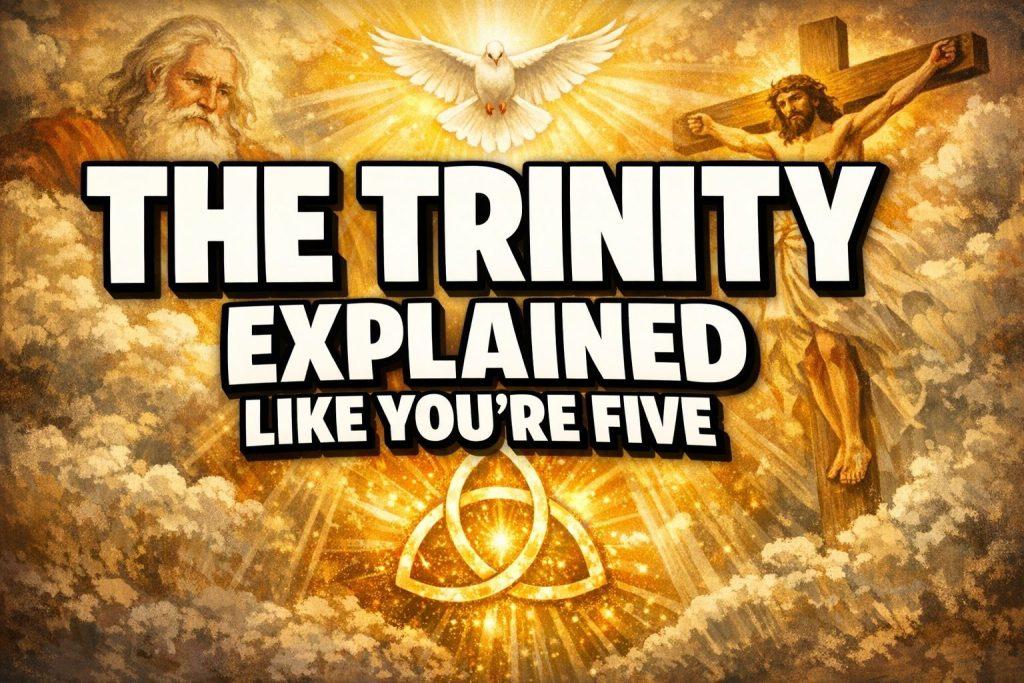
- The Trinity means that there is one God who exists as three Persons: the Father, the Son, and the Holy Spirit.
- The three Persons of the Trinity are not three separate gods but one God who has always existed in a relationship of perfect love.
- God the Father is the Creator who made everything and loves us as a perfect Father loves his children.
- God the Son is Jesus Christ, who became a human being, died for our sins, and rose from the dead to open the way to eternal life.
- God the Holy Spirit is the Third Person who lives inside every baptized person and helps us know God, pray, and live good lives.
- The Trinity is the most important mystery in the Catholic faith, meaning it is a truth so big and so deep that no human mind will ever fully understand it, even in Heaven.
What the Trinity Is and Why It Matters
The mystery of the Holy Trinity is the central and most fundamental truth of the entire Catholic faith, and every other Christian doctrine connects back to it in some essential way. When the Church says God is a Trinity, it means that the one God who created everything and who revealed Himself to Israel exists eternally as three distinct Persons: the Father, the Son, and the Holy Spirit. This is not a complicated way of saying God has three jobs, three names, or three different moods. It is a precise and carefully considered claim about the actual inner life of God, about who God is in Himself before He ever created a single thing. The word “Trinity” does not appear in Sacred Scripture, but the reality it describes does, and the Church arrived at this precise terminology through centuries of prayerful reflection on the Scriptures, on the apostolic tradition, and on the lived experience of baptism and worship. The Catechism of the Catholic Church teaches that the Trinity is the central mystery of the Christian faith and of Christian life, and that it is the mystery of God in Himself, the source of all other mysteries of faith (CCC 234). To call the Trinity a “mystery” in the Catholic sense does not mean it is merely puzzling or confusing. It means it is a truth that exceeds the full capacity of the human mind to comprehend, not because it is irrational or contradictory, but because God is so much greater than any created intellect. A mystery in this sense is not a locked door. It is an open door into a room so vast that a lifetime of exploration, and indeed an eternity, will never exhaust its depths. Understanding the Trinity as well as we are able to in this life is not an optional extra for advanced Catholics. It is the starting point for knowing God as He truly is.
The Trinity Is Not Three Gods
One of the most important things to understand about the Trinity is what it does not mean, because the most natural human misunderstanding is to imagine that Father, Son, and Holy Spirit are three separate divine beings who cooperate closely with each other. This view, called tritheism, meaning the belief in three gods, is flatly contradicted by both Scripture and Tradition, and the Church has always rejected it clearly and firmly. The God of the Old Testament insists with relentless force that He is one. The great profession of Jewish faith, the Shema, begins: “Hear, O Israel: the LORD our God, the LORD is one” (Deuteronomy 6:4). Jesus quotes this passage Himself when a scribe asks Him which commandment is the greatest (Mark 12:29). The New Testament does not abandon this Jewish monotheism, meaning the belief in one God. It deepens it by revealing that the one God is, in His inner life, a communion of three Persons. Saint Paul writes to the Corinthians of “one God, the Father, from whom are all things” (1 Corinthians 8:6), and the entire New Testament maintains the assumption that there is one God, not three. The three Persons do not split the divine nature among themselves, as if the Father had one third of divinity, the Son another third, and the Spirit the remaining third. Each Person is fully and completely God. The Father possesses the fullness of the divine nature. The Son possesses the fullness of the divine nature. The Holy Spirit possesses the fullness of the divine nature. The Catechism teaches that the divine persons do not share the one divinity among themselves but each of them is God whole and entire (CCC 253). The unity of God is therefore not threatened by the Trinity. It is the very foundation on which Trinitarian faith rests.
The Trinity Is Not One Person Wearing Three Masks
A second common misunderstanding runs in the opposite direction from tritheism and is equally mistaken. This error, called modalism or Sabellianism after an early third-century teacher named Sabellius, holds that the Father, Son, and Holy Spirit are simply three different roles, modes, or appearances of the one God, rather than three genuinely distinct Persons. On this view, the same God who created the world as Father became incarnate as the Son and then came at Pentecost as the Holy Spirit, wearing different masks at different times in history. This error has a certain surface plausibility because it sounds like a simple and clean way to preserve both monotheism and the distinct names of Father, Son, and Spirit. The Church rejected it firmly because it directly contradicts what Scripture shows us. At the baptism of Jesus, for example, the Son stands in the water, the Holy Spirit descends from above in the form of a dove, and the Father speaks from heaven: “This is my beloved Son, with whom I am well pleased” (Matthew 3:17). Three genuinely distinct Persons are present and acting simultaneously in this scene, which cannot be the case if they are merely sequential roles of the same Person. Similarly, Jesus prays to the Father throughout the Gospels, and His prayer is a real conversation between two genuinely distinct Persons, not a performance for the benefit of onlookers. The Catechism teaches that the three divine Persons are truly distinct from one another, and that it is the Father who generates, the Son who is begotten, and the Holy Spirit who proceeds, making their distinction real and not merely apparent (CCC 254). This distinction within the one God is not a division. The three Persons are distinct but never separate, different but never divided, three but always perfectly one.
The Father — The First Person of the Trinity
The First Person of the Holy Trinity, God the Father, is the source and origin within the life of the Trinity itself, not in the sense of being older or greater than the Son and the Spirit, but in the sense of being the unoriginated origin from whom the Son is eternally begotten and from whom the Spirit eternally proceeds. The title “Father” is not a human projection onto God, as if we are simply imagining that God resembles a human parent. Rather, every good human father dimly reflects the perfect fatherhood that God the Father possesses in absolute fullness. Jesus teaches His disciples to address God as Father with a directness and intimacy that scandalized His contemporaries. In the Lord’s Prayer He instructs them to say “Our Father” (Matthew 6:9), and in the Garden of Gethsemane He prays to the Father using the Aramaic word “Abba” (Mark 14:36), a term of close personal intimacy that early Christians also applied to their own prayer to God. God the Father is the Creator of heaven and earth, the one from whom all things come and to whom all things return. The entire created universe, from the smallest particle of matter to the most distant galaxy, exists because the Father, acting in unity with the Son and the Spirit, freely willed it into being out of nothing. His fatherhood extends beyond creation in the most intimate sense to the baptized, who through grace receive a genuine share in the divine sonship of Jesus and can truly call God their Father, not as a polite religious phrase but as a statement of real spiritual fact. The Catechism teaches that God the Father is almighty because His power is universal, loving, and interior to all things, and that nothing is impossible with God (Luke 1:37) (CCC 268).
The Son — The Second Person of the Trinity
The Second Person of the Holy Trinity is the Son, the Word, the eternal self-expression of the Father, and the one who in the fullness of time took on human nature and was born as Jesus of Nazareth. The relationship between the Father and the Son within the eternal life of God is one of perfect, mutual, and total love. The Father generates the Son from all eternity, communicating to the Son the fullness of the divine nature, and the Son receives this nature perfectly and completely, knowing and loving the Father in return with the same infinite perfection. The Gospel of John opens with the most profound statement about the Son anywhere in Scripture: “In the beginning was the Word, and the Word was with God, and the Word was God” (John 1:1). The Greek word “Logos,” translated here as “Word,” carries rich philosophical and theological meaning: it refers to the rational principle, the divine self-expression, through which God reveals Himself and through whom the Father creates all things. John then makes the earth-shaking announcement: “And the Word became flesh and dwelt among us, full of grace and truth” (John 1:14). The eternal Son of God took on a real human nature in the womb of the Virgin Mary, without ceasing to be God, without diminishing His divinity in any way, and without confusing or mixing His divine and human natures. He lived a fully human life, suffered a real death, rose bodily from the dead, and ascended in His glorified humanity to the right hand of the Father. The Catechism teaches that the Son is eternally begotten of the Father, God from God, Light from Light, true God from true God, as the Nicene Creed proclaims, and that His eternal generation from the Father is the foundation of His mission in time (CCC 242).
The Holy Spirit — The Third Person of the Trinity
The Third Person of the Holy Trinity is the Holy Spirit, and grasping the Spirit’s place within the divine life requires understanding the relationship between the Father and the Son that the Spirit completes and expresses. The great tradition of Western theology, developed especially by Saint Augustine and refined by Saint Thomas Aquinas, describes the Holy Spirit as the personal love of the Father and the Son, the living bond of their mutual gift to each other, so real and so perfect that this love is itself a Person. The Father loves the Son with an infinite love, and the Son returns that love to the Father with equal infinity, and the Holy Spirit is the eternal “fruit” of that perfect mutual love, proceeding from both the Father and the Son as a single shared act of love-giving. The Nicene Creed articulates this by saying the Spirit “proceeds from the Father and the Son,” which the Western Church has held from early centuries against the Eastern tradition that says the Spirit proceeds from the Father alone through the Son. This difference is one of the theological tensions between the Catholic and Orthodox traditions, but both agree that the Holy Spirit is fully and completely God, the Lord and giver of life, co-equal and co-eternal with the Father and the Son. The Spirit descends on Jesus at His baptism, drives Him into the desert, anoints His public ministry, and is promised to the disciples as the Paraclete, meaning Helper and Advocate, who will remain with the Church forever. The Catechism teaches that the Holy Spirit is inseparable from the Father and the Son in both the inner life of God and in every act of God toward creation, and that wherever the Father sends His Word, He always sends His Breath as well (CCC 689).
How the Church Came to Define the Trinity
The precise language the Catholic Church uses to describe the Trinity did not spring fully formed from a single moment of inspiration. It developed gradually over the first four centuries of Christian history through a process of prayerful reflection on Scripture, debate with those who proposed insufficient explanations, and the authoritative guidance of the Holy Spirit acting through the bishops gathered in council. The first great crisis came in the early fourth century when a priest named Arius taught that the Son of God was the greatest of all creatures but not truly God in the same full sense as the Father. Arius’s slogan, “there was a time when he was not,” implied that the Son had a beginning in time and was therefore not eternal. This teaching spread widely and caused enormous controversy throughout the Christian world. The First Council of Nicaea, convened in 325 AD under Emperor Constantine, condemned Arianism and defined that the Son is “consubstantial” with the Father, meaning He shares the same divine nature or substance. The Greek word used was “homoousios,” a term that seemed to some bishops to go beyond the literal vocabulary of Scripture, but which the council judged to be the most accurate way of expressing what Scripture clearly teaches about the Son. Controversy continued even after Nicaea, and the question of the Holy Spirit’s full divinity was settled at the First Council of Constantinople in 381 AD, which expanded the Nicene Creed with a fuller affirmation of the Spirit’s divine identity and His role as the giver of life. The Catechism teaches that the formulation of Trinitarian doctrine in the early councils was not an innovation that departed from the apostolic faith but a faithful clarification and defense of what the Church had believed from the beginning (CCC 250).
The Trinity in Sacred Scripture
Scripture does not present a systematic theological treatise on the Trinity, but every part of the New Testament assumes the Trinitarian reality as the framework within which it makes sense. The clearest single Trinitarian text in the Gospels is the baptismal command Jesus gives to His apostles after the Resurrection: “Go therefore and make disciples of all nations, baptizing them in the name of the Father and of the Son and of the Holy Spirit” (Matthew 28:19). The singular word “name” rather than “names” is significant: the Father, Son, and Holy Spirit share one divine name, pointing to their unity of nature even as their personal distinctness is named. Saint Paul concludes his second letter to the Corinthians with what has become one of the most familiar Trinitarian blessings in the liturgy: “The grace of the Lord Jesus Christ and the love of God and the fellowship of the Holy Spirit be with you all” (2 Corinthians 13:14). The baptism of Jesus in the Jordan, the Transfiguration on the mountain, the Last Supper discourses in John, the sending of the Spirit at Pentecost, and the great hymns of Philippians and Colossians all either show or imply the Three Persons acting in distinct yet perfectly coordinated ways. The Old Testament also contains anticipations of the Trinity, most notably in the plural language of creation, “Let us make man in our image” (Genesis 1:26), and in the mysterious appearance of three visitors to Abraham at Mamre (Genesis 18:1-3), which early Christian interpreters including Saint Augustine read as a foreshadowing of the Trinity. The Catechism teaches that the whole of Scripture is Trinitarian in its deepest structure, because it tells the story of God’s self-revelation as Father, Son, and Holy Spirit (CCC 236).
Analogies for the Trinity — What Helps and What Fails
Because the Trinity is a mystery that surpasses human comprehension, theologians and catechists across the centuries have reached for analogies, meaning comparisons drawn from ordinary experience, to help make the doctrine more accessible without reducing it to something false. Saint Patrick famously used the three-leaved shamrock as a teaching aid, showing how three distinct leaves can belong to one plant. Saint Augustine spent many years looking for analogies within the human mind, noticing that the acts of memory, understanding, and will in a single person might dimly reflect the Trinitarian structure of God’s inner life. He developed this analogy with great sophistication in his work “De Trinitate,” acknowledging throughout that every analogy ultimately breaks down because God is infinitely greater than any human experience can capture. The analogy of water, ice, and steam is popular in informal religious education, but it actually illustrates the heresy of modalism by suggesting that God is one substance appearing in three different states rather than one nature existing in three distinct Persons. The analogy of the sun, its light, and its warmth has a longer theological pedigree and is found in early Church writers, but it too has limitations because it can suggest that the Son and Spirit are somehow less than the Father rather than fully equal to Him. The analogy that the tradition finds most useful, even while acknowledging its limits, is the analogy of love: a lover, a beloved, and the love between them. This analogy, developed by Richard of Saint Victor in the twelfth century, captures something real about the relational nature of the Trinity and about why love is so central to the divine life. The Catechism acknowledges the legitimate use of analogies while insisting that no created reality can fully represent the uncreated mystery of God (CCC 42).
The Trinity and Creation
The Catholic Church teaches that all three Persons of the Trinity are active in the work of creation, and that the created world bears the marks of its Trinitarian origin in ways that careful reflection can begin to detect. The opening verses of Genesis show the Spirit of God moving over the waters, the Word through whom all things are made present at the very beginning of creation, and the Father whose creative will brings everything into existence. Saint John confirms the Son’s role in creation: “All things were made through him, and without him was not anything made that was made” (John 1:3). Saint Paul adds that the Son is the one “in whom all things hold together” (Colossians 1:17), meaning the Son is not only the agent of creation but the ongoing principle of its coherence and continuity. This Trinitarian understanding of creation has profound implications for how Catholics think about the natural world. The universe is not the product of blind chance or impersonal forces. It is a free and loving act of the Triune God, made with wisdom and care and ordered toward a destination. The Catechism teaches that the Father creates through the Son in the Holy Spirit, and that this Trinitarian action is the source of the order, beauty, and goodness present in the created world (CCC 292). Human beings hold a special place within this Trinitarian creation because they alone among all earthly creatures are made “in the image and likeness of God” (Genesis 1:26). The Catechism interprets this image primarily in terms of the human capacity for reason, freedom, and love, the three facets of human existence that most directly reflect the Trinitarian God in whose image we are made (CCC 356).
The Trinity and the Incarnation
The Incarnation, the event in which the Son of God took on human nature and was born as Jesus of Nazareth, is a fundamentally Trinitarian event, and understanding it correctly requires seeing all three Persons at work. The Father sent the Son: “For God so loved the world that he gave his only-begotten Son, that whoever believes in him should not perish but have eternal life” (John 3:16). The Son freely accepted the mission the Father gave Him, emptying Himself, as Saint Paul writes, “taking the form of a servant, being born in the likeness of men” (Philippians 2:7). The Holy Spirit brought about the conception of Jesus in the womb of Mary: “The Holy Spirit will come upon you, and the power of the Most High will overshadow you” (Luke 1:35). Throughout the earthly life of Jesus, the Trinity continues to act in a coordinated and distinct way. The Father speaks His approval over the Son at the baptism and the Transfiguration. The Spirit anoints Jesus at His baptism, leads Him into the desert, and empowers His ministry of healing and teaching. The Son obeys the Father perfectly in everything He does and says, and He promises to send the Spirit from the Father after His return to heaven. The cross itself is a Trinitarian act: the Father gives His Son, the Son offers Himself freely, and the Letter to the Hebrews tells us that Christ offered Himself “through the eternal Spirit” (Hebrews 9:14). The Catechism teaches that the entire economy of salvation, meaning the whole plan by which God saves humanity, is the common work of the three divine Persons, even as each contributes to that work in a way proper to His own identity (CCC 258).
The Trinity and the Life of Grace
The mystery of the Trinity is not simply a doctrine to be believed and then set aside while getting on with the practical business of living the Christian life. It is the very foundation and source of the Christian life, because the life of grace is nothing other than a real participation in the inner life of the Trinity itself. When Jesus promises that He and the Father will come and make their home in the one who loves Him (John 14:23), He is not speaking metaphorically. He means that through the grace of baptism and the ongoing work of the Holy Spirit, the believer enters into a genuine personal relationship with each of the three Persons of the Trinity. The Father adopts the baptized as His children, giving them a real share in the divine sonship of Jesus. The Son dwells in the believer through faith and the Eucharist, forming His own life and character within them. The Holy Spirit takes up residence in the soul of the baptized as in a temple, as Saint Paul says: “Do you not know that your body is a temple of the Holy Spirit within you?” (1 Corinthians 6:19). This indwelling of the Trinity is the deepest reality of the Christian life, more real than anything we can see or touch, more permanent than any human relationship, and more transformative than any effort of human willpower. The theological tradition calls this reality “sanctifying grace,” meaning the grace that makes a person holy, and it is nothing less than the life of God shared with a creature. The Catechism teaches that the whole life of the Christian is a communion with each of the three Persons of the Trinity, and that this communion is the source from which the moral and spiritual life of the Christian flows (CCC 259).
The Trinity and Prayer
Understanding the Trinity transforms the act of prayer from a vague reaching out toward a distant deity into a precisely directed conversation with the living God as He actually is. Catholic liturgical prayer follows a Trinitarian structure that is both ancient and deeply intentional: prayers are typically addressed to the Father, offered through the Son, in the power of the Holy Spirit. The great Eucharistic prayers of the Mass follow this pattern, and the Gloria, the Sanctus, and the final doxology of the Mass all reflect the same Trinitarian orientation. The Sign of the Cross, which Catholics make upon themselves at the beginning and end of prayer and when entering or leaving a church, is a brief but complete Trinitarian profession of faith: “In the name of the Father, and of the Son, and of the Holy Spirit.” The Gloria Patri, commonly called the Glory Be, offers praise directly to all three Persons and affirms their eternal co-equality: “Glory be to the Father, and to the Son, and to the Holy Spirit, as it was in the beginning, is now, and ever shall be, world without end.” Baptism is performed in the threefold name of the Trinity, and the blessing of the bishop at the end of Mass calls down the grace, peace, and love of all three Persons upon the congregation. The Catechism teaches that the whole liturgical life of the Church revolves around the Trinitarian mystery, and that the sacraments are always actions of the Holy Trinity because the Trinity dwells in the Church (CCC 1077). A Catholic who understands this Trinitarian structure of the liturgy attends Mass not as a passive observer of religious ceremonies but as a participant in the very life of God.
The Trinity and Human Love
One of the most practically significant implications of Trinitarian theology is what it reveals about the nature of love itself. The God who is a Trinity of Persons is not merely a God who loves. He is, as Saint John tells us, Love itself: “God is love, and whoever abides in love abides in God, and God abides in him” (1 John 4:16). The deepest reason why God is love is precisely that He is a Trinity. Love, by its very nature, requires a lover and a beloved and the bond of love between them. A solitary being, no matter how powerful or wise, cannot be love in the fullest sense, because love is inherently relational. The Trinity shows us that God is, in His very being, a perfect relationship of self-giving love: the Father gives Himself entirely to the Son, the Son returns Himself entirely to the Father, and the Holy Spirit is the eternal expression of that mutual self-giving. This has direct and transformative implications for how human beings understand love in their own lives. Human love, at its best and most genuine, reflects the Trinitarian structure of God’s inner life: it is self-giving rather than self-seeking, it moves outward toward the other rather than circling back on itself, and it produces a fruitfulness that overflows beyond the original relationship. The love between a husband and wife, when ordered toward its proper ends, images the Trinitarian love of God in a particularly direct way, which is why the Catholic Church speaks of the family as a “domestic church,” a small community whose life of love is meant to reflect the communion of the Trinity. The Catechism teaches that the vocation of every human person is ultimately to participate in the communal life of the Trinity, and that every authentic form of human love is a participation in and reflection of divine love (CCC 1604).
Misunderstandings to Avoid — Historical Heresies and Modern Confusions
The history of Christian theology includes a number of specific errors about the Trinity that the Church has formally rejected, and being aware of them helps a Catholic understand more clearly what the Church actually teaches. Arianism, which held that the Son is a created being subordinate to the Father, was condemned at the Council of Nicaea in 325 AD and remains the most historically influential Trinitarian error. Macedonianism, also called Pneumatomachianism, meaning “Spirit-fighters,” held that the Holy Spirit is a creature rather than a divine Person; it was condemned at the Council of Constantinople in 381 AD. Modalism, discussed earlier, denies the real distinction of the three Persons and was condemned by several early synods. Tritheism, the error of treating the three Persons as three separate gods, represents the opposite failure and is equally incompatible with the Christian faith. In more recent centuries, various liberal theological trends have sought to reduce Trinitarian language to human metaphor or social symbolism, treating the names “Father, Son, and Holy Spirit” as culturally conditioned labels that can be swapped out for other terminology without loss of meaning. The Catholic Church firmly rejects this approach, because the names Father, Son, and Holy Spirit are not arbitrary titles chosen for cultural reasons. They are the names Jesus Himself used to reveal God’s inner life, and they correspond to real distinctions within the divine Being. The Catechism teaches that the Trinitarian faith of the Church flows from the living experience of God in the apostolic tradition, and that the precise formulations of the councils are irreplaceable guardians of that experience (CCC 250). Getting the Trinity right matters because getting it wrong means worshipping a God who does not exist.
The Trinity in the Lives of the Saints
The great saints of the Church have not only believed in the Trinity as an intellectual doctrine. They have lived in a personal and intimate relationship with each of the three Persons, and their writings and witness provide some of the most illuminating accounts available of what Trinitarian life actually looks like in practice. Saint Augustine’s monumental work “De Trinitate” represents perhaps the greatest sustained intellectual reflection on the mystery in the entire Latin theological tradition, and throughout it Augustine never loses sight of the deeply personal dimension of what he is exploring. His famous prayer, “You have made us for yourself, O Lord, and our heart is restless until it rests in you,” is a Trinitarian prayer because the rest he seeks is the rest of participation in the divine life of the Father, Son, and Spirit. Saint John of the Cross, the sixteenth-century mystic and Doctor of the Church, describes in his poetry and prose the soul’s progress toward complete union with the Trinity as the ultimate destination of the spiritual life, a union so intimate that the soul participates in the very exchange of love between the Father and the Son. Saint Elizabeth of the Trinity, a young French Carmelite who died in 1906 and was canonized by Pope Francis in 2016, made the mystery of the indwelling Trinity the organizing center of her entire spirituality, writing meditations of great theological depth on what it means to live as a temple of the Father, Son, and Holy Spirit. Her famous prayer to the Trinity, written in 1904, asks God to establish a perfect interior silence in her soul so that she might be, as she puts it, “another humanity for Jesus.” The Catechism points to the lives of the saints as authoritative evidence that Trinitarian doctrine is not merely abstract theology but transformative encounter with the living God (CCC 2014).
Why the Trinity Is Good News
It would be easy to approach the Trinity primarily as a difficult doctrine that must be believed on authority, a theological puzzle that occupies theologians but has little bearing on ordinary Catholic life. This would be a serious misreading of what the Trinity means and why it matters. The doctrine of the Trinity is, at its heart, extraordinarily good news about the nature of reality and the nature of the God who made it. If God were simply a solitary absolute power, a single will of infinite force who created and governs the universe, then love would be, in God, only a characteristic or a decision rather than the very essence of His being. The Trinity tells us that love is not something God does. It is what God is, from all eternity, within the perfect communion of Father, Son, and Spirit. This means that when God created human beings for love, when Jesus commanded His disciples to love one another as He has loved them (John 15:12), and when the Holy Spirit pours love into our hearts (Romans 5:5), these are not arbitrary commands from a distant authority. They are invitations to participate in the most fundamental reality in the universe, the life of a God who is, in His innermost being, a community of giving and receiving love. The Catechism teaches that the ultimate end of the whole divine economy, meaning the whole of God’s plan for creation and salvation, is the entry of God’s creatures into the perfect unity of the Blessed Trinity (John 17:21-23) (CCC 260). This means that when we stand before the Trinitarian God in Heaven, we will not be standing before a doctrine or a formula. We will be standing before three divine Persons who have loved us from before the creation of the world and whose whole plan from the beginning has been to bring us home into the life they share with one another.
What This All Means for Us
The doctrine of the Holy Trinity is not a theological tax that Catholics must pay before getting to the more interesting parts of the faith. It is the very foundation on which everything else rests, and understanding it, even partially, reshapes every aspect of how a Catholic thinks, prays, and lives. When we make the Sign of the Cross and say “In the name of the Father, and of the Son, and of the Holy Spirit,” we are not reciting a formula. We are placing ourselves consciously within the life of the Triune God, acknowledging that every prayer we offer, every Mass we attend, and every sacrament we receive carries us deeper into the communion of the Trinity. When we love another person genuinely, sacrificially, and without counting the cost, we are participating in the life of the God who is Love, reflecting in our fragile human way the eternal self-giving of the Father to the Son and the Son to the Father in the Holy Spirit. When we struggle to forgive someone who has hurt us, the grace that makes forgiveness possible comes from the Father, passes through the sacrifice of the Son, and is applied to our wounded hearts by the Holy Spirit, a Trinitarian act of mercy as certain and real as any event in visible history. The Trinitarian faith also gives every human being an unshakeable foundation for dignity and worth, because we are made in the image of a God who is, in His very nature, a communion of love, and every human person carries that image regardless of their circumstances, abilities, or failures. To live as a Catholic is to live consciously within the reality of the Trinity, receiving the Father’s love, following the Son’s example, and cooperating with the Holy Spirit’s action in every dimension of daily life. The Trinity is not just something we believe. It is the life we are called to share.
⚠ Disclaimer: This article presents Catholic teaching for educational purposes only. The content shared on CatholicAnswers101.com is intended to inform and support the faithful in their understanding of the Catholic faith, and does not constitute official Church teaching or magisterial authority. For authoritative and official Church teaching, we encourage readers to consult the Catechism of the Catholic Church and relevant magisterial documents. For personal spiritual guidance, pastoral advice, or matters of conscience, please consult your parish priest or a qualified spiritual director. For any questions, corrections, or inquiries regarding the content on this site, please contact us at editor@catholicanswers101.com.